 Military spending and foreign aid are almost opposites. Not only is one about life and the other about death, military spending actually creates the need for aid. So you might hope that we put more money towards development and aid than we do towards the means to kill, but in fact our priorities are completely upside-down.
Aid or defence?
A quote from a book I was reading on Planet Management struck me hard.
“Count out 60 seconds and 3 of the world’s children will have died for lack of safe water/sanitation. Count out another 60 seconds, and within these two minutes the world will have spent $3.4 million on its military.”
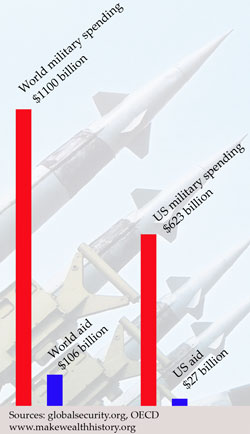
In 2004 (when the quote above was written) the world spent approximately $1100 billion on instruments of death while billions of people were already fighting for their lives against hunger, thirst and disease. Over half of this ($623 billion) was spent by the United States (Second came China who spent $65 billion). That same year, ‘The Land of the Free’ spent $1 in aid for every $19 in defence. In 2005, the UK spent $42.8 billion on the military compared to the $1 billion spent by Bangladesh. Most of these figures are so huge they’re almost meaningless.
While the UK spent its $42 billion on the military, $10.75 billion was set aside for Official Development Assistance (ODA). In one year when the US spent over $600 billion on war and defence, it spent a meager $27.46 billion on ODA.
Between 1945 and 2000 there have been an estimated 50 million unnecessary deaths due to war and conflict. The number of deaths each year from social neglect reaches 7 million people (3.7 million deaths from malnutrition, 1.7 million from lack of sanitation, and 1.6 million from indoor smoke from cooking fires, for example) and yet in 2000, military spending from the “developed countries” was ten times the amount spent on aid.
Budgeting priorities
A year into the 2003 Iraq war, the United States had already spent $150 billion. Put to better use, this same amount of money would have provided better health care for 82 million American children. Internationally, that amount of money would have halved world hunger, leaving enough petty change to supply HIV/AIDS vaccines, childhood immunization, and clean water to developing countries for over two years. Rather than do that, the money was spent on such weapons as the “cruise missile”, one of which costs $800,000 (320 were launched at Baghdad). Between 2000 and 2005, America alone spent $2.2 trillion on military activities.
Sometimes the military is prioritised over basic education at home. In 2004 the US spent $413 billion on military and $437 billion on defence yet left only $60 billion for education. Poorer countries are often no better. In 2004 Ethiopia spent 5.2% of its GDP on the military and 4.8% on education, 1.8% on health. Costa Rica sets a better example with 4.4% spent on education and health and 0% on the military.
In 2003 the ‘developing countries’ spent $245 billion on military activities between them. It is estimated that an extra $6 billion would have been required to send 115 million children to school.
Missing targets, failing promises
As if this wasn’t all bad enough, we can’t even deliver the pittance in aid that we’ve promised to the poor. According to Oxfam:
“the latest figures represent the clearest sign yet that governments are badly off track for meeting G8 and EU goals for increasing aid spending, and are therefore in serious danger of breaking their promises to the developing world.”
The G8 leader’s summit in Gleneagles in 2005 pledged an increase of $50 billion by 2010, but Oxfam’s calculations predict a shortfall of $30 billion. Only Denmark, the Netherlands, Luxembourg, Sweden and Norway have met the promise made by rich countries in 1970 to give 0.7 % of their gross national income (GNI) as aid. Sadly, that percentage has fallen for two years in a row.
Are we as generous as we think?
According to George Bush, speaking just last week, “The American people are generous people and they’re a compassionate people. We believe in the timeless truth, ‘To whom much is given, much is expected’.” It would be nice if that were true. In the league tables of aid as a percentage of overall income, the US comes second to last. The US economy is vast, so the actual figures are still high, but it simply can’t be said that Bush believes in the much given, much expected principle. The US gives away just 0.18% of it’s income, against a global average of 0.31%, and a promised target of 0.7%.
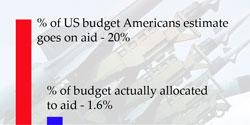 Americans aren’t aware of this. A poll asked people to guess what percentage of the annual budget was set aside for aid, and they guessed it was around 20%. The truth is nearer 1.6%. And that’s the budget. Put that into the overall income, and you’ve got the 0.18% figure quoted above.
It’s a hard truth, and the same poll found that people didn’t believe it when they were told, but check the stats and see for yourself. It’s vital that people know this, or they’ll assume that everything is fine and nothing will change.
—
It seems humanity has reached a stage where destruction is endorsed over restoration. As people die and the environment with it, the world invests in death over life – forget sustainability for a moment – this is a matter of simple morality.
What can we do?
- We can talk about it. Do you know how much your country gives in aid? Ignorance of the needs is a big problem – why would you campaign on poverty issues if you already think that your country gives away 20% of it’s income already?
- Our governments have promised 0.7%. Let’s hold them to it. Most countries are going to miss that target (the UK is on track here). Write to your representatives and remind them.
- Support campaigns already working here. Oxfam, Make Poverty History and so on are doing good work already.
- Campaign to reduce military spending. This is a big one, because war is immensely profitable. It’s a matter of priorities. For example, the UK is considering replacing it’s nuclear arsenal. A new generation may cost as much as £76 billion, a phenomenal amount of money on an utterly obsolete technology – what use have we got for nuclear weapons now that the Cold War is over? Modern conflicts are completely different. Write to your MP urging them not to vote for any replacement to Trident. There are some good suggestions here.
Update: I just came across this post by Filip Spagnoli, on trends in world wars. Fascinating, and good to see a fairly consistent downward trend over the last century. Despite the rampant militarism of some nations, we seem to be slowly learning our lessons.
Update 2: Apologies for closing comments on this post. For some reason it’s the only post here that ever gets spammed. If you have something you want to say, email it to jeremy {at} makewealthhistory.org and I’ll post it for you.
 The Earthbound Report

An American organisation trying to demonstrate the ridiculous amount spent on the US military budget created this: http://www.truemajority.org/oreos/ to expain the military budget in comaprison to other spending: it’s a pretty good way of making the comparison.
Thanks Nickoli, it is indeed an effective and clear way of demonstrating the military budget. Clear and memorable.
I read your article, it was good you guys deff did your research. However I have a few criticisms.
Though your points are all indeed true I felt that the reasons for spending in defense were overlooked.
For example though the UK defense budget is an astronomical amount of money, its acctually been the lowest since the 1930’s, We spend less than countries such as Greece, only 2.5% of our overall budget is on defense.
Our armed services are also understrength and stretched across every part of the globe, underpaid and with very poor support. A private makes less than a street cleaner, Troop numbers are down and men are dying because they dont have the right equipment
Lets not forget the other roles of armed forces, though as you say the military is primarily here for “death”, it also serves humanitarian causes such as disaster response and peacekeeping in areas such as Kosovo and Bosnia. Liberation in areas like afghanistan also allow opressed people a better way of life, women in Kabul can now attend schools and education, impossible under the taliban.
Finally in terms of your mention of the redvelopment of our nuclear weapons program, I feel that it is acctually a neccesity. With countries such as North Korea and Iran developing Nuclear programs we need to have up to date weaons to act as our shields preventing us from offensive action, it would not be wise to let our defense shield to fall out of date.
I agree actually Dan, the UK army is stretched too far. We have family members in the forces, and the lack of investment in even basic equipment puts lives at risk, which is never acceptable to me. However, I’m talking about the US army, which is another beast altogether.
As for the nuclear issue, you suggest we need weapons as shields to protect us from offensive action. A nuclear weapon is never defensive, except as a deterrent, and since I cannot think of a single good reason to ever launch one at another country, they’re actually a pretty empty threat. Wars aren’t against nation states any more. You can’t nuke the Taliban, or Al Qaeda. Nukes are a relic of the Cold War days where only the grim prospect of ‘mutually assured destruction’ kept the world safe. They have no relevance today and if we were to de-commission ours, perhaps we could encourage others to do likewise.
Instead, nuclear weapons are like the world leader equivalent of bringing a gun to school – it’s far too serious a weapon for any situation you might encounter, but since you’ve got one, others feel they threatened unless they get one too.
Thanks for your comment Dan – You made some good points, especially about the budget being the lowest since the 1930s.
I think a major issue, certainly within the UK, but most probably in other countries is that money, within the military is misdirected. While certain elements of the army are squeaky clean, others are a shambles. Without research into the matter i can only speculate, however i would bet that the majority of the British army’s funds don’t go on the troops on the ground helping refugees. It cannot be denied, as you mentioned that yes, often the military is used to help in foreign aid. There have been circumstances at home in the UK (not infrequently) where flood victims have been rescued by the RAF. Despite this however, is it necessary for these troops to be equipped with state of the art weapons and technology in order to distribute food to starving people or air life flood victims to safety?
As Jeremy mentioned, the post is mainly focusing on the United States. We felt it necessary expose just how much “the leaders of the free world” spend on what could be argued as tools of oppression rather than liberation. This post doesn’t cover where the money spent on the military goes. For example, i would be interested to know how much is spent on the manufacturing of weapons which are actually sold and sent to places like Sudan. How much money is made from selling weapons and how much money is in turn spent in aid. That is something you’ve made me consider and perhaps seek to address.