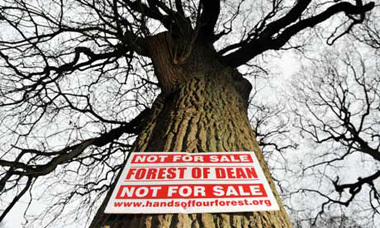
 I said this was going to be a positive week, so I’m pleased to be able to report something of a victory today. Campaigners have been celebrating the government’s decision to cancel all talk of selling off England’s national forests.
It was talk, still. Despite the anger, the plans hadn’t got any further than asking how a sale could be organised, rather than actually posting ‘for sale’ signs on Britain’s forests. But it never was a good idea, and it seems to have touched a nerve. The campaign was broad, taking in environmental and conservation interests, right through to the National Trust and the conservative heartlands. Hundreds of thousands of people had signed petitions, and there are little action groups for individual forests all over the country. It was a hard campaign to ignore, and the government has done the right thing. I even felt a little bit sorry for environment minister Caroline Spelman telling the House of Commons today that they were sorry.
What’s interesting is that the whole idea of selling the national forests is how on earth it got suggested in the first place. It hints at the ideology behind much of what David Cameron’s government is up to. Ostensibly, services are being cut and departments scaled down because we’re in debt and we can’t afford them any more. Fair enough, except that it was broadly recognized that selling the forests was unlikely to turn a serious profit, if any at all.
The government’s willingness to sell off public assets without making a return on them shows that it’s just as interested in small government as an aim in itself. Why should the government manage woodland, when someone else could be doing it? The sell-off was motivated by a privatization and a small government agenda, not because we couldn’t afford to keep our forests.
And that’s where I disagree with the government most. I’m all for private enterprise, but it’s not an absolute. Some things are better shared, and the Victorian campaigners who fought for parks and libraries and nature reserves knew this. Making things public guarantees access. It recognizes that taking a walk in the woods should be something everyone can do, that it’s a public good.
It’s also about a sense of belonging and ownership – if you go walking in the National Forest, it’s your forest. And as such, perhaps you’re more inclined to take an interest in it. Shared spaces like libraries, swimming pools and public squares are also places where ordinary people cross paths. They are centres of community, social spaces.
So let’s celebrate the things we own together, and build a big society around them, rather than flogging them in a firesale of national treasures.
 The Earthbound Report