
 If you live in an urban environment, you probably have a house, legal or illegal, on a street with neighbours in a certain part of town. You know where you’re allowed to go and where you’re not within the highly structured urban geography – pavements for people, roads for cars. Particular buildings and places are significant to you, working here, shopping there, and you navigate the routes between.
You do not live in a forest in the same way that you live in a city. You don’t necessarily work or shop or live in specific bits of a forest – you live in the whole of it. You have no specific workplace, there are no boundaried areas that are yours, while your neighbour works the next patch. Property rights don’t really work for those who live in and depend on forests for their livelihoods.
That’s a problem, and it makes forest communities some of the world’s most vulnerable people. Until recently, most had no legal right to the forests they call home. It’s difficult to draw up territories or shares, and next to impossible to police boundaries or borders where they do exist. And because forest lifestyles leave little trace on the environment, it’s very hard to prove that a certain part of a forest is important to you.
All of this means that when competing interests emerge, the legal entities of industry usually win out over traditional land ties. Businesses can secure paper rights to land that mean nothing to the people occupying those areas, and the land can be sold off for logging or mining without any compensation for those displaced. It’s not just extractive industries either – this can just as easily happen with nature reserves or areas put aside for carbon credits. The rush to secure the world’s forests for carbon trading has seen many indigenous people groups lose the legal rights to their own traditional lands.
 Mapping for Rights is a project that aims to address this problem by literally putting forest communities on the map. By creating user-generated maps of forest areas, indigenous people will be able to show where they live and how they use the forest – “demonstrating their presence” as the website puts it.
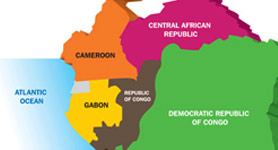
The Rainforest Foundation project launched ahead of the Durban round of climate talks, with maps of the Congo basin. Local people are able to contribute to maps of the forest online and through community workshops, demonstrating where and how they use the forests they call home.
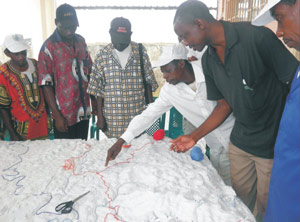
Community maps are sketched on the ground, drawn, or shaped in 3D models like the one shown here, and then refined into scientifically sound documents with more high-tech tools such as GPS tracking. They can include elements that cartographers overlook, such as hunting grounds, sacred places, or even spots where the fishing is good. Maps provide a way to distil that local knowledge of the landscape into an easily communicable form.
As the video below says, “cartography has long been used as a way to create and perpetuate power”. Mapping for Rights is a way of giving that power back to indigenous communities.
- If you want to do some participatory mapping of your own, here are instructions on how to make a fruit map of your town.
 The Earthbound Report
I’m filling this form as the owner and the intellectual property on matters geomapping program here in Kenya that I filed before the DCI on 23 Dec 2019, DPP on 3rd Jan 2020, Hon. Attorney General on 12 Feb 2020, Judiciary Ombudsman on 12 Feb 2020, KRA-Legal Department on 13 Feb 2020, the Judicial Service Commission on 17 Feb 2020, the Estate Agents Registration Board around August 2020, the Lands Ministry around August 2020 when I served them with claim that if Gordas Agencies along with Samuel Kamau the landlord who were not registered under CAP 533 Laws of Kenya among others in the country could have mapped then the State through could have collected the Ksh650 billion lost monthly and Ksh7.8 trillion yearly. At that time KRA never new about data mining system until now have copied and wants to use as their source! KRA must be stopped from implementing this system in accordance to the Injunction Order in place.
I’m greatful and most obliged to be in the books of history as an earthbound human creature after sir Jeremy Williams in the world who has discovered the mapping rights system under Data Mining, lifestyle auditing and land flipping anchored in Forensic and investigative accounting in curbing tax evasion, tax haven fraud and Money Laundering syndicates in Kenya, Africa and the world.
My intellectual property as a whistleblower shall be applied upon my consultation
That’s a great job Mr. Bosire….may it be implemented to improve the economy in Kenya and globally from Vanice kabego from Kenya
We appreciate the work of your hands Mr. Bosire and we totally support it as Kenyans. Due to the Country’s Economy is on the rock and hard place we therefore ask the government of Kenya to look into the weighty of this matter that a poor Kenyan like you coming up with this strong idea that has been welcomed in Africa and globally and recognize you. You are fearless man who is a patriotic and just. The fight against global tax evasion, tax fraud and money laundering has been all through a thorny however your systems of house mapping, geo-mapping under data mining, lifestyle auditing and land flipping as anchored in forensic and investigative accounting will solve all these scams once for all. Never give up until we reach Canaan through you since you are anointed by God to do it as Joshua in the Bible