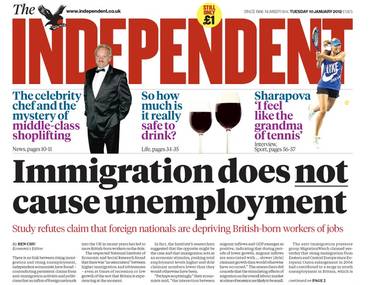
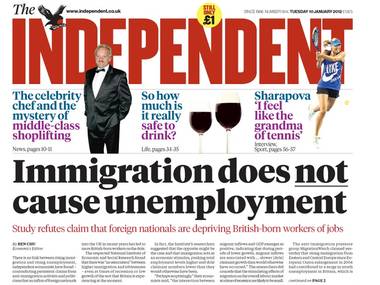
 It’s been a bizarre week for immigration headlines. ‘Immigration does not cause unemployment‘ declared the Independent on the front page. ‘Immigrants are not causing unemployment‘ said the Telegraph, and the Guardian announced that ‘Migrants do not affect jobless levels‘.
Meanwhile the Mirror has reported that ‘Every four non-EU immigrants puts a Brit out of work‘, The Sun said that ‘160,000 Brits lose jobs to migrants‘ and the Daily Mail declared that Immigration is reducing jobs for British workers and David Cameron must act now.
What’s going on here?
The main reason for the confusion is that two separate research bodies have released details of their latest work within a day of each other: the National Institute of Economic and Social Research on Monday and the Migration Advisory Committee on Tuesday. The NIESR report finds no correlation between migration and and joblessness. The MAC study finds a negative impact on British workers under very specific circumstances.
The anti-immigration headlines are the result of papers ignoring the first report and taking the worst possible interpretation of the second. Consider the Sun’s headline that 160,000 people have been put out of work. That sounds pretty terrible, until you remember that there are 2.64 million people out of work right now. If the Migration Advisory Committee is correct, immigration would be responsible for around 6% of our unemployment problem. But of course the big number with all the zeroes looks better in the headline.
The MAC report says that “skilled migrants are, on average, net contributors to the public finances” and that “lower levels of skilled migration simply worsen the public finances.” It also says that “any link between immigration and employment of British-born people cannot be proved to be causal.” It says that EU migrants, which are the ones the papers get particularly angry about, don’t appear to impact unemployment at all.
Rather, the negative impact of migration is very, very narrow. It only seems to displace British workers when non-EU migrants, who have been in Britain for over five years, apply for low-skilled jobs, in times of economic recession. Outside of those four criteria, immigration has no impact on unemployment. Taken as a whole, migration is good for the economy.
So here’s a reminder – don’t take the headlines at face value, regardless of which paper you read. If you want the full facts on the links between migration and employment, read the reports themselves, or at least the executive summaries.
- Here’s the Migration Advisory Committee Report
- And here’s the NIESR discussion paper.
 The Earthbound Report
I seem to remember noticing that The Guardian reported on both reports on successive days, with contradictory headlines!
Jimella, Is that called a balanced view, or, part 1 & part 2!!
So, in what way is immigration “good for the economy”?
If you’re a country will a skills shortage or an aging population, it’s invaluable. We have a habit of importing nurses from developing countries, for example, and the health service would hardly function without the nursing schools of the Philippines or South Africa. (this isn’t a good thing, but it is a fact)
But I’m not arguing for more immigration, or that we should do things just because they’re ‘good for the economy’. This is more a post about media bias and journalistic integrity.
I just thought it was a dangerous thing to say, implying that increasing the number of people is good for an economy, which would imply economic growth is good. Depending on immigration to replace workers as a population ages is Ponzi demography. At some point we need to just deal with the adjustment required as we stabilize population and economic activity.
If the world needs to stabilize or reduce population in conjunction with reducing consumption – in order to get back to a sustainable equilibrium – then we have to stop depending on the number of people to make an economy work. An economy only needs to be big enough to meet the needs of the population it serves. Add people and your economy needs to be bigger.
Sure, boosting the population is a shortsighted and ultimately unsustainable technique for stimulating the economy, and I wouldn’t want to recommend it. I’m in favour of equilibrium myself, but thanks for pointing out a potentially unhelpful comment.