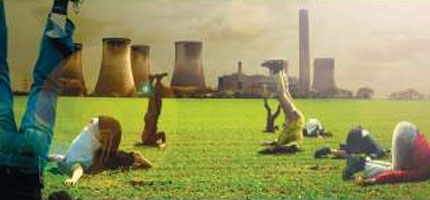
This week I’ve been reading a new paper from the RSA, A New Agenda on Climate Change. It argues that a scientifically sound response to climate change is entirely at odds with economic priorities. It suggests that sceptics are not what holds us back from acting on climate change, but the paralysis that springs from perceived political and economic impossibilities – something they refer to as ‘stealth denial’. It’s quite long, but it has some interesting new perspectives and is worth downloading if you follow climate change.
One thing that jumped out to me was the observation that there is now no non-radical future. In a world of rising carbon emissions, we either face a radically destabilised climate, or a radical re-ordering of society and economy in order to avoid it. Here’s Professor Kevin Anderson:
Today, in 2013, we face an unavoidably radical future. We either continue with rising emissions and reap the radical repercussions of severe climate change, or we acknowledge that we have a choice and pursue radical emission reductions: No longer is there a non-radical option. Moreover, low-carbon supply technologies cannot deliver the necessary rate of emission reductions – they need to be complemented with rapid, deep and early reductions in energy consumption.
That’s still a truth that is regularly denied, in my experience. There is no direct swap-in of renewable energy for fossil fuels. We cannot avoid talking about reducing consumption – and you can’t reduce consumption without talking about postgrowth economics.
 The Earthbound Report
This really sums up what I think about climate change, as well. People still seem to think we have the choice of business as normal or dealing with climate change. If we don’t deal with it, that won’t be business as normal either! Do you think it’s the media that can be blamed for widespread ignorance about climate change?
I don’t think the media can be blamed. The public never choose a radical option unless the failure of the alternatives is stark. Even then they aren’t very radical. The two supposedly radical post war UK governments were only radical in one direction. Atlee’s government may have set up the welfare state but it was quite socially conservative and on foreign policy very conservative. Thatcher’s government equally might have privatized and broke the unions but the NHS and the rest of the welfare state was barely touched.
So the question is how would you get consent from the public for a radical reduction in their living standards for something that isn’t obviously imminent?
Jeremy: I too have been reading this paper. I was put off by its constant use of “denier”, but nonetheless persevered. Jonathan Rowson has developed an interesting and – at least for me – novel approach to taking action on what he sees as the “global climate problem”. I would take issue with much of his thesis. But I’ll confine my comment here to one basic issue: his logic would seem to be based on a false premise.
In the Executive Summary (page 4) he says this:
“The overwhelming scientific consensus that anthropogenic climate change
is real and poses a significant and ongoing threat to the stability of the
human habitat is now well established …”
I know of no evidence that supports that position. Here’s my evidence to the Energy and Climate Change Select Committee’s inquiry concerning the IPCC’s 5th Assessment Review:
http://data.parliament.uk/writtenevidence/WrittenEvidence.svc/EvidenceHtml/4191