
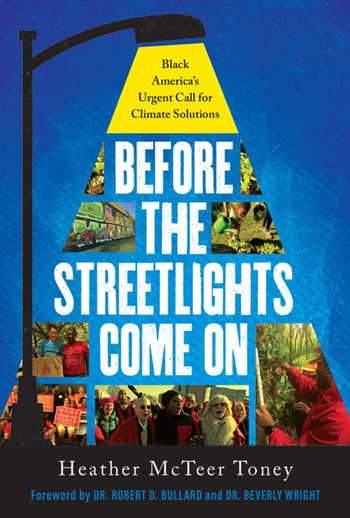
About five years ago, while I was researching my book, I compiled a list of the top 50 climate books. 42 of them were written by men, and 49 by white authors. I started seeking out a greater diversity of voices on climate change, and here’s another book to add to the list: Before the Streetlights Come on – Black America’s urgent call for climate solutions.
Heather McTeer Toney is an experienced environmental justice campaigner, an attorney and former mayor of Greenville, Mississippi. Her book is an insight into climate change in American’s Black population – how it is experienced, and how it is addressed.
It also looks at why it is sometimes overlooked, something raised in the very first line of the book: “How in the world are Black folks supposed to talk about climate change when we have other pressing issues to deal with?” But as McTeer Toney explains, climate change affects all the other things that communities are fighting for, and it disproportionately affects people of colour. Just as the author had to run home before the streetlights came on, there’s now a race to deliver affordable and inclusive climate solutions. Daylight is wasting and there are a lot of people to get to safety.
The book shares stories from the front lines of climate in the United States, drawn from the author’s own experiences and networks in the South. Some of these are things I hadn’t read about before. For example, I knew about the environmental injustice of majority Black areas that host more than their fair share of refineries and chemical plants. I hadn’t heard about how climate change makes them worse. Petrochemical plants carry out a ‘burn-off’ of toxic chemicals ahead of storm in case they lose power. So every storm is accompanied by a blast of pollution into local communities. More climate-amplified storms means more pollution, and the worse health outcomes that follow.
Another first (for me) is a section on education, heat and climate. Majority Black schools are less likely to have air conditioning, due to historic inequities and segregation. Heat affects concentration and learning, so increased heat in warming world is compounding disadvantage for young Black students. Never seen that in a climate book before, but if it’s true in the southern United States, it’s something we should consider across the global south more generally.
Another section looks at heat and violence. Patience erodes during the discomfort of heatwaves, drawing a statistical connection between climate risk and “child abuse, domestic violence, assault and murder – when temperatures rise so do tempers.” This has an added urgency when viewed alongside the existing problem of police violence.
The book also has the best explanation I’ve come across so far of the interplay of climate change and the legacy of redlining. Across hundreds of US cities, Black residents were excluded from some parts of town by mortgage lending rules and zoning. This is now exposing communities of colour to more pollution, greater urban heat, and higher flood risk – along with the economic disdvantage. And as a politician as well as an activist, McTeer Toney has personal experience of how hard it is to fix these problems, how clean-up operations are unfunded or even opposed.
Before the Streetlights Come On is most relevant to an American readership, but instructive to those of us elsewhere. It’s imaginatively written, with wit and generosity, deploying a whole host of metaphors and examples you won’t have read elsewhere, and it’s full of practical tips for action. Perhaps most importantly, it’s a really clear demonstration of what intersectional climate action is and why it matters.
“The difference between mainstream majority-white environmental movements and minority-led Black, brown and Indigenous environmental movements is that the latter does not have the luxury of silo,” writes McTeer Toney. “Our issues coexist. Climate change collides with other historic and systemic racially based issues to create a long-overdue desire for one thing: equity.”
- Before the Streetlights Come On is available from Earthbound Books UK and US.
 The Earthbound Report
Equity : I hope the “loss and damage” agenda gets proper implementation at COP 28.