A lot of car buyers are choosing between electric or fossil fuels at the moment. A growing number of them are choosing electric, with sales quadrupling in the last five years. It isn’t always a straight choice between electric or fossil fuels though. Sometimes there’s a third option: convert what you already have.
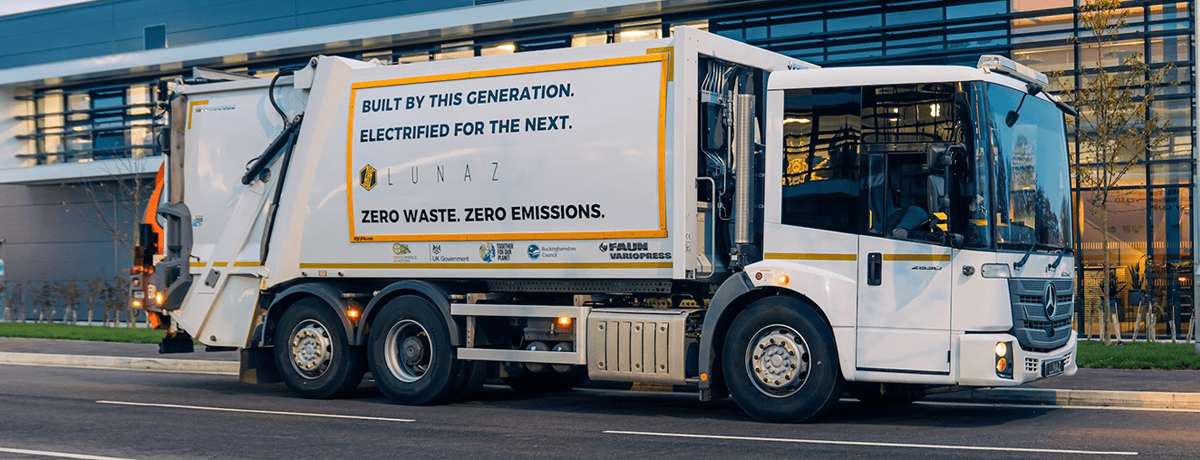
This week a company called Lunaz (I’ve mentioned them before) announced a new partnership with Buckinghamshire Council. They are going to electrify their ‘municipal refuse fleet’ – or bin lorries to the rest of us. Work will begin this year to convert each 26-tonne rubbish truck from diesel to electric, stripping the vehicle down and rebuilding it as good as new.
Buckinghamshire Council will benefit from cleaner and quieter lorries with zero emissions, reducing air pollution on the streets and bringing down their carbon footprint. They’ll also be cheaper to run in the long term.
This is a big answer to embedded carbon, one of the common objections to electric vehicles. The argument here is that it takes energy to make a car as well as to run it. EVs are more complicated to manufacture because of the battery, and so they begin their lives as new cars with more carbon to their name. Converting a vehicle to electric eliminates 82% of the embedded carbon at a stroke, as the steel chassis and bodywork are kept and refurbished.
Conversion also addresses another big obstacle to EV adoption – the cost. It’s expensive to convert a truck to electric, but it’s considerably cheaper than buying a brand new electric vehicle. Buckinghamshire Council calculate that they will save £1 million for every 20 vehicles they convert.
A third advantage of converting vehicles is that it guarantees real change. Often when people buy an electric car for the first time, they sell on a petrol or diesel vehicle to another owner. In some cases older and less efficient vehicles are sold on to other countries, potentially remaining on the roads for decades. Every converted vehicle guarantees one fossil fuel vehicle off the road. (Just to be sure, Lunaz decomission and recycle every engine they remove.)
So, there are good arguments for converting an existing vehicle where possible – and that’s mostly with fleets. It’s a good place to start. It brings in larger numbers, standardises the job and gets economies of scale. Lunaz have specialised in refuse lorries. Kleanbus hopes to do the same thing with the UK’s bus fleets, and a company called Pepper are doing the same in Germany – they call it ‘e-trofitting’. There’s Cell Propulsion working on delivery vans in India, and OpiBus‘s electric matatu in Kenya. Symphony EV have developed a kit for converting London black cabs, and they say that a conversion could keep each taxi running for another 25 years at zero emissions.
Beyond taxi fleets, there are options for converting cars too, but naturally the market has prioritised cars that people want to keep forever. That means classic cars, and there are companies that offer bespoke electrification for those with deep pockets. Some iconic older cars, such as the Volkswagen Beetle or the original Mini, survive in large enough numbers that there are companies offering kits for conversion.
Very recently, EV kits for more standard cars have begun to emerge too. Transition One is a French firm that has released conversion packages for the Renault Clio, the new Mini, and several others. They aim to do it for €5,000, making it an affordable option for people who have a car that they like. And again, each conversion is a fossil fuel car off the road. There’s a global fleet of 1.5 billion cars out there – far more than can be feasibly replaced, even if we wanted to do such a thing. We should plan to convert the best of them and keep them on the roads with zero emissions.
Ultimately a future with fewer cars is best, with high quality public transport and lots more walking and cycling. But EVs have their place, and they don’t all need to be new. Converting cars and other vehicles to electric might seem like a niche industry at the moment, but give it a couple of years. It might not be long before converting an existing car is an affordable option for a lot more people.
 The Earthbound Report