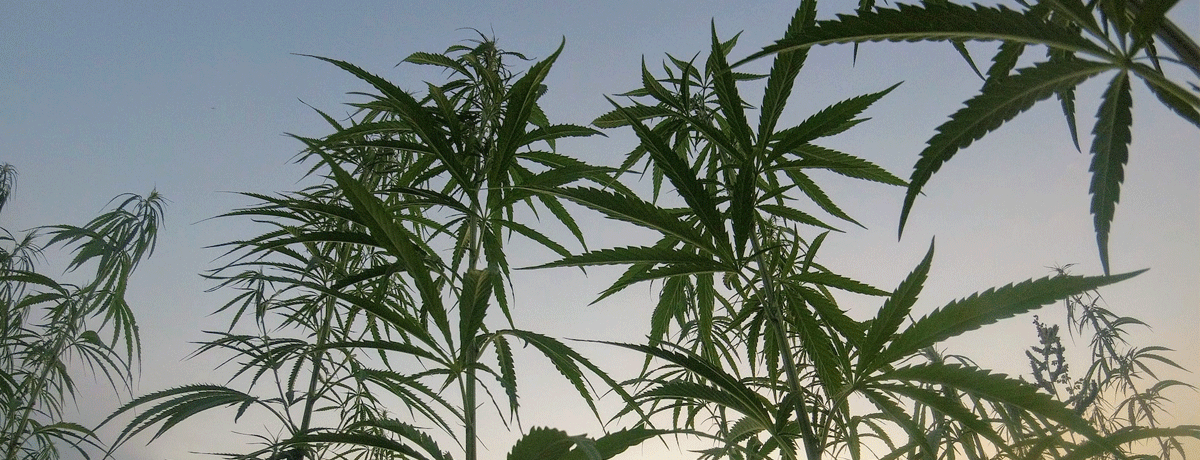
A lot of big claims have been made for hemp over the years – for fabric, for medicine, or its nutritional properties. I will let you investigate those for yourself later, and just write for now about hemp as a climate solution.
How so?
Hemp grows very fast. It’s one of the fastest growing plants, reaching maturity in a matter of months and hoovering a large amount of CO2 out of the atmosphere to build out that growth. It absorbs twice as much carbon as a woodland of the same size, and in some parts of the world hemp farmers can get two crops a year. You can explore some more detailed calculations here, but in the right circumstances, hemp will be a carbon negative crop, absorbing more carbon than it takes to farm it.
Once it’s in the plant, that carbon can be locked safely away by turning the hemp into something useful. That’s where hemp’s versatility comes into play, as the fibres can be made into all kinds of useful things, from fabric, to plastic, to paper, food, or construction materials.
The most useful applications will be those where hemp can reduce carbon or energy-intensive alternatives. When used for paper, for example, it replaces wood and takes pressure off forestry land. Ideally we need more standing trees. We could save timber for where it really comes into its own, like furniture or construction, and make more paper and packaging with faster-growing and more sustainable plants. Used for plastic, hemp would be replacing the fossil-fuel feedstocks that currently dominate the plastics industry.
Perhaps the most impressive possibility for swapping in hemp is with concrete. Hempcrete is commercially available, though somewhat niche, and it qualifies as a carbon negative building material. Where the CO2 emissions from cement production is a lingering climate problem, hempcrete offers genuinely zero carbon construction.
Given the possibilities for sequestration in hemp products, you can also use hemp farming as a carbon offset. I expect a rush of money into hemp farming any time now, as people realise that there isn’t enough land to plant the trees they’ve promised as part of their offset schemes. What if your carbon offsets aren’t in a newly planted forest somewhere far away? What if they’re in a line of clothing from a fashion brand instead, or the panels for an electric van, or built into the walls of a housing estate? That’s a lot more immediate, rather than waiting 20 years for your trees to reach maturity, and hoping they don’t get burned down in a forest fire in the interim, like Microsoft’s offsets did in 2021.
Sceptical of the hype around hemp? That’s fair, given its hippy associations. There’s a lot of nonsense about it on the internet, including conspiracy theories about why it was suppressed. There are two things to consider though before dismissing it. First, most of what I’ve written above would also be true of bamboo. The principle of using fast growing woody plants to generate the fibres we need for industry is sound. In warmer parts of the world, it’ll be bamboo that makes the most sense, whereas the UK would be better off with hemp.
A second reason to consider is that hemp was a widely used industrial crop in the past. Hemp farming effectively ceased when cannabis was banned in the UK in 1928, and the US in 1937, unfairly rolled together with the mind-altering marijuana in a global wave of scare stories. It didn’t become legal again in the USA until Trumps’ Farming Bill in 2018, and it’s proved a lifeline for tobacco farmers who had seen demand for their product erode as smoking rates decline. Many have switched to hemp instead, and the US has already leapt to the third largest producer of hemp, behind Canada and China.
Here in the UK, hemp can still only be grown in the UK with a special licence, which is an obstacle to its adoption that needs fixing. Nevertheless, a handful of companies are on the case and willing to jump through the necessary hoops to get ahead of the crowd. For example, Gaia’s Farming Co is a relatively new company that has invested in hemp specifically as a climate solution, with plans for certifying it for offsets as well as a line of hemp-based foods.
I think we’ll be hearing more about hemp in future.
 The Earthbound Report
A project to watch is this, on crops for high carbon capture: https://www.niab.com/research/agronomy-and-farming-systems/centre-high-carbon-capture-cropping. This will be evaluating hemp as a fibre crop, which should move things usefully forward.
High-strength moulded plastic parts are often reinforced with fibres, and hemp can be a good candidate for this (instead of glass fibres), with better recycling potential etc.
Some caution is needed over promoting Hempcrete as a ‘carbon-negative’ solution: it often uses lime (which uses lots of fuel for the high temperatures needed to process it). This occurs on a short timescale, but the reabsorption of carbon dioxide happens more slowly (and time is not on our side ref climate change). Also Hempcrete has low strength so won’t replace concrete in a great many situations. So more nuanced discussion is important here. This Wikipedia article discusses these issues quite well: https://en.wikipedia.org/wiki/Hempcrete
As a fibre product from tropical regions, I suspect plant fibres like jute or ramie may be better for processing than woody bamboo – unless anyone knows better?
Yes, and I linked to the Wikipedia entry in the article rather than a company promoting hempcrete, so that people would get a balanced view. It’s been around for long enough to be quite well studied (since the 80s in France and the 90s in the UK, though only from 2024 in the US because it only just got approved as a building material.)
Like any building material, it has its limitations. But even with the lime considered, it’s still a carbon negative product. Obviously the less lime you can use in the mix, the lower the overall embedded emissions. Local production also brings that down, which is why it’s important to clear away some of the remaining obstacles to growing commercial hemp.
Processing bamboo for fibre is quite chemical intensive, depending on the process used, so it’s not a great choice for fabrics. But it can be used much more directly in construction and manufacturing, unlike hemp.
I’m 100% in favour of growing hemp. Very versatile, very useful.