Last year I read George Monbiot’s ReGenesis, a book that upset a few people because it couldn’t endorse some favourite environmental farming solutions. For example, Monbiot argues that we can’t feed the world with traditionally farmed organic food. It’s too labour intensive and therefore hard to do at the scale that we need to feed a large population.
Maybe food should be more expensive, some might think. We could afford to pay a little more to avoid environmental harm, pay farmers properly, and get higher standards – right?
That’s fair in some places, but not at the global level. Wealthy consumers might be able to tolerate higher food prices, but in most middle and lower income countries people spend a higher proportion of their incomes on food. Kenyans spend 56% of their income on food – almost seven times more than the average in the UK. There really isn’t the wriggle-room in household budgets for higher prices.
It’s possible that fruit and vegetables could come from organic farms and local production, but nearly 40% of all the calories eaten around the world are from the mass-produced and filling grain crops of rice, wheat and maize. To protect soil and water for future generations, we need to be able to do large scale agriculture on an organic basis.
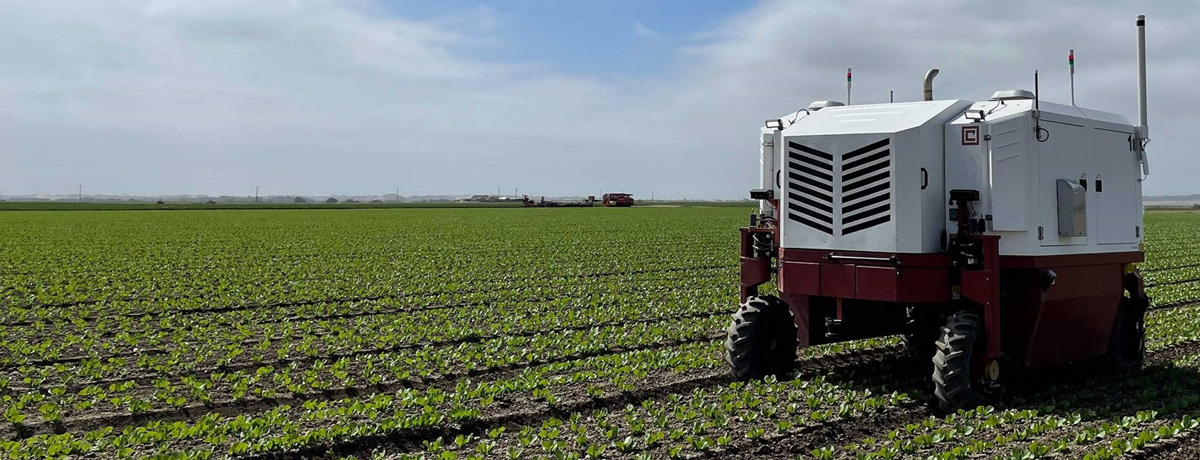
It might look a bit like this:
This is a robot weeding machine from Carbon Robotics. It trundles autonomously up and down the fields, reading the crops with bright lights and frying weeds with highly targeted lasers. It can work 24 hours a day, zapping 10,000 weeds an hour in fields of 40 different crops.
Laser weeders replace herbicides. Instead of indiscrimately spraying a field and poisoning the soil with chemicals, it just targets the weeds. That removes competition for water and nutrients, and delivers better yields with lower fertiliser use.
We should always interrogate a techno-fix, and sure, there are downsides. It’s a technological solution that directly competes with human labour – although it is replacing back-breaking work, which is the best kind of work to make obsolete. Because it’s an expensive machine, it’ll be more accessible to bigger farms and corporations, who already have many advantages over small farms. And of course it’s one step further away from human connection to the soil.
Robots in farming aren’t an unalloyed good then, but what I find interesting here is that it challenges an old divide in farming. There’s small scale, sustainable, organic and traditional farming over here, and mechanised, corporate, large scale and exploitative farming over there. It’s never been that simple on the ground of course, but it often feels like that in environmental arguments over the future of food. Robot weeders are a high-tech enabler of organic farming, and they complicate that polarised debate.
It’s not the only solution that does that. No-till agriculture, drip irrigation and remote sensing are all breaking down the idea that sustainable food production involves a return to traditional techniques. In some places it will, especially for fruit and vegetable farming, preferally local. But the world also needs reliable sources of cheap calories, in vast quantities. For that, sustainable farming might need robots with lasers.
 The Earthbound Report
I think that robots can find quite a few useful farm roles, though I note this weeder seems targeted more on high value horticulture crops, and I suspect it will be some time before it ever became economical on cereals.
But for reliable sources of cheap calories in big quantities I think that soil fertility and health (including pests and pathogens) could be the biggest issue. As David Montomery’s ‘Growing a Revolution’ expounds, that calls for zero/minimum tillage and maintaining vegetation cover (no bare earth), alongside varied crop rotation. Those first two don’t seem compatible with robotic weeding based on computer vision, although robot-assisted condition monitoring could be valuable here.
Yes, we’re still dealing with large scale mono-cropping here, which isn’t the way nature ever does anything and seems inherently limited. I should look up Montgomery’s book. I’ve read his book Dirt, on the importance of soil in history.
I think you have a point here. And AI driven small machines are probably much more compatible with agro-ecological systems than traditional large relatively dumb machines. Maybe cooperatives of small farms could afford these machines…
Yes, cooperative ownership is one way to ensure that it’s affordable for smaller farms. I expect some companies will offer weeding as a service too, and do away with ownership altogether.
Interesting. Thanks for sharing.