The planetary boundaries were first formulated by the Stockholm Resilience Centre in 2009, as an answer to the question of whether or not nature had any identifiable limits that we couldn’t exceed. The idea of ‘limits to growth‘ has been both influential and controversial, and the planetary boundaries attempted to draw up a definitive list of thresholds that couldn’t be safely exceeded.
It was a pioneering project that gave us some new ways of thinking about sustainability, including providing the basis for Kate Raworth’s doughnut economics. I wrote extensively about the planetary boundaries in 2013, a series which is now out of date but still online here.
In the first iteration it wasn’t possible to identify clear limits to all nine boundaries. Scientists knew there was a theoretical limit to the amount of aerosols we could put into the natural environment, for example, but we didn’t know what that limit was. It’s taken a lot of further research to fill in the gaps, and a new update of the planetary boundaries provides limits for all nine for the first time.
The boundaries aren’t cliff edges, where everything unravels into catastrophe when they are exceeded. Lead author Katherine Richardson uses more of a healthcare metaphor: “We can think of Earth as a human body, and the planetary boundaries as blood pressure. Over 120/80 does not indicate a certain heart attack but it does raise the risk and, therefore, we work to reduce blood pressure.”
Here’s the latest summary graphic of where we stand, with more detail from the Stockholm Resilience Centre. If you’re not familiar with the boundaries, you’ll find a few notes for reading the graphic below.
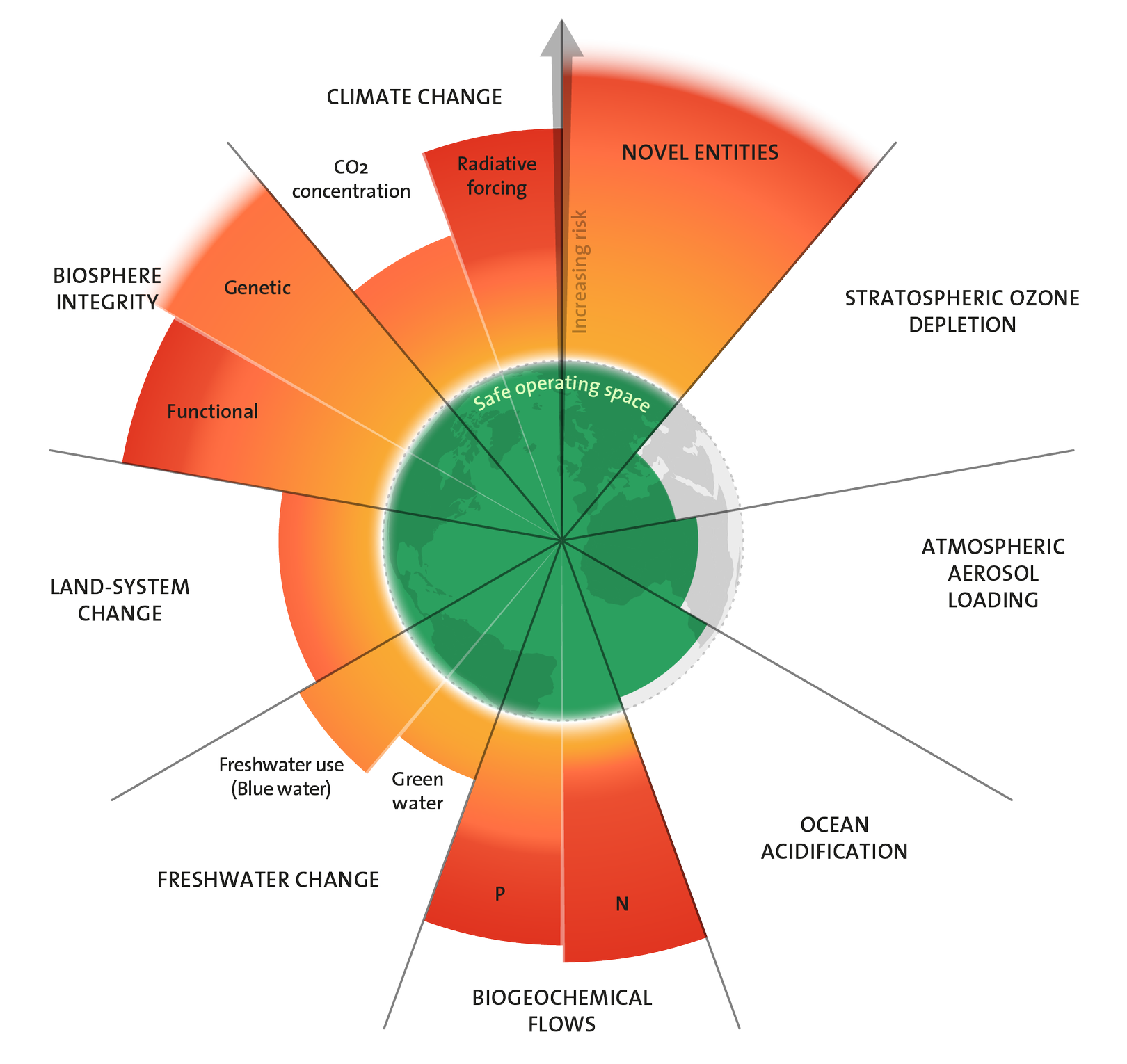
The nine boundaries are plotted in a circle, and the ‘limits’ are shown by the radius of the earth in the middle. If the ‘slice’ falls within the radius of the ‘safe operating space’, then it is sustainable at present. Ozone depletion, aerosols and ocean acidification have not yet gone beyond the boundaries.
The other six of the nine have, some of them quite spectacularly. Those other six are as follows, working clockwise from the bottom.
- Biochemical flows – the P here is phosphorus and the N is nitrogen. This represents pollution, mainly from farming, that disrupts the natural cycles of these elements in nature.
- Freshwater change – ‘blue water’ is surface water in streams and lakes, and is a measure of the health of rivers. ‘Green water’ is the water in the soil and that is used by plants, so is more of a measure of desertification.
- Land-system change – there are a few processes that matter here, but the most important one is deforestation.
- Biosphere integrity – this was originally called the biodiversity boundary. The genetic and functional integrity measures here are quite complex, but the main concerns are extinction rates and ecosystem health.
- Climate change – the best known of the boundaries, which is of course 350 parts per million of CO2 in the atmosphere in order to prevent global warming.
- Novel entities – read chemical pollution. Modern industry uses thousands of different chemicals, which all interact in different ways. Nuclear material is also a novel entity, and a few other categories. There’s no upper limit here. The more we add, the more dangerous it gets, indefinitely.
 The Earthbound Report
Yes. Six out of 9 planetary boundaries crossed and the planet is slowly becoming uninhabitable if we don’t do something about it. Thank you, Jeremy 🙏🌍
A few months ago Johan Rockstrom et al released a report that 7 out of 8 quantifiable boundaries had been crossed. In that article they reference ‘safe and just Earth System Boundaries’, so I guess they are calibrating it slightly differently. If anyone reading can explain what the difference is it would be appreciated (although whether we have crossed 6 of 9 or 7 of 8 doesn’t change the overall message, of course!). Here’s the link to the 7 of 8 article: https://www.nature.com/articles/s41586-023-06083-8
Yes, that’s a closely related but slightly different concept that integrates social justice and equity into the boundaries concept. This version is the original boundaries which just looks at sustainability.
Thanks very much for clarifying, Jeremy.