
“When they asked me
To come up with
Words that could speak
To a world on the verge
Of environmental collapse,
I had a crisis of my own.”
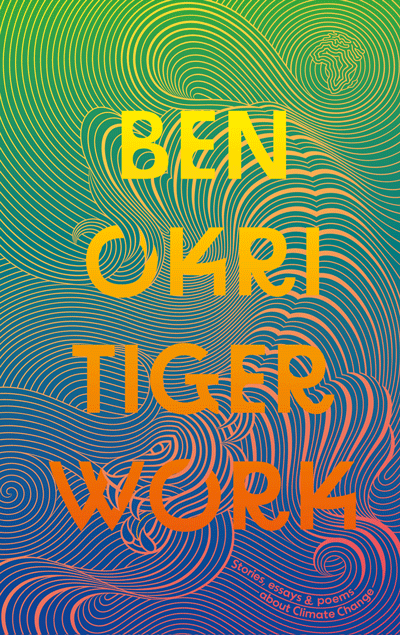
That’s the beginning of one of the poems in this collection. Across its selection of stories, essays and poetry, the Nigerian Booker Prize Winner wrestles with the threat of catastrophe, our inability to face it, and how to respond as a writer.
Sometimes the truth is easier to get at sideways, so there are parables and allegories about denial, consumerism, and creeping disaster. One story sees a family living in a house that is sinking into the ground. Every year they have to duck a little lower to get through the front door, but they find ways to ignore it. Eventually they live entirely underground and come and go through the skylight.
Another story cycle is written from the perspective of future interplanetary explorers, who have found an empty world and are searching for evidence of what happened. They present a series of fragments from people who continued “their suicidal relationship with the earth right up to the very last moment.”
“We are the crisis, the emergency and the catastrophe,” writes Okri. “There will be no permanent solution to environmental disasters till we heal the disaster that is our divisive and selfish thinking.” Some of the pieces explore this too, including a story where two people learn to trust each other and cooperate in an abandoned city.
Another future-facing piece poetically contrasts fossil fuels and renewable energy. Fossil fuels are “the liquidised bones of the dead,” he observes, and in a line that caught my attention in the light of current industry denial, “I sing the death of fossil fuels.”
No need to use
the dead to drive
us backwards. No
Need to bring them
Into our air
No need to live
Off death when we
Can live on light.
Amongst the stories and poetry are occasional reflections from Okri himself. He describes what he is doing as “existential creativity” – writing in the face of disaster, gearing his imagination and talent towards the crisis and its solutions. Everything he writes should matter, no word should be wasted. Everything should be written as it was the last thing he gets to write.
I really liked Tiger Work. It’s eloquent, imaginative, urgent. All the pieces are short and it lends itself to dipping in and out. In fact, it’s best not read too much in one go and Okri tells us that at the start. There’s a an empty page at the start with the simple admonition to ‘read slowly’ – a useful reminder for someone like me who tends to eat books for breakfast.
Like any collection, some pieces will resonate more than others. Some sound a despairing note, others invite us forward into something new, and it’s never without hope and humour even when looking dystopia in the eye. As Okri writes, “sometimes I think we must be able to imagine the end of things, so that we can imagine how we will come through that we imagine.”
- You can order Tiger Work from Earthbound Books UK and US
 The Earthbound Report