
17 years ago Elon Musk wrote the very first blog post on the newly launched website of his car company, Tesla. It’s still online today, and it’s called The Secret Tesla Motors Master Plan (just between you and me). In it, Musk explains how Tesla is a means to an end. The elite sports car they had just released was a tool for changing perceptions on electric cars, and there was a bigger goal in mind:
“The overarching purpose of Tesla Motors (and the reason I am funding the company) is to help expedite the move from a mine-and-burn hydrocarbon economy towards a solar electric economy, which I believe to be the primary, but not exclusive, sustainable solution.”
To back up that ‘secret plan’, Musk also bought SolarCity and incorporated it into Tesla. The huge investment in solar, cars and batteries helped to push all of them towards mainstream adoption in the US and beyond. Whatever else one might think about Elon Musk, it was a significant contribution to the clean energy transition.
Will anyone remember that when the dust settles on Musk’s extraordinary career? Hard to say, given how his acquisition of Twitter has tarnished his green credentials. Since he took over the platform, climate mis-information has ballooned. All the accounts that had previously been banned were restored, which led to an immediate rise in hate-speech of all kinds, along with climate denial and harassment.
As advertisers pulled their support for Twitter, Musk cut costs by sacking staff by the thousand, including the moderation and curation teams. Fewer people working on policing the site inevitably led to more abuse going unnoticed.
In response to this spiral of climate denial, along with Musk’s petulant ineptitude at the helm of Twitter/X, many climate scientists and advocates quit the platform. The number of people talking about climate and environmental issues halved this year, according to one study. That left fewer people responding to climate misinformation.
A recent investigation into climate misinformation on social media found that Twitter/X had the weakest set of policies for dealing with the problem. They didn’t have clear policies, didn’t enforce the ones they did had, and didn’t respond to queries about them. In total, Twitter scored just one point out of a possible 21.
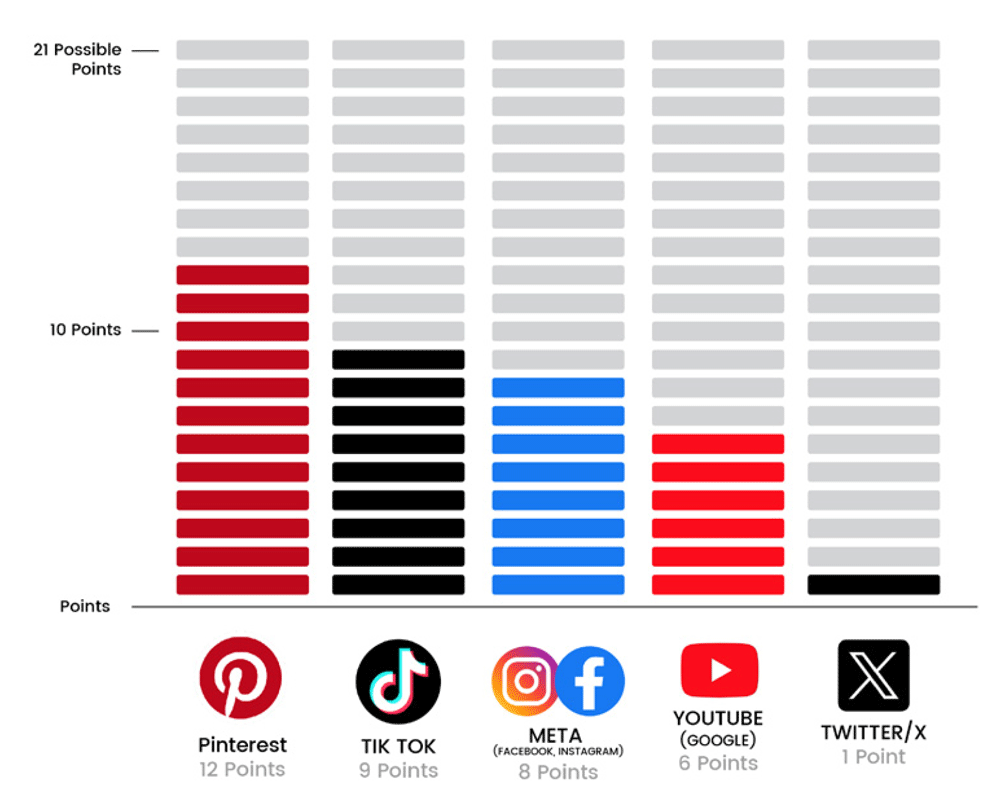
What kind of thing are we talking about? The study looked at how easy it is to report climate misinformation, and whether things are fact-checked or taken down when proven to be false. Does the social media company release data on climate denial to researchers, or release annual reports? And most importantly, does the platform allow paid climate denial or greenwash content?
Musk’s Twitter takes advertising money from climate denial campaigns and greenwash. While Musk talks about investing in companies that will solve climate change, he also seems perfectly happy to make money from denial. We can see the outworking of this in some very specific ways. For example, a study found a deliberate campaign against the Ultra Low Emissions Zone in London this year, with an estimated spend of £168,000 to amplify anti-ULEZ messages. There’s no way of knowing who ran that campaign and what interests they were trying to protect, but it was run on Twitter and would have been impossible without them.
Musk himself has muddied the waters on climate change recently by coming out against President Biden’s climate policies, because he doesn’t like government spending. He recently told a conference in Norway that the world needed more oil and gas, not less. And he has declared low birth rates to be a bigger problem than climate change, though as the father of 11 children he cannot be accused of not doing his bit to fix that. His opinions are as unpredictable as his business decisions, and just as prone to backfiring.
As the UN have warned, “mis- and disinformation about the climate emergency are delaying urgently needed
action to ensure a liveable future for the planet.”
Bizarrely, the world’s richest man (sometimes) owns one of the companies doing the most to enable the solutions to climate change, and one of the companies doing the most to delay them.
PS – I’d be interested to hear your suggestions for an alternative to Twitter, which no longer functions for useful climate dialogue. It doesn’t work for my writing either – I get 90% less traffic through Twitter than I did last year, because Musk changed the algorithm to downgrade tweets with links. Got to keep them eyeballs on his platform!
I’m pretty sure the answer is not Mastodon, which is complicated and too siloed. It’s not Threads either, because that’s owned by Facebook – an even bigger amplifier of climate lies. So you’ve got the recently branded Pebble, (where I have a shell account to claim the name, if you’re on it and want to follow me) or BlueSky, which I haven’t got an invitation for yet. Or maybe it’s time to surrender the idea that anyone will pick up and replicate the Twitter experience and let it go.
 The Earthbound Report
Are you on LinkedIn? It’s definitely a network where you can find a large audience of astute professionals and build a large following.
I am and it’s okay, but almost all my interactions on there are PR folks looking for something, so that hasn’t endeared me to it! But maybe I should give it another try.
Incredible to see how Musk’s vision stayed true throughout the years.
Can I recommend reading the article before commenting next time?