
When the Conservative government was junking their own environmental policies a few weeks ago, they offered an unusual reason why: we’re great at this stuff. Probably the best in the world, according to the Prime Minister. Since we are, in his words, “so far ahead of every other country in the world,” the best thing to do is take our foot off the accelerator and coast for a while.
He then went on to delay targets on electric cars, electric heating and insulation. A simple look at the trends in Britain’s carbon emissions would tell you why this wasn’t a good idea:
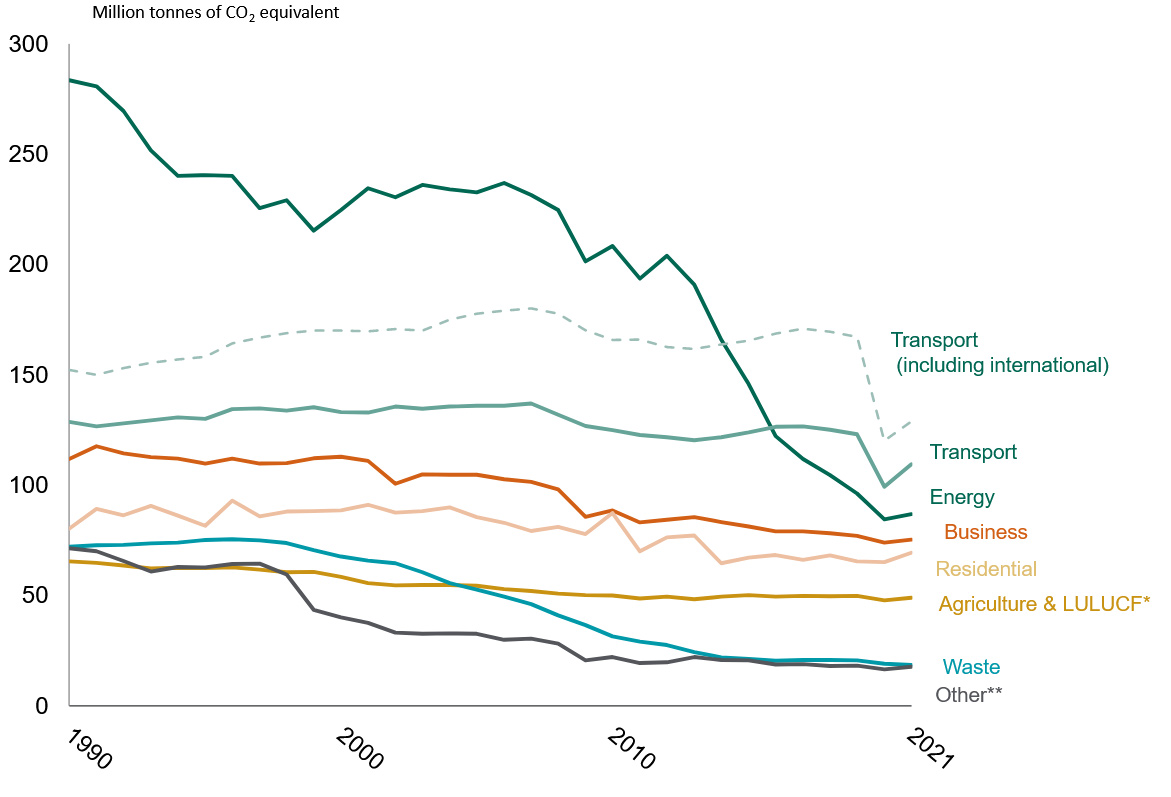
This graph is from the government’s recently updated transport emission statistics, and it shows which sectors are making progress on cutting greenhouse gases and which ones aren’t. As standard, this is domestic emissions and doesn’t include imports or international emissions.
There’s no question that there are some success stories here – driving coal off the UK electricity grid has indeed delivered a world class reduction in energy emissions. That has happened mostly on the Conservatives’ watch. But little else has.
The other big sector that has reduced emissions since 1990 is waste, and most of the gains happened before the Conservatives took office. The trend has flatlined over the last decade. So has agriculture and land use, and there have only been very modest reductions in residential and business emissions. Congratulating ourselves and taking a breather is misguided – the thing to be doing now is taking the momentum from our successes in the energy sector and inspiring faster change everywhere else.
Transport has been the biggest source of carbon emissions since 2017, ticking along virtually unchanged for thirty years – until the pandemic. 2021’s statistics are still reflecting that and it’s too early to tell if there’s been a permanent dip. However that turns out, it’s the next big thing on the to-do list.
Looking closer at those transport statistics hints at some solutions. There’s been a big decline in bus travel over those 30 years. Investing in buses again – electric ones and the infrastructure for them – would be a useful thing to do. With the rise of online shopping, emissions from vans have gone up by 119%. Maybe we should incentivise greener delivery services.
Cars remain the biggest transport problem, causing 57% of emissions. That’s down from 75% from 1990 due to improving efficiency and that aforementioned boom in vans. It’s still the biggest priority, and so Britain is moving manifestly in the wrong direction. In the last couple of years the government has halved its funding of walking and cycling, delayed electric vehicle targets, abandoned its own plans to protect bus services that were affected by the pandemic, and taken such a theatrically pro-motorist stance that it might as well have been scripted by Mister Toad.
The chances of the Conservatives still being in charge this time next year don’t look great, so this is a challenge for the next government. We have had some success in reducing emissions in the UK. How do we build on those and go further?
 The Earthbound Report