“The richest people in America are funding a new space race,” wrote a commentator in the Guardian, because the billionaires “are making plans to get the hell out of here.” It’s a story I’ve heard plenty of times: the wealthy want to escape earth. Their space programmes are their own private lifeboats and the rest of us will go down with our climate-ravaged planet-shaped Titanic.
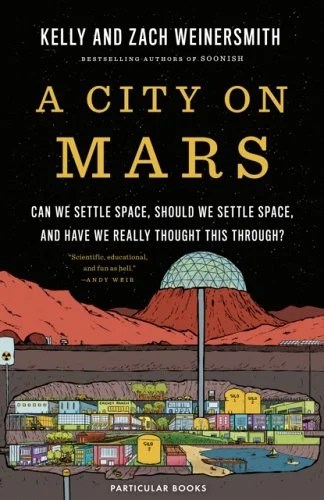
If there is any reality to this story, it is both an unlikely and an unwise plan. The reasons why are all set out in A City on Mars: Can we settle space, should we settle space, and have we really thought this through?
It’s an unusual book, written by the all-star husband and wife team of biologist Kelly and cartoonist Zach. It is both rigorously researched and very funny, a rare combination that will be familiar to readers of their previous book, Soonish: Ten emerging technologies that will improve and/or ruin everything. Their new book zooms in on a question the last one raised – can we settle space? And by settle, we mean self-sustaining communities on other worlds. There’s no doubt that this is what people like Elon Musk are after. He reckons the first humans will reach Mars by 2029, and that there’ll be a city of a million people by 2060. That’s the kind of thing the title refers to.
When people imagine such things, it is almost always very glamorous and high tech, exciting and futuristic. It’s aspirational, visionary, humanity extending its story beyond the humble earth and into the deep future. It’s ambitious – almost mythically so. Start talking about space settlements, and it’s only a matter of time before someone deploys the word ‘destiny’.
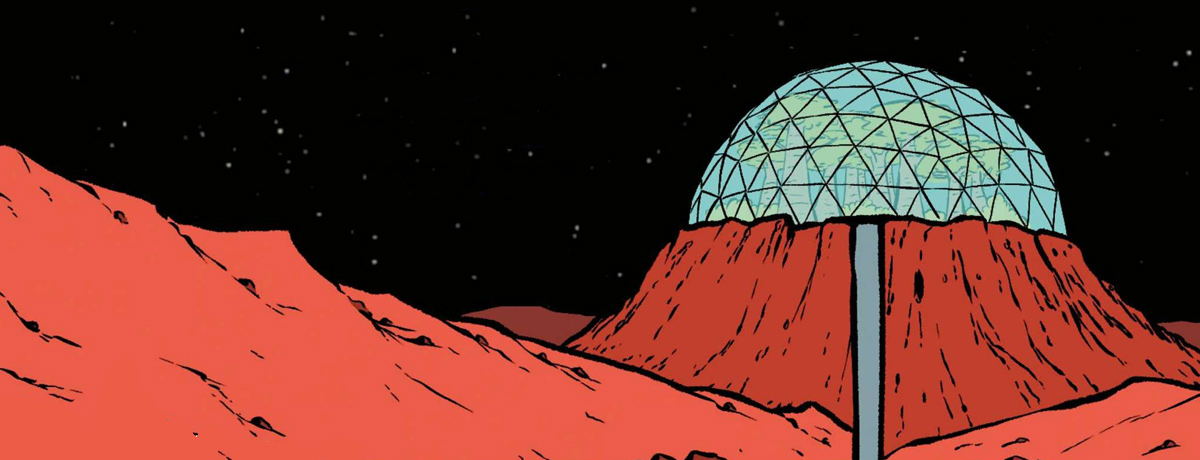
However, it’s important to recognise just how seriously “space sucks”, as the Weinersmiths put it. And while we kind of know that, very few people know just how dramatically and unremittingly miserable it would be to live on Mars. It’s minus 60C. There’s no air, and the ground itself is toxic. The radiation from the sun is so vicious that you’d have to live underground. Humans living on Mars, or the moon for that matter, would be living like worms or woodlice.
With this in mind, there is almost no conceivable situation where you’d be better off in space, certainly not climate change. As the authors say, “you’d be crazy to leave Earth for Mars.”
As the book makes plain on several occasions, this is a somewhat disappointing conclusion for the authors. They describe themselves as ‘space geeks’ and they like the idea of space settlement. (I sympathise, with the poster next to my desk advertising space holidays on Kepler 16b.) But the more they looked into it, the more convinced they became that the whole business is so much more complicated than most people realise.
Technology is not the big problem. It’s biology, economics, law, things that advocates of space settlement haven’t accounted for and don’t include in their books. For example, how much time has Elon Musk spent thinking about the practicalities of pregnancy and childbirth in space? I’d hazard a guess at precisely zero seconds. A self-sustaining community would need to be able to replicate itself, which means babies and children in space. Very complicated for lots of reasons.
Another rarely considered factor is law. Contrary to geek imagination, there are laws governing space. Most of them are somewhat antiquated and reflect the priorities of previous eras, but they exist and they limit who can do what. You can’t claim land on other planets. The legal status of settlements and settlers is contested, and there are already competing ideas from international powers around how to resolve them. The complications of politics on earth will replicate themselves in space, no question about it.
You’ve also got lots of false contentions about why space settlement is so necessary in the first place. The book goes through all the big arguments for it and finds that the only one that stands up is that it’s awesome and we want to do it. That’s fine, by the way. But we can’t pretend that it will save us from climate change, extend the human story, or make us better. It won’t happen fast enough to get us out of trouble with climate or resource scarcity. “Space settlement isn’t the solution to any short-term problem,” and it may make us less safe.
There are a host of serious and under-studied themes in the A City on Mars, from interplanetary law to militarism, to space capitalism, to existential risk. It explains the science, learns from history, and the authors are always clear when they’re getting more “hand-wavy” and speculative.
The level of research is impressive, referencing UN committee notes, NASA design handbooks, legal treaties, astronaut’s diaries. But it’s hard to overstate how much fun the Weinersmiths are having with it all along the way. There are doodles and cartoons throughout, recurring jokes, asides about astronauts with amusing names. Even the footnotes are funny.
If you have even the most passing curiosity about space settlements, the book is entertaining enough to make A City on Mars well worth your time. It’s important too, because almost every book on space settlement is making the case for it. The Weinersmiths didn’t expect to write a counter-argument and are almost apologetic about it, but it matters. If we don’t have the facts, we can’t make good decisions. And the last thing we want is to for the space cowboys to rush ahead with something that puts us all at risk because they didn’t think it through.
- A City on Mars is out on Thursday and you can get it from Earthbound Books UK or US
 The Earthbound Report