
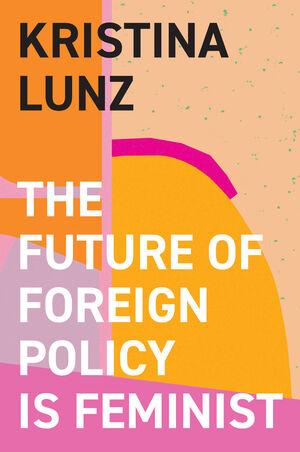
When I was an international relations student, there were entire lecture series on ‘political realism’. Realism holds that all international politics is and can only ever be competitive, and the key to success is power. The very word ‘realism’ pushes everyone else “into the naive corner”, to borrow Lunz’s phrase. Idealists, liberals, feminists, pacifists – whatever you want to call them, these are the people who don’t get it and who would make the world more dangerous if we listened to them.
I know some readers will have got as far as the title of this book, and resolved to take to the comments to say exactly that. Restrain your mansplaining hands. ‘Realism’ is a fundamentally masculine way of seeing the world, and if that’s all you think global politics can ever be – well, how’s that working out for you so far?
The Future of Foreign Policy is Feminist is the first ever book about feminist foreign policy for a popular audience. For that alone it deserves an audience. It’s also by someone with considerable experience. Kristina Lunz has been working on feminist approaches to diplomacy in Germany, with some success. She is well connected, involved in the nuts and bolts of creating change through national and international politics. The book was published in Germany, and is now reaching a wider readership with an English translation.
Though it might not be very familiar, there is a history to the idea of feminist foreign policy. Having been historically excluded, women in Europe began to organise and demand a say in diplomacy in the early 1900s. There’s an intriguing story about how women’s organisations proposed a peace settlement to end the First World War that was based in restoration and future conflict prevention. It was presented to President Woodrow Wilson, who rolled many of their ideas into his famous plan for peace – without attribution.
They were then shut out of the peace talks themselves at the end of the war, because the men in the room thought women would be too lenient. As we know, the humiliating terms of that settlement planted the seeds for the Second World War. Still, many important aspects of international law can be traced back to the International Women’s Peace Congress held at the Hague in 1915. Among them is the idea that wars of aggression are unlawful – a preposterous feminist idea in 1915 that we readily accept today.
Peace is a central theme here, because settling conflict through violence is a fundamentally masculine thing to do. Men commit more violent crime than women, at a ratio of ten to one. Notions of power through aggression and victory through domination run through politics when it is run by men, with nuclear weapons the ultimate expression of this. “They reflect the assumption that force and physical strength are essential for security. Anyone who can subordinate and destroy others is powerful – and safe.”
Feminist foreign policy focuses on peace and on conflict resolution through dialogue and cooperation, rather than threat and repression. It defines peace positively, not just as the absence of conflict but as holistic flourishing. It is intersectional, looking to the needs of the weakest in society first. It seeks to unmask and confront forces of oppression, from patriarchy to colonialism to racism.
The best evidence that this approach is practical and realistic is that eleven countries in the world have explicitly stated that they are going to pursue it. Sweden was the first, in 2014. Germany has followed, in part due to Lunz’s own advocacy. You can count Trudeau’s Canada among the pioneers, along with Spain, the Netherlands and Luxembourg. Feminist approaches to peace played an important role in the acceptance of Colombia’s peace treaty, and it is now part of their foreign policy. Liberia are exploring it in an African context. France are doing it badly, says Lunz, and Mexico may be emerging “as a kind of global gold standard”.
If British readers want to see what it might look like closer to home, Scotland outlined their plans for feminist foreign policy just last week. “Globally, there is growing momentum towards adopting a feminist approach to foreign policy, one that is fair, intersectional and human rights based,” says the Scottish government, which echoes the title of Lunz’s book – this is the future.
As a book, The Future of Foreign Policy is Feminist captures a point in time and it doesn’t get to everything. I’d have liked a chapter on global development, for example, and there’s only passing mention of economics and trade. I’m also curious to know how explicitly feminist foreign policy is viewed outside of the west. How is it translating culturally? Is it meshing with other movements for equality and justice that use different framing to the right-based approach of western feminism?
That’s for later books to explore. This is a field that is emerging and changing, and it won’t be the last word. And whether or not you’re sold on the idea that this is the future, Lunz offers a modest suggestion to move things along: “If the book could be read with an attitude of ‘yes, and…’ rather than ‘yes, but…’, we would be taking a huge step forward.”
- The Future of Foreign Policy is Feminist is published by Polity Books and is available from Earthbound Books UK or US.
 The Earthbound Report