
The idea of decoupling is a central tenet of the world’s response to climate change. Greenhouse gases are tied to economic growth. The richer countries are, the more people tend to consume, the more energy they use, and so the higher the emisssions. So the best route to lowering emissions is to ‘decouple’ rising CO2 from rising prosperity. Build out clean energy, make things more efficient, eliminate waste and so on, so that growth can continue without the increasing damage to the climate.
No, say others. The quickest route to a safe climate is for the richest countries to stop growing. Trying to reduce emissions while growing the economy is like trying to run down the up escalator. If you’ve already got enough, wouldn’t it be better to stop pursuing more?
Needless to say, politicians and economists only gave one of those approaches any attention, and as the years pass we can see how that’s playing out. Here is a graph of the UK’s GDP, which is rising while emissions fall. The gap between the green line at the top and the red line at the bottom is what decoupling looks like.
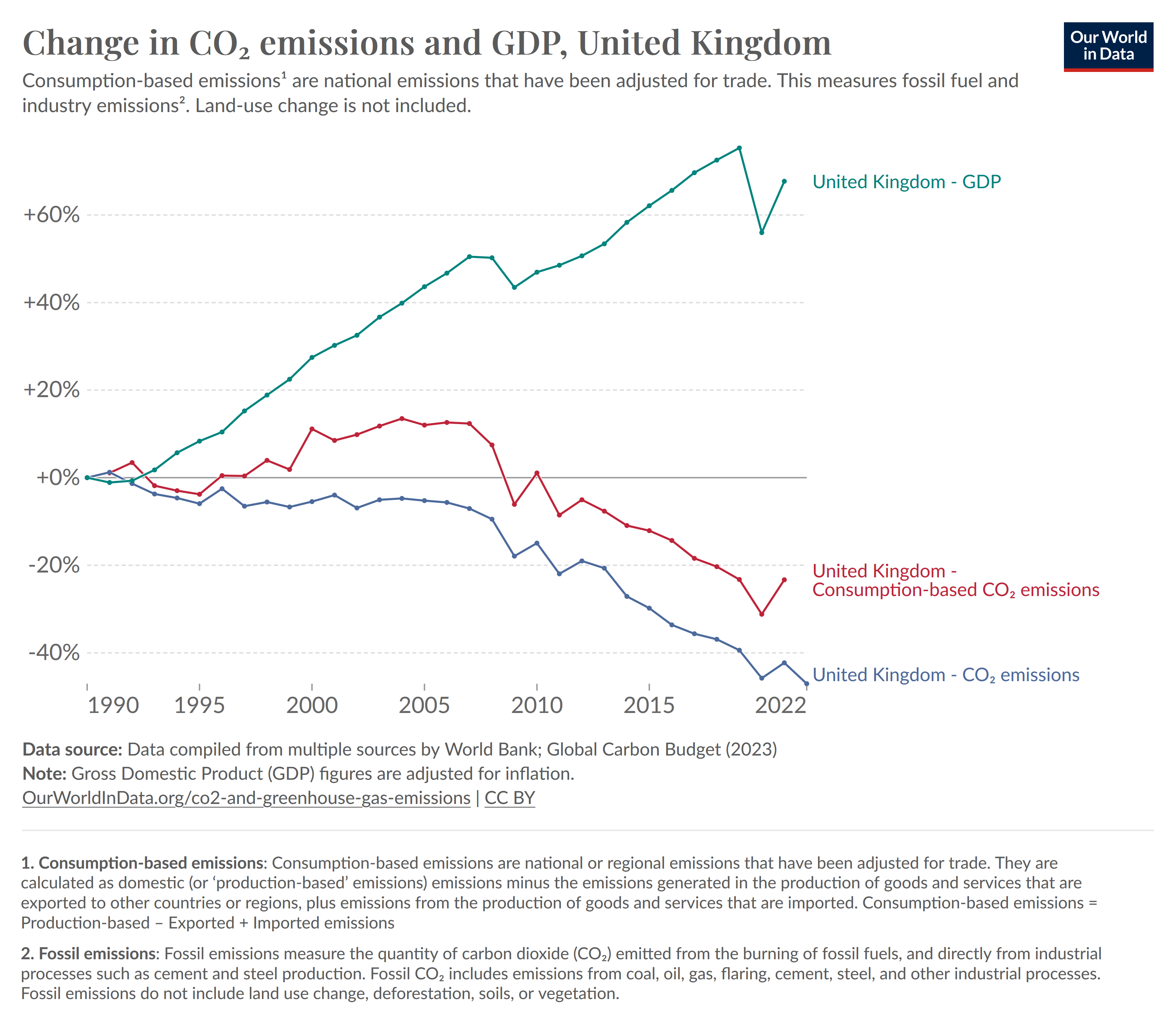
There are two measurements for CO2 emissions on this graph. That’s because a big chunk of Britain’s emissions are outsourced to other places. The red line includes the products made overseas and consumed in Britain, and is a better reflection of our overall climate impact. While progress is visibly slower when you take this into account, there is still progress. The economy is growing with emissions falling.
The UK isn’t alone in this either. Our World in Data, who compiled the graphic above, show how this pattern is observable in many advanced economies. That’s what I would hope to see. Mature economies need less infrastructure, and the rapid increase in emissions that accompanies development begins to slow. Low carbon technologies can now replace older infrastructure and there’s a net reduction in emissions.
The problem with all of this the question of pace. Yes, decoupling is possible, but is it fast enough? Before we hail Britain as a success story, we ought to ask if it’s going to meet its target to be net zero by 2050. The answer to that is no, and Britain is decoupling faster than many others. Hannah Ritchie at Our World in Data reaches the same conclusion: “Economic growth is not incompatible with reducing emissions. A key question is whether we can decarbonize fast enough, and across more countries.”
As things stand, the degrowth question remains unthinkable. It’s the big ‘what if?’ of the climate story. If Britain was pursuing a wellbeing economy, would we be on track with those targets? If rich countries disarmed the growth imperative and moved beyond GDP as a metric of success, would emissions fall faster?
More on decoupling:
 The Earthbound Report
That idea is a tough sell, and the sale has not been made. Time is running out. Don’t believe it myself, decouple and still grow sounds like a pipe dream that is good to think about but not going to happen. We need to think about what will be Plan B.