
I visited Copenhagen for the first time last year, and I was impressed. Bikes are everywhere and if it isn’t quite there just yet, a truly sustainable modern city feels within reach in a way I hadn’t seen before. It’s also clearly a place where good design is valued and is part of the culture.
The family were less excited about exploring this. They told me that I should consider myself lucky to get to either the Danish Architecture Centre or the Design Museum, but under no circumstances would they be dragged around both. (The architecture centre won because it has a slide by Carsten Höller, and a good time was had by all.) So it falls to books like this one to fill in the gaps for me as I think about the connection between the Danes’ appreciation for design and the challenge of sustainability.
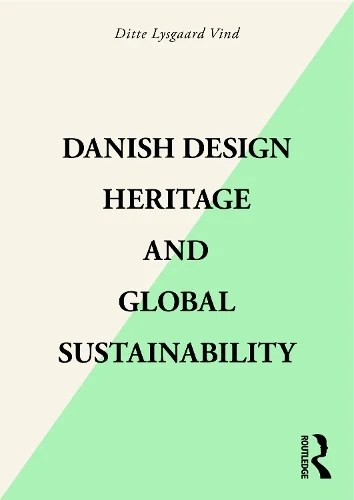
In this new book, design and circular economy expert Ditte Lysgaard Vind has mined the country’s heritage for lessons, interviewed designers and architects, and presents a host of ideas for taking that history into the future. Danish design is known for its quality and durability. It also has an aesthetic of simplicity and purpose. It may be more elite today, especially outside of Denmark, but it originally catered to ordinary people rather than the luxury market. The companies and the products both demonstrate these values, with Danish businesses seeing themselves as improving people’s lives.
Danish designers were influential, and there’s a good chance that if you look around the room where you’re reading this, there will be an item that’s taken inspiration from them – a Kaare Klint or Arne Jacobsen chair, or a Poul Henningsen lamp. Originals from these designers have held their value because they are timeless and made to last. Longevity depends on quality materials and craftsmanship, but also on ‘aesthetic resilience’ – something that still looks great 80 years later, regardless of changing fashions.
The book features contemporary examples of the same approach, such as Bang & Olufsen. They have produced a portable speaker that is designed to last for decades. They’re aware that changing music formats can make a product obsolete, and so they have planned for that. The design is modular and can be upgraded, and it’s the first ever Cradle to Cradle certified electronic product. Other examples look at buildings made from upcycled waste materials, or Copenhagen’s cycling infrastructure. These examples show how the Danish design tradition is being used to address today’s challenges. It isn’t about replicating a certain style, and some of the designers interviewed mention the risk of that. It’s more like a toolbox of useful ideas that can be applied in different ways.
One of those useful ideas is that design is not intimidated by limits. All design responds to a brief and works within specified parameters – a budget, format, user requirements, etc. Where economics is horrified by the idea of limits, “design, in general, is brilliant in working within constraints” and doesn’t seem them as a barrier to creativity. I hadn’t really thought about this before, but it puts a different spin on the idea of planetary boundaries.
Design is also deliberate. That’s important in a culture that defaults to ‘laissez faire’ approaches and ‘leaving things to the market’. Design requires us to stop and think about what we want, and take steps towards it. Without that kind of purposeful action, the best we can hope for is slightly less bad versions of the status quo. Truly transformative businesses, infrastructure or policies – the kind that will undo fossil fuel extractivism and create a regenerative future – those need meaningful design.
I enjoyed Danish Design Heritage and Global Sustainability. It would have been helpful to have had a few more photos included, as I found I had to pause and do a Google image search on various things. Is the ‘swan chair’ the one I think it is? (Yes it is). I also think there’s more to say about how Danish design has been appropriated somewhat for mass consumerism, and how that could be reversed. But overall I think it strikes a good balance of past and future, drawing lessons from the best of a tradition without being overly reverent. It adds new perspective to discussions on the circular economy and the planetary boundaries, and backs up Buckminster Fuller’s famous invitation, that “the best way to predict the future is to design it.”
- You can get Danish Design Heritage and Global Sustainability from Earthbound Books UK or US
 The Earthbound Report