
I know I’m a month late for this sort of thing and everyone else writes their best-of lists in December. But I tend to get a lot of reading done over the Christmas period. Better late than never.
As usual, there’s no particular order to these favourites. Of just over a hundred books I got through in 2023, here are a handful that I enjoyed most, got plenty from, and would recommend for a variety of reasons.

The Seaweed Revolution, by Vincent Doumeizel
I’ve been expecting this book for a decade: sooner or later someone was going to write an accessible and inspiring case for ocean farming. That person is French oceans advocate Vincent Doumeizel, and he spells out just how useful seaweed is for all sorts of purposes, the state of ocean farming at the moment, and what needs to happen to take it forward. Given that a handful of countries in Asia have ocean farming and the rest of the world doesn’t, it’s not theoretical: it works and we can do it. Forget space travel – the biggest unrealised opportunity staring humanity in the face is in the oceans. Read it and see if Vincent can convince you.
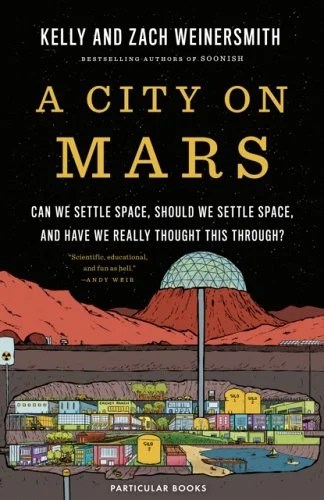
A City on Mars, by Kelly and Zach Weinersmith
Speaking of space travel, here’s a useful corrective to billionaire fantasies, and to the increasingly common ‘the rich are trying to escape the earth’ hand-wringing while we’re at it. In their painstakingly researched and highly entertaining book, this husband and wife science-writing team show just how complicated space settlement really is, and why we’re not anywhere near such a thing. Regrettably, as far as they’re concerned – as ‘space geeks’ they’d love to see it happen. We should take care of the planet we already have, and if that doesn’t feel like enough, play some Starfield.

The Nutmeg’s Curse, by Amitav Ghosh
Most books on climate change are written from a Western perspective and tend to rehearse familiar themes. The Nutmeg’s Curse deserves a place in this list simply for the number of times I thought “I haven’t heard that before” in a climate book. It could equally earn its place as one of the most eloquent books that I read last year. Amitav Ghosh is a celebrated novelist and a masterful writer. He approaches his topic like a storyteller, basing the book around the story of colonialism in the Banda islands of Indonesia and using it as a parable to explore the interplay of climate and power. Wise, powerful and original.

The Golden Mole, by Katherine Rundell
Another superb writer who works in both fiction and non-fiction, you can’t visit a bookshop in the UK at the moment without bumping into a table of Katherine Rundell books. And you’ll get no complaints about that from me. Rather than tell you about all the things going wrong in the world, Rundell draws our attention to a series of extraordinary animals and says “behold!” Just as motivating to environmental stewardship and a lot of fun too, full of quirky cultural and historical anecdotes. Similar themes are explored through children’s fiction in Rundell’s other bestseller this year, Impossible Creatures, which I also enjoyed.

Breathe, by Sadiq Khan
For all the inspiration and challenge in the books above, here’s a book about getting stuff done. As mayor of London, Sadiq Khan has grappled with air pollution and climate change, often in the face of co-ordinated and well funded opposition. This is a book about pushing through the complexities of politics, about taking the time to have the important debates, and doing the green thing even when it makes you unpopular. A lot of people don’t like Sadiq Khan, but while government climate policy takes three steps forwards and two steps back, I for one am thankful for activist mayors doing transformational things in global cities.
That’s five. I could round out a top ten with Chris Van Tulleken’s Ultra-Processed People, which delivers a significant blow to our late capitalist food system while looking innocently like a book on health and nutrition. Guy Standing’s The Politics of Time clearly articulates why time should be higher on the political agenda, and how time could be a huge opportunity for improving lives without increasing consumption. Climate, Catastrophe and Faith, by Philip Jenkins, is an intriguing look back at the history of religion through the lens of climactic change, and well worth reading for insights on what that story can tell us about the future.
On the fiction side of things I really enjoyed Becky Chambers’ novella A Psalm for the Wild-Built. Chambers slips all kinds of radical political ideas into her sci-fi, which is kind and wise and deeply human even when it’s about robots and aliens. And for children, SF Said’s book Tyger deftly navigates themes such as prejudice, class, empire and land enclosure in a story with magic portals, superpowers and talking animals. No mean feat.
Should you wish to read any of these yourself, they are all in a list on Earthbound Books.
I read 100 books in 2023 and listened to three as audiobooks. 45 of those were reviewed here on the blog. Of those I didn’t review, 22 were fiction for adults. Given my other career as a children’s author, a further 23 were novels for children or young adult readers – though I recommend reading a couple of children’s books a year regardless. If you don’t know why you should bother with that, the aforementioned Katherine Rundell explains here.
38 books were by women and I’ll have to try and get nearer a 50/50 split this year. 23 were by writers of colour. Beyond the usual English speaking nations, author nationalities included Algeria, Italy, Ukraine, India, Poland, Nigeria, Pakistan, Russia, Greece, Brazil, Philippines, Germany, Sweden, China, France, Netherlands and Denmark.
 The Earthbound Report