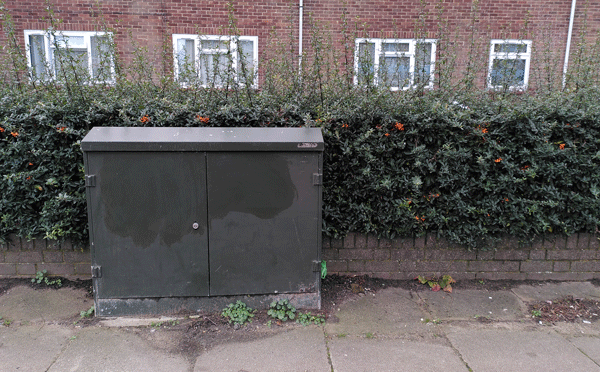
Does your street have one of these? There’s a slightly smaller version about twenty metres down the street from me, and I found five on a quick walk around the block.
They’re telecoms cabinets, and if you live in Britain, there’s a very good chance there’s one nearby. BT has 90,000 of them scattered around the country, and they contain the connection points for home phone lines and broadband.
They’re a critical part of telecommunications infrastructure – or at least they have been. As the internet is gradually upgraded to fibre-optic cable, the copper wire network is becoming obsolete and eventually these boxes won’t be needed. Rather than scrap them all, BT are investigating the possibility of recycling them to host EV charge points.
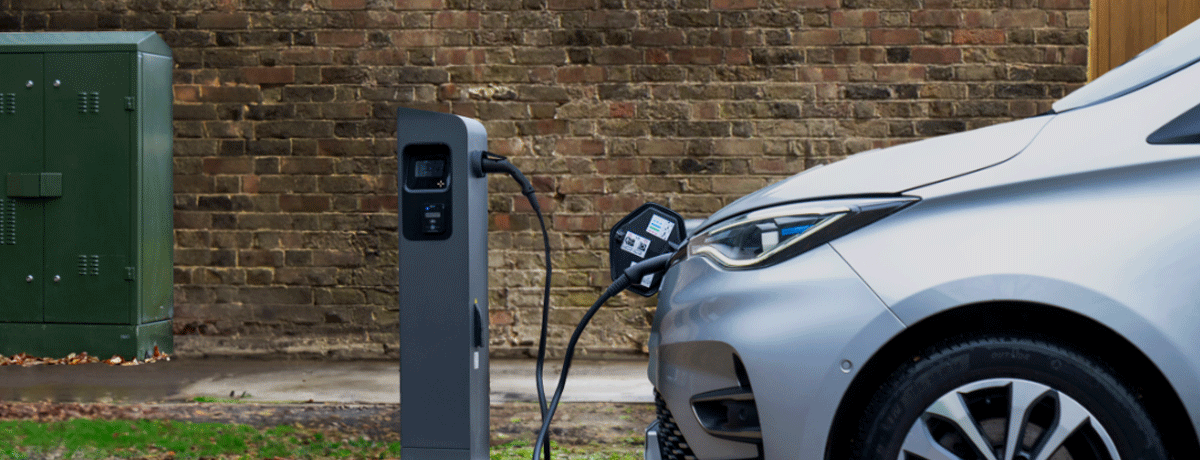
To test the concept, the first one just launched in East Lothian, Scotland. Pictured in the header above, this proves it’s possible, and further pilot conversions will follow. Whether it evolves into a wider programme remains to be seen, as it depends on locations and power capacities. Some cabinets are in suitable places and others aren’t, but initial studies look promising – it might be possible to adapt around two thirds of the cabinets.
That would be 60,000 locations, and to put that number in context, it’s more than the 53,000 public charging points currently available across the UK. I suspect that final numbers will be nowhere near that, but it could still be a major shortcut to more local charge points. It’s easier for an established company to repurpose existing street infrastructure than for new companies to get permission to install things from scratch in public locations. Each cabinet already has a power supply, reducing the need to dig up streets and lay new cable. And cabinets don’t need to be obsolete to be used in this way – the power supply is split to run the chargers, with no interruption to local broadband users still on the older network.
Thinking about the possibilities for my street, there are a handful of car chargers on private driveways. The nearest public charge point is half a mile away, if we discount two listed points on lamp-posts that have never worked. If a couple of the cabinets in my neighbourhood were converted, it would open up charging possibilities for those without driveways, as well as for visitors and delivery vehicles.
Indeed, one advantage for BT is that if they run a network of charge points, their own van drivers will be able to use them as they move the OpenReach fleet to electric. With 29,000 vehicles, BT runs the second biggest commercial fleet in the country, second only to Royal Mail. They’ve committed to moving to all-electric, and they’re going to need the charge points for those vans.
We’re a long way from any of this, but I like the idea of reusing existing infrastructure wherever possible. I’m also pleased to see a major infrastructure firm involved, as it just brings a potential speed and scale to EV charging that we haven’t seen in the UK so far, in a market with lots of smaller players. And it’s a good example of the new thinking around EVs and a post-oil transport system – things are going to move fast in the world of EV infrastructure in the next couple of years.
 The Earthbound Report
A brilliant idea – but the elephant in the room (or rather under the pavement) it seems to me is the capacity of the electricity supply. I would not have thought that BT boxes (or for that matter lampposts) have high power cabling, and if even a few households on a single street charge their cars overnight, that is a lot of demand on the cable infrastructure, at typically 30 odd amps (7kw) per charger.
Has anyone done some analysis of this?
This is compounded with all electric houses running a heat pump and electric hobs and ovens. We regularly draw over 30 amps at once to cook a meal, though admittedly not for too long – it only takes a few minutes to boil water and get the oven up to temperature, but those few minutes are repeated at roughly the same time every day everywhere, as in the famous story from when we only had three TV channels, of standby power stations having operators watching the TV ready to switch the power on for when half the country put the kettle on at the same time at the end of a popular TV program.
Perhaps a solution, at least for individual households, is load balancing of the sort that already exists on our high performance induction hob. The car loses out to the cooking and such like.
Locally, we recently had some disruption when a new very fat cable (actually three fat cables – one for each phase) was laid from an electricity substation over some considerable distance, and it seems to me a lot of this will need to happen fairly soon – but who will pay for it all?
Yes, that crossed my mind too, and I presume there’s a simple upgrade to the cabinet to draw more power if needed. We had a very simple and quick upgrade when we had the charger fitted, and that was done at no cost by Power Networks.
National Grid are the ones that have done the advance modelling on a more electric future, and so far they’ve done an impressive job of that and of integrating more renewables. Laying Very Fat Cables (I hope that’s the official industry term) is all part of that.