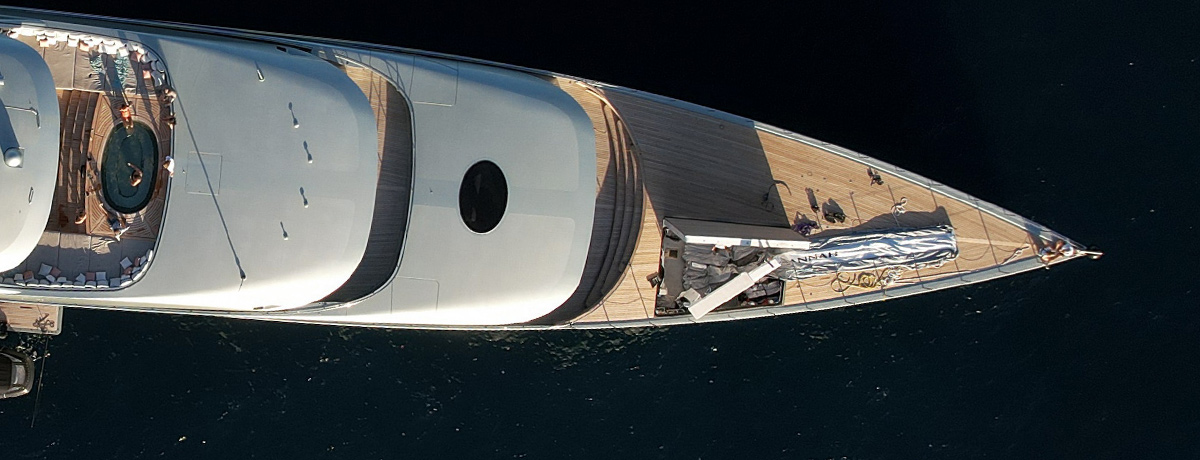
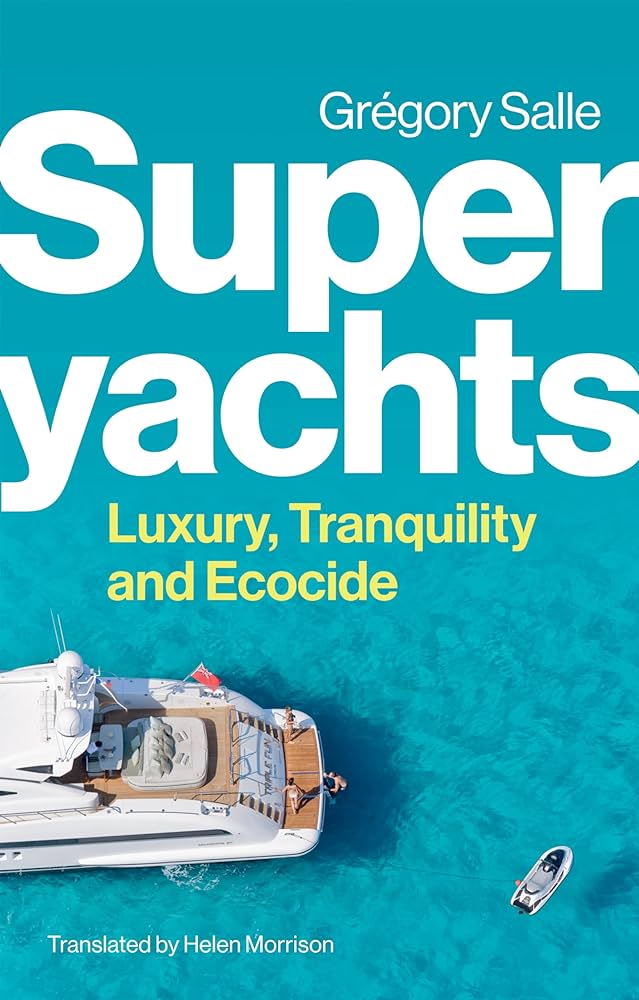
The superyacht is often used to illustrate luxury and extreme wealth, for those who approve and aspire to such things and for those who don’t. A yacht is the ultimate symbol of success to some, and visual shorthand for inequality to others. We understand the symbol without really taking those yachts very seriously, and so Gregory Salle invites us to dwell a little longer on the subject in his book Superyachts: Luxury, Tranquility and Ecocide.
Personally, I wasn’t initially convinced that this was a worthwhile exercise. I don’t like the use of yachts on reports on inequality and the like. It focuses attention on the lifestyles of a few thousand people, which glosses over more mundane imbalances in wealth and power. It personalises it too much – the problem isn’t billionaires per se, but the system that creates them in the first place. Criticising the leisure habits of the richest is very easily dismissed as the ‘politics of envy’ by those beholden to the charms of capitalism.
Still, I read Superyachts because it’s short and to the point, like an extended essay, and Gregory Salle is a smart enough commentator to avoid the traps. “This is an activity that involves only an infinitesimal fraction of humanity” he admits. “At first sight, luxury yachting is so far removed from the ordinary that it concerns almost nobody.” So what he’s really interested in is not so much the boats themselves, but what they represent. What are they expressing? Could we view them as a kind of “measuring device” of the social order?
Measuring certainly matters to the yacht owners, who take a great interest in whose is the biggest. A yacht has to be over 30 metres long to qualify as a ‘superyacht’, and such things used to be very rare. The size of yachts has been increasing. Today the largest is 180 m, and larger ones are on the drawing boards. They are of course extraordinarily expensive – not just to own, but to run. It could take a million dollars to fill the tank before setting sail and yes, the carbon emissions are obscene. A moderately sized superyacht can consume 2,000 litres of fuel per hour.
Annual spending on the 6,281 listed superyachts is enough to wipe out developing world debt, according to one observer the book cites. They are a symptom then of a system that serves the richest ten times over before the poorest get anything at all.
The rich aren’t asked for anything in return, either. The book mentions the various tax loopholes that superyachts benefit from. There are no penalties for the environmental damage they do either, through tearing up protected marine environments or dumping waste at night and then sailing away. Neither are there labour laws for the many servants on board, who always outnumber the guests.
The angle that I found most interesting is the borderlessness of superyachting. They do a circuit of the Caribbean in winter and the Mediterranean in the summer, dropping anchor where they please. The richest are citizens of the world, while the poor are stopped at the border. There is a painful symmetry between the yachts and the dinghies, the way that the Mediterranean is a playground for some and “at the same time, a place of death for others.” It’s a stark symbol of the lives that matter and the people capitalism considers expendable, and puts a different spin on the Conservatives’ refrain of “stop the boats”.
There are serious issues in play, but Salle generally approaches his subject with tongue in cheek. That feels entirely right – superyachts are inherently ridiculous. One chapter is written in the first person, with various yachts introducing themselves. As a counterpoint, Posidonia Seagrass later shares its own perspective on the idea of superyachts. Salle has more fun with his book than you might expect, and writes with an ironic detachment that is well captured by translator Helen Morrison.
Superyachts is about more than the boats themselves. As the book concludes, “superyachting provides a perfect illustration of an astonishing sleight of hand” that characterises our age of climate breakdown. “The capacity of the wealthiest individuals to exonerate themselves from the social and environmental cost of their activities and behaviours.”
- You can pick up Superyachts from Earthbound Books
 The Earthbound Report
Wow. Incisive. Might be a great book to give to friends with sailboats, who in my experience are as keenly aware of their impact on the environment as they are of its impact on themselves and their trajectory!
That’s something that the book touches on briefly, that those in sailing communities are often closer to nature because of their hobby, and well alert to environmental issues. That’s not necessarily true of superyacht owners, however!
Yes, I can well imagine. Hubris and sails are a bad combination!