
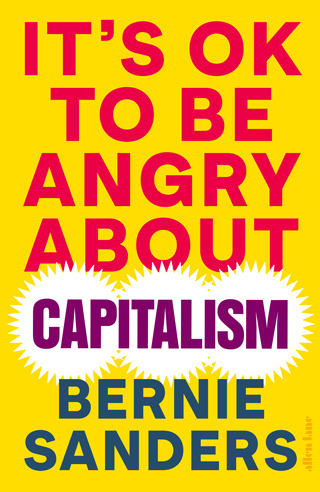
If you had lined up 100 forthcoming book titles and invited me to choose which one was by Bernie Sanders, I reckon I’d have picked out It’s Okay to be Angry About Capitalism. It’s a book title that could only be more Bernie Sanders if it came with mittens, and very good it is too.
The book tells the story of Sanders’ run for the presidential nomination, and how the Democrats rallied to exclude him in favour of Hilary Clinton and then Joe Biden – despite higher numbers when polled against Trump. The “economic justice message is rarely if ever delivered by the Democrats,” he explains. “That has a lot to do with our broken campaign finance system and Democrats dependency on campaign contributions from the wealthy and powerful.”
Biden nevertheless recognised the strength of Sanders’ endorsement, and it’s interesting to see how many of his ideas have been adopted by the current administration.
After telling the story, the book turns to the agenda that Sanders stands for, with chapters on fixing healthcare, education and the media. These will be more relevant to American readers, though they’re helpful for those of us in the UK who scratch our heads over the apparent inability of the world’s richest country to provide basic things to its citizens.
How politics should be conducted is as much a part of Sanders’ vision as the ideas themselves. His politics is resolutely on the side of the working class, based in grassroots organising and movement building. For him, this is the political legacy that he wants to leave to future generations: how to do politics in a more relational and meaningful way, bringing people on board and building power as a mass movement. It has certainly inspired some of America’s most promising young politicians, who will hopefully remember the integrity of that model when corporate money comes calling.
At times It’s Okay to be Angry About Capitalism reads like a manifesto, sometimes like a stump speech. It uses repetition and catchphrases. Sanders is almost incredulous at the way the United States has failed to raise the minimum wage, or the way that buying just one politician in a balanced Senate can thwart the will of millions of voters. And yes, there’s anger at capitalism too, at the vast inequality of billionaire wealth, and a system that endlessly rewards the very richest.
In its sections on inequality, the book shares a common interest with Limitarianism, which I reviewed last week. Both of them have sharp words for the way that people shut down discussion and make it almost impossible to talk about the things that matter. Sanders’ book title is really important here – it gives people permission to use the C word, to name the problem and confront it. The more people admit to being angry about capitalism, the greater our chances of doing something about it.
- It’s Okay to be Angry About Capitalism is available from Earthbound Books UK or US.
 The Earthbound Report