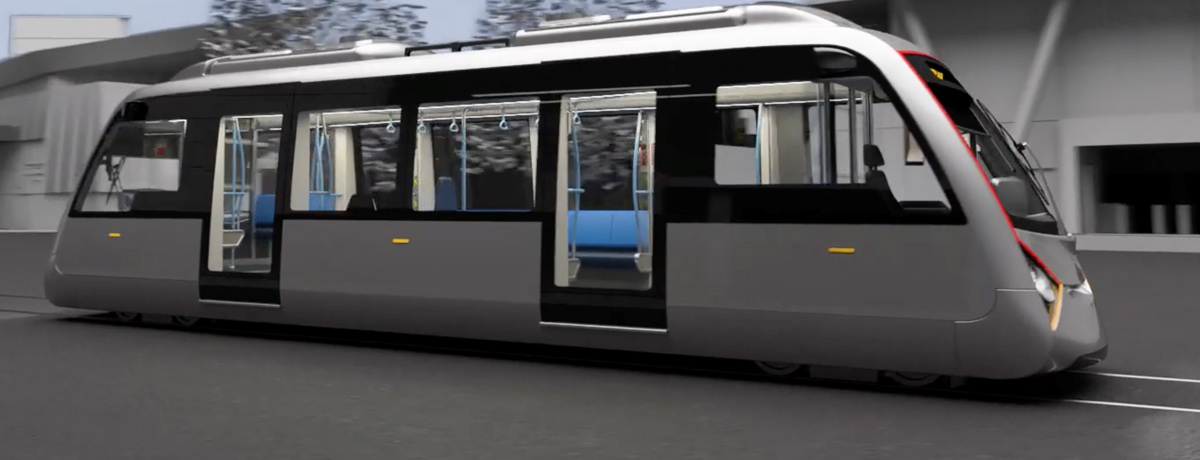
Light rail and trams are useful options in the sustainable travel toolbox, able to move lots of people around a city cheaply and easily. But if you’ve lived in a city that’s building them, you’ll know how disruptive it can be. I remember visiting my brother in Edinburgh over the course of years and wondering when they were going to finally finish with their tram system. So did the locals, with growing resentment over the closure of roads and the remodelling of junctions, and the escalating costs that it all implied.
Coventry may have a new and innovative solution to this problem. They’re developing something that they have simply called Very Light Rail (or VLR) – small and lightweight electric trams that run on simplified tracks that are much quicker to install.
There are multiple advantages. The smaller vehicle sizes mean you can run trams on existing roads without much adaptation, with tighter turning circles than most light rail systems. The vehicles are battery electric and there’s no need for overhead wires.
Perhaps most importantly, the light weight means you don’t need to dig deep foundations to underpin the track. This is one of the main reasons that urban rail projects take so long. Deep foundations compete with existing cables, sewers and pipes laid under the road surface. Those need to be moved and so cities aren’t just laying tracks, they’re having to reroute all the utilities along the way. This dramatically extends the time and the expense, with budgets running from $25 million a kilometre to as high as $100 million per kilometre in busy city centres.
At that kind of price, light rail is beyond the budgets of smaller towns and cities. Even Edinburgh, a capital city, was nearly bankrupted by the cost overruns on their tram project. That’s the clever thing about Coventry’s proposal: they’ve designed a system for themselves and cities like them.
In doing so, Coventry is drawing on their industrial heritage. The city was at one point the world’s biggest manufacturer of bikes, and then home to some of Britain’s best known car brands. It’s a place with a legacy of automotive engineering, and that gives Coventry council the confidence to attempt a project like this. Coventry Very Light Rail currently exists as a prototype vehicle and a test track, with investment funds secured to develop the idea further. It will take some time and there is competition for this sort of electric mass transit. But I hope that Coventry can solve their own problem, and possibly add another sustainable transport option for towns and cities intimidated by the cost of light rail.
 The Earthbound Report
How exciting for Coventry to have imagined a new, sustainable chapter in its story of industry. Thank you the for share!
This is a valuable technology that addresses limitations of existing tram technology. But the inadequacy of mass transit in Coventry & elsewhere is not a structured, complicated problem that can be “solved”, it’s a socially complex and unstructured issue that can be eased or worsened. Coventry had trams and then neoliberalism, promoting interests of Coventry’s car industry’ ripped out the rails – destroying the possibility of cross model competition / complement, when it would have been cheaper to leave them. Political economy renders new technology normative and not politically neutral – hence, it’s not a solution that neutralises lack of sustainability. Where will the new rails run from to? It won’t connect poor areas with work or the hospital. Again, the language of solution, as if we doing a difficult crossword is not the right way to think about this, in my view
I share your nuanced view of solutions, which is why I talk about a toolbox at the start. Climate solutions aren’t like puzzle answers, and they always have a political and economic context that a short blog post won’t do justice to. (And I live in Luton, another car manufacturing town that ripped out its trams…)
Out of interest, what word would you use instead of solutions? Is there a term that implies a bit more complexity?
Thanks for the reply. You do open with “toolbox”, yes, and this makes sense. I believe it could be complimented later in the piece with terms such as “proposals”, “responses” and “interventions” etc. These are not as catchy or intensively hopeful as your later intermixing of implicit promise that trams-can-solve discourse, but I think they maintain space for complexity, and reduce that for ideologies that promote technology as negating need for related social change / transformation.