A few years ago Hannah Arendt’s The Origins of Totalitarianism surged up the bestseller charts, propelled by the online buzz at how appallingly relevant it seemed. Arendt was writing about the collapse of politics that happened in Nazi Germany and Soviet Russia, and there were troubling echoes in the performative cruelty of the new Trump administration.
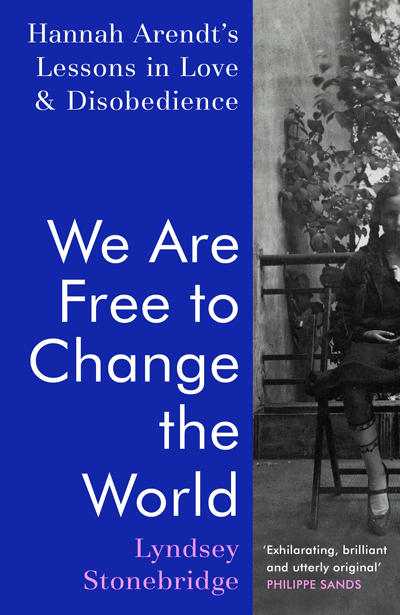
I didn’t read Arendt at the time because she seemed like a complex and interesting writer, and I wanted to understand her own life and context better first. This is the book I was waiting for then: We Are Free to Change the World – Hannah Arendt’s Lessons in Love and Disobedience, by Lyndsey Stonebridge.
Hannah Arendt was raised in a Jewish family in Königsberg (then German, now Russian). She went on to complete her doctoral studies among the luminaries of inter-war German philosophy, and then began researching and challenging the rising anti-semitism around her. That led to her arrest by the Gestapo, and she fled Germany after eight days in prison. She settled in France, was briefly interred in a prison camp, and eventually escaped to the United States. This would become her home after she was stripped of her German citizenship, and her refugee experience and outsider status would inform her writing from then on. “No one is better at marking the borders of a terrain than the person who walks around it from the outside,” she wrote.
Looking back at Europe, Arendt made a name for herself with her observations on how totalitarianism takes hold, how truth is undermined, anger flares and conspiracy flourishes. She warned that “the ideal subject of totalitarian rule is not the convinced Nazi or the convinced communist, but people for whom the distinction between fact and fiction (ie the reality of experience) and the distinction between true and false (ie the standards of thought) no longer exist.” It’s this kind of statement that chilled readers in 2016, faced with a president who lied on a daily basis and faced no consequences for doing so.
Also familiar is the “structureless mass of furious individuals”, the “vague pervasive hatred of everyone and everything”. I heard a resounding echo in the sense of preposterous inevitability of terrible decisions, something I felt throughout Brexit and the failures of government that followed. “Nothing which was being done, no matter how stupid, no matter how many people knew and foretold the consequences, could be undone or prevented,” wrote Arendt of inter-war turmoil. There’s a similar sense building around US elections and the prospect of a second Trump presidency.
Arendt’s writing ranged across history, empire, race and anti-semitism, what it means to be human, the nature of evil. It is uncomfortable reading at times, both now and on publication. She lost friends over some of her essays and books, and was at times almost a pariah. Stonebridge deals fairly with Arendt’s mistakes, when she was wrong and when she was misunderstood, and the book does a fine job of showing how her writing was received both positively and negatively.
I will take away a handful of useful ideas to mull over. In the face of totalitarianism, nothing is more important than thinking for yourself. Freedom needs other people and is not just about personal sovereignty. Totalitarianism is lonely, because in a post-truth world we lose the shared reality on which to find common ground. Behind all human rights lies the basic “right to have rights” in the first place. “Nobody has the right to obey”. Or Arendt’s wrestling to express what it means to love the world: “I want you to be”.
As a biography, We Are Free to Change the World is unusual, mixing life story with philosophy and politics and history. It flips backwards and forwards in time, following themes as much as chronology. Occasional notes of travel writing slip in as Stonebridge retraces Arendt’s steps.
The book uses a lot of Arendt’s own words, drawn from her books and from letters – she left a lifetime of correspondence with other academics, activists, philosophers and poets. This collection gives us all kind of insights into her influences, how her thoughts developed, and how she felt about what she was writing. Stonebridge uses Arendt’s words in italics, dropping snippets into her own sentences, making the text almost a conversation with Arendt at times.
We Are Free to Change the World is not light reading and won’t be for everyone, but it’s a timely and important book. We appear to have forgotten a lot of the lessons on what went wrong in the 20th century. Who better to turn to for a refresher than Hannah Arendt, who witnessed some of the century’s darkest moments first hand and spent the rest of her life studying them and reflecting on them?
- We Are Free to Change the World is available from Earthbound Books UK and US.
 The Earthbound Report