Globalization was one of the big talking points of my International Relations degree twenty years ago, when it was discussed with a certain inevitability about it. Despite the protests from some quarters, it felt like history led definitively towards greater integration. Trade would open the doors of the furthest reaches of the globe, and everyone would benefit from the cheaper goods and stability that comes from mutual inter-dependence.
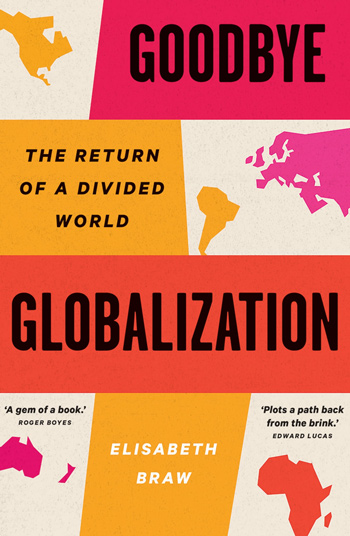
It hasn’t turned out that way. Most of the world’s powers have a much more sceptical view of integration today. “Belief in globalization is evaporating,” writes Elizabeth Braw, and she traces the reasons why in her new book Goodbye Globalisation: The Return of a Divided World.
The book tells the story of globalization chronologically, beginning with its rise in the 80s and 90s. We hear all the big hits: financial deregulation that allowed money to move more freely between countries. The end of the Cold War and the vast opportunities in the former Soviet states. China’s slow and controlled opening to foreign investment and trade. Global supply chains that brought new products at cheaper prices to more of the world’s people.
There were always those left behind, even at the best of times, but “in the nineties, the opportunities were so plentiful that everyone seemed to benefit.” Events such as 9/11 and the financial crisis rocked the boat but didn’t tip it over. The internet and mobile phones supercharged the consumer revolution and that sense of inevitability continued until it suddenly didn’t.
Braw points out that three trends came together at once to break the consensus on globalization. One was the growing discontent at the way it had enriched a global elite, while ignoring the needs of those who were harmed by it, such as industrial regions that had lost jobs – see Brexit and Trump.
A second trend was the role of China, and the book tells a number of stories of how China has weaponised globalization. From theft of intellectual property to punishing countries who criticise their human rights record, China always had its own rules. Braw writes about Huawei as a key moment when Western countries realised they were dependent on a technology provider that they couldn’t trust.
And then there’s Russia. Along with China, “the two globalizing countries that were also strong enough to form geopolitical counterweights to the West chose a different track.” They chose to liberalise trade but not democracy, and that made interdependence into a vulnerability for the West.
This might all be a familiar story if you lived through it. What Braw does is make it relateable on a human scale by structuring it around the experiences of a wide range of interviewees. These are really interesting people. There’s Michael Treschow, chairman of Ericsson at the boom of mobile telephony, and then Unilever. Lithuanian politician Gintarė Skaistė saw the potential of globalization as her country opened to the world, and also the risks. (Lithuania offered Taiwan an official office in the country, and China strangled its trade in retribution.) There are entrepreneurs, bankers, politicians. One of the latter is MP John Spellar, representing the de-industrialising Midlands.
From these more personal perspectives, paragraph by paragraph, Braw weaves a kind of tapestry of stories that grounds this huge international phenomenon in lived experiences. It’s clever, and it helps to make sense of a story that can otherwise seem very distant and abstract.
Goodbye Globalization doesn’t celebrate or lament the change in the tide, sidestepping the tropes of both the pro and the anti-globalization camps. It just tells the story, trying to unpick what globalization meant to different people, how they were affected by it, and what we can learn from it all if we want to do things better in future.
- Goodbye Globalization is published by Yale University Press and is available from Earthbound Books UK and US.
 The Earthbound Report
Someone from the Atlantic Council telling us how bad China is. No conflict of interest there.
Sure, the book has a western perspective and could do with some voices from China. It doesn’t blame China for the stalling of globalisation though. In fact the west comes across as naive and arrogant in the book for assuming that liberal democracy would be universally embraced as part of a new global order.
“assuming that liberal democracy would be universally embraced as part of a new global order” that in itself is subtle spin. Lead by the US these Western liberal democracies & their liberal values have been more rhetoric than anything else. That is why you will hear again and again the international rules based mantra while they continue to flout international law. Something they have been doing for decades.
Also regarding the Lithuania example I’d imagine if China or Russia decided to offer an official office to a breakaway province, the US or a European country wouldn’t take that lying down. Similarly Australia regularly raised the Uighur genocide propaganda & wondered why China didn’t take that well. Hey we are lying about genocide but still buy our stuff. BTW compare that to their rank hypocrisy over the real genocide in Gaza. What little moral credibility many Western countries had has died a quick death with Gaza.
“They chose to liberalise trade but not democracy, and that made interdependence into a vulnerability for the West.” Same subtle spin here because for both countries trade & interdependence – Germany did quite well on Russian gas- isn’t an issue if the West respects international law and sovereignty which it doesn’t; running with their arbitrary international rules based order & looking project onto China & Russia what they get up to. For example if you want to raise Ukraine if Russia or China did what the US did in Mexico as the US did in Ukraine the US would lose it’s shit.
Anyway, if you are interested in a different take Youtube’s Jerry’s Take on China from a Brit is quite good you will get many takes that don’t make it into Western MSM.
Cheers
Twice in that comment you say there is ‘subtle spin’ in what I’m saying. I understand ‘spin’ to be manipulation of a message. I’m not sure whether you mean it that way, but for the avoidance of doubt I’d like to be clear about this: I intend no manipulation, subtle or otherwise.
I’m describing what the West said it was doing, not advocating for it. Over the years I’ve written extensively about the West’s failures to practice what it preaches on democracy, human rights and free trade.