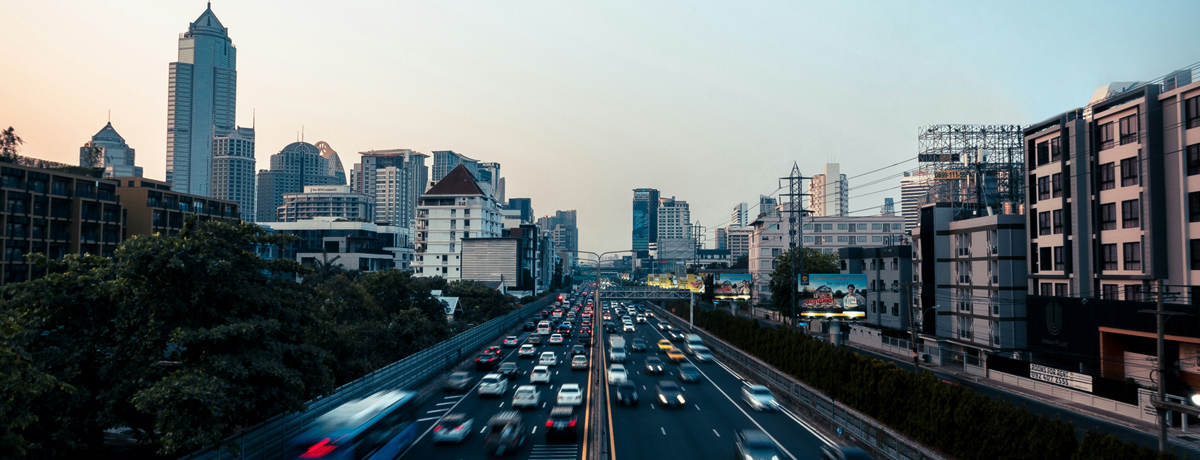
When I was a student I lived in a residential hall that was divided from the rest of the university by transport infrastructure. All the infrastructure in fact. The university library was about 200 yards away, but there was a canal, two railway tracks and six lanes of traffic in between. It divided my neighbourhood, it was noisy, and it was a long way round for pedestrians – a five minute walk in the wrong direction to get to either one of two gloomy underpasses.
In fact, it was such a long way around for pedestrians that I borrowed the jack from a friend’s car, bent some bars in a fence and made myself a shortcut. But that’s another story.
During the road-building boom of the last century, many cities were divided in this way. It brought noise and air pollution into the middle of the town. It cut across relationships between people and also relationships with place – shops, clinics or schools that were now inconvenient, a park that wasn’t safe for children to walk to on their own any more. It fractured natural walking routes and increased car use and traffic.
It also had long term consequences for the parts of town on the ‘wrong side of the tracks’. An area that is cut off is marginalised, and jobs and businesses move. Investment drains away, community services and amenities atrophy. Land and property values fall, neighbourhoods get left behind and poverty gets entrenched. All of this perpetuates existing inequalities, whether those fall along class, racial or economic lines, or a combination of all of the above.
That makes highway removal an interesting opportunity for intersectional climate action. Removing a highway through a city has so many benefits: reduced carbon emissions, noise and pollution, huge opportunities for urban renewal and economic stimulus, and usually in areas that are deprived.
The Biden administration is alert to these sorts of issues as part of its focus on environmental justice. As I’ve written about before, the Justice40 commitment aims to direct 40% of government spending towards marginalised communities. So a couple of weeks ago President Biden committed $3.3 billion in funding to US cities that have been divided by transport infrastructure.
“At its best, transportation infrastructure connects people to opportunity and spurs economic growth” says a White House briefing on the announcement. “But historically, some of our nation’s infrastructure investments and decisions have done the opposite.”
Scoping by the the Department of Transportation suggests that a million people have been displaced in the construction of the highway system, and many more disadvantaged by it – often along familiar social divides. “Highways and rail lines have disproportionately torn through Black and other communities of color and low-income communities, displacing residents and businesses, stifling economic development, and cutting communities off from essentials such as groceries, jobs, transportation, and health care.”
This new funding will quite literally make communities whole again, and the methods for doing so vary according to context. In some cases it will involve building a ‘cap’ over the highway and creating new public spaces and green spaces over the top. In Atlanta, for example, a project called The Stitch will see 14 acres of parks and plazas on a platform over the highway. (It’s called the Stitch because it’s mending the urban fabric.)
In other places the priority is to build connections between neighbourhoods, so the funding will go on pedestrian and cycling routes. A project in Toledo takes this approach, making it safer and easier to access the riverfront downtown. Sometimes removing a highway means relocating traffic, rebuilding city grids, and encouraging more active transport. One of the funded initiatives in Los Angeles will involve bus lanes and segregated cycling infrastructure.
When I wrote about the Justice40 commitment, I said that Britain needed something similar. Now that we can see the practical outworking of that commitment to environmental justice, I think the case is more clear than ever. Intersectional environmental action could heal our cities, and we’d all be better for it.
 The Earthbound Report
Great piece.
In UK, certainly in England, we have fewer disastrous major roads – although the breaking of the tarmac necklace in Birmingham is an example: https://en.m.wikipedia.org/wiki/Queensway,_Birmingham#:~:text=It%20is%20now%20widely%20regarded,expansion%20of%20the%20city%20centre. The digging up of Masshouse Circus was particularly dramatic. We have a huge problem with the ubiquitous Distributor Road, separating pods of development.
I suspect that breaking this effective ‘carapace’ around the post-70s areas of towns could be more difficult, but worthy of exemplars, in places private property could have to be purchased. We have the massive issue that the possibility of proximity and thus walking, wheeling and Public Transport, is shut off by this housing development form and the ubiquitous culs-de-sac.
Graham