A few weeks ago I wrote about how highways can divide communities and create long-lasting social problems in cities. Removing highways and bringing neighbourhoods back together can be a powerful act of restoration and regeneration, and it’s great to see the US government committing funds to doing this in several major cities. As a follow up, here are some examples of where highway removal has already been done, and the difference it has made to those places.
Seoul – The Korean capital put highway removal at the heart of its renewal strategy 20 years ago, digging up a highway and uncovering a stream that had been concreted over. The Cheonggyecheon stream isn’t natural – the water is pumped out of the metro system and then flows through a concrete culvert, so it’s not as biodiverse as one might imagine. But it is nevertheless a striking improvement on what was there before. Although there were fears that removing the roads would cause traffic chaos, traffic movement actually sped up afterwards, while simultaneously creating a slower pace of life along the walking routes and social spaces along the 10km run of the river.

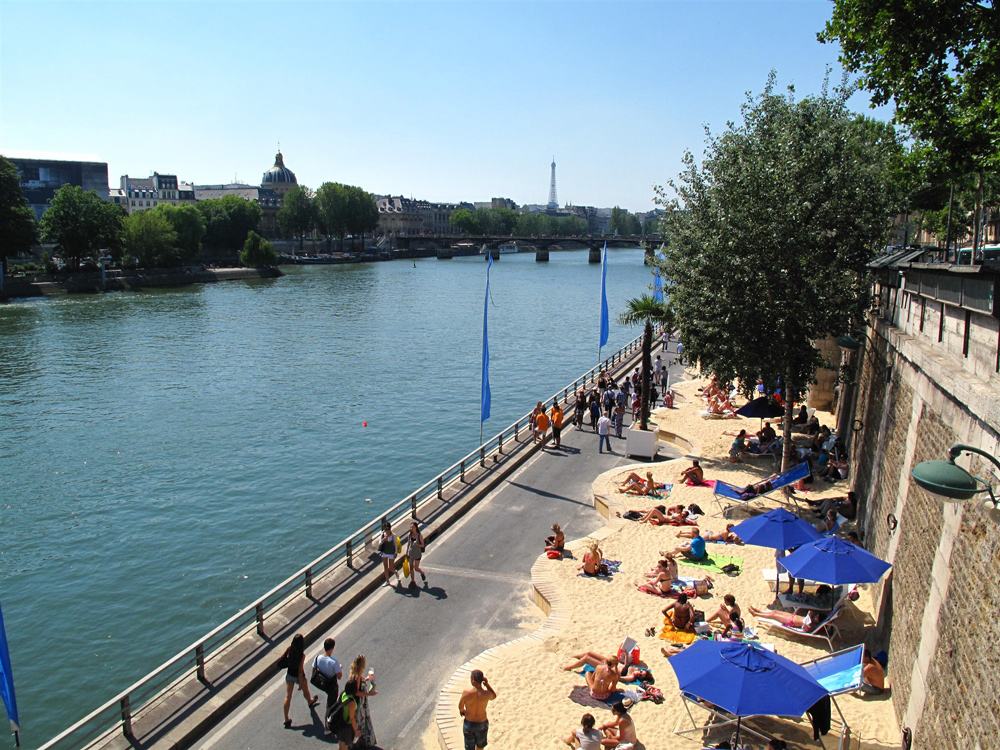
Paris – under the leadership of the city’s progressive mayors, Paris has substantially re-imagined its relationship with the car. There are bold plans for the Champs-Elysee, impressive investment in pedestrianisation and cycling infrastructure, and a renegotiation of public space that has removed parking and roads. One of the more iconic is the reclaiming of the roads that ran alongside the Seine, taking the cars away and turning it into a beach. This was a temporary feature in the summer for years, and then became permanent, giving Parisians back their riverfront. (If you want to see what it looked like before, I recommend that car chase out of the 1998 movie Ronin.)

Utrecht – Another place that rediscovered its waterways is Utrecht, as I’ve described before. The town in the Netherlands turned its medieval moat into a circular road and then regretted it for decades. A long term project then removed it, bit by bit. After 18 years it was finally reopened as a complete waterway in 2022.

Tokyo – All three of the projects above re-opened waterways and created public spaces. Tokyo recently green-lit the removal of a flyover more for heritage reasons. In the 1960s (it was always the 1960s, wasn’t it?), an elevated road was built through the city that blocked views of Mount Fuji and hid the historic Nihonbashi bridge. This stretch of the highway will be removed and dug into a tunnel, bringing light and breathing space back to the historic downtown.

Boston – I’ve had to look around for examples outside the US, because there are just so many stories of American cities wrecked by highways and now undoing the damage. One of the most impressive transformations is Boston’s ‘Big Dig‘, where its dysfunctional inner city highway was re-routed through tunnels. It was the most expensive highway project in the country’s history, with vast cost overruns and delays. But the Rose Kennedy Greenway that now fills the space is surely worth it in the end.

Most of the above include waterfronts and rivers, but sometimes there’s no water involved – like the Yannan linear park in China. Sometimes you can leave the infrastructure in place and repurpose it, like Seoul’s sky garden. You can do this with rail infrastructure too, like Manhattan’s High Line or the park on Manchester’s Castlefield viaduct. There are many more such stories to come.
Of course, the best way to stop highways from destroying cities is to never build them in the first place. London dodged a bullet in the 1960s, and has had less to undo than some other British cities. These might be success stories, but all of them are rectifying urban planning mistakes of the past. Rapidly growing cities should take note, and make sure they don’t make those same mistakes as they grow.
 The Earthbound Report