
I like what the organisation Wild Card are doing. They are calling on some of the UK’s most established land owners, such as the royals and the Church of England, to use their land for wildlife better.
If the world’s SUV fleet were a country, it would be the fifth largest emitter, according to the IEA.
For those who have wrung their hands at the many different EV charging networks in the UK and all the apps and memberships, consider the Electroverse from Octopus, which brings them all together into one account. More pioneering work from the folks at Octopus.
Some of my colleagues at Ashden are taking part in Running out of Time, a nationwide relay to deliver a call to climate action to Westminster. There are relay slots available if running is your thing, so have a look and see if the route passes near you.
Speaking of Ashden, a quick job advert: there are just four spaces left to fill in the national network of Climate Action Advisors to schools. If you’re in Kent, Norfolk, Cumbria/Lancashire, or Lincolnshire/Hull, come and join us. (And if you’re more interested in hearing from a schools advisor than being one, here’s the link for that too.)
This week’s articles
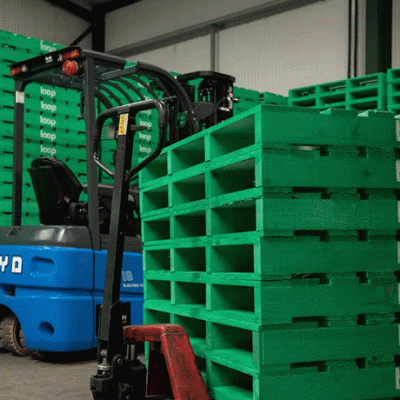
Circular logistics with The Pallet Loop
Out the front of my house there’s a Little Free Library with a base made out of old pallet boards. In the back garden there’s a planter made from more of the same. There’s another pallet in pieces in the wood store waiting to be fed into the rocket stove. I regularly come by discarded…
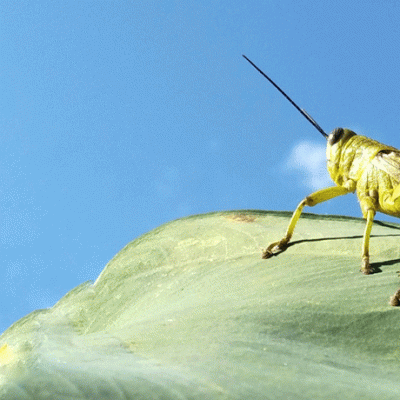
Citizen science with Bugs Matter
Insect life has been in decline across much of the planet in recent decades. It might not be something many of us have noticed, as the change is slow and we might not pay much attention to insects anyway. But if we stop and think about it, we might realise that what we consider normal…

Book review: Cultivated Meat to Secure our Future
It’s a tricky time to be writing about food sustainability. The issue seems to be strangely divisive at the moment. On one side are those who see our future needs being met through small scale organic farming. On the other are those who see no way to produce enough for all the world’s population that…
 The Earthbound Report