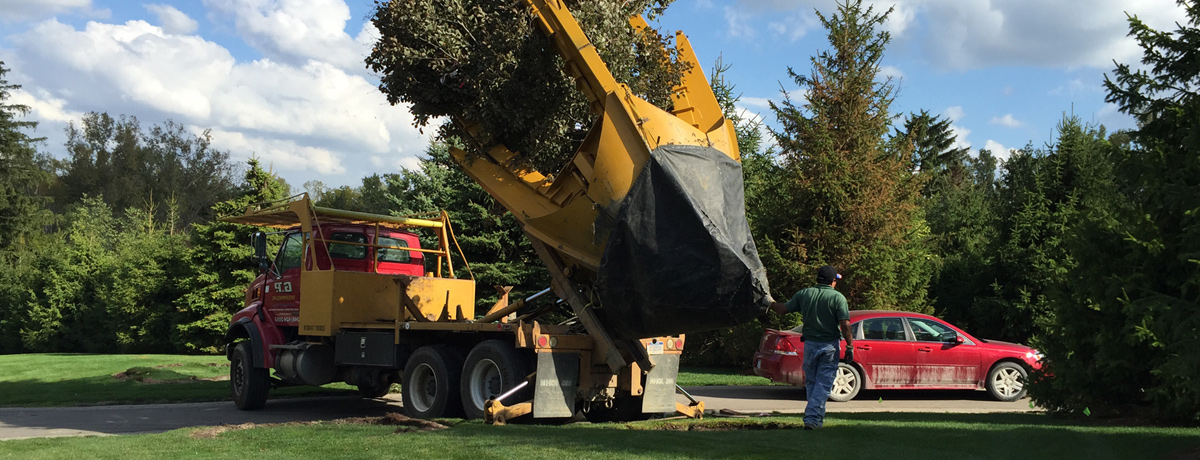
A recent housing developer near the Norfolk town of Diss needed to clear a small woodland in order to build houses. After some consideration, they decided not to cut the trees down. Instead, they relocated them to another woodland 20 miles away and put them back in the ground. 49 trees were relocated in total.
The project won an award for its approach, which is considered very unusual. But tree relocation itself isn’t a new idea, and others have done it with much bigger trees in the past. The oak and beech trees relocated in Diss were 10 to 15 years old and relatively small. It is possible to move far larger ones too, with enough money and time, and there is a long history of people with resources attempting it.
Marco Polo suggests that if the Mongol lord Kublai Khan liked the look of a tree, he would order it to be relocated to his palace grounds. He used elephant transport, and so the technology to relocate a tree was around in the medieval times. It may go back further, as there are references to moving mature trees in ancient Greek and Roman texts that suggest it may have been attempted.
If you’ve spent any time around English formal gardens, then you’ll know that tree relocation was part of landscape design on big estates. Capability Brown would relocate mature trees into his landscapes to save his over-privileged clients from waiting for them to grow. Charles McIntosh brought full sized trees into his plans for the Botanical Gardens in Edinburgh.
Often the job was done in stages. The trench around the tree would be dug a year in advance and metal rods pushed through underneath the tree. The roots would then grow around the rods, which would help to keep the root ball together when it was moved. The moving itself was done with horse-drawn wagons, with the tree either upright if it was moving a short distance, or lying on its side.
More modern appliances have made the process simpler, with ‘tree spades’ able to lift and move trees with their roots for replanting. See the video below for a time lapse of how it was done in Berwick a few years ago (including a pause for a photo opportunity with the local council, which is of course an essential part of the process.)
Even when mechanised in this way, it’s still much more expensive to move a tree than to cut it down in one place, plant another somewhere else and wait for 40 years. So it remains unusual, and tends to be reserved for important trees and landscapes.
Should it happen more often, given how important trees are? That’s an interesting question. Even though the biggest roots come with it, the process does sever all the smaller ones and breaks the connection with neighbouring trees. It’s a traumatic experience, and relocated trees are weaker and generally don’t live as long. Sometimes they don’t take at all, something the Diss foresters acknowledge. It’s always going to be better to leave a tree alone, and to design developments around existing trees as much as possible.
From a climate change perspective, a mature tree absorbs far more carbon then a young one. So the idea that we can cut down trees and plant an equivalent number somewhere else is nonsense in the timeframe that matters most. Unfortunately this ‘biodiversity offsetting‘ approach has become part of the planning process in recent years. If a tree absolutely has to go for development, then maybe we should consider moving more of them and preserving the carbon sinks that they represent – but then how much carbon does it take to move a tree? Does the energy needed to move a tree outweigh the benefits?
I don’t know the answer to those questions. Given the cost and uncertainty involved, I suspect that tree relocation is going to remain a niche business, but well done to the developer Flagship Group for spotting an opportunity and going the extra mile with their trees.
 The Earthbound Report