
Here in Luton, we await the government’s decision on whether or not the airport can expand. I fully expect them to wave the plans through, as they did with Stansted last week. Many of Britain’s airports are expanding at the moment, emissions be damned. But for a brief moment, there was a possibility of an exception. Doncaster-Sheffield, also known as Robin Hood Airport, operated international flights from 2005 to 2022 before closing down as unprofitable. As it was wound down, various ideas emerged for how to reuse the site.
What could you put on an old airport site? How could you reuse and transform terminal buildings? After all, airports always have great transport connections for onward travel. If you put a town on an airport site it would come with excellent public transit from the start, and could therefore potentially be a sustainable new community. It would be a shame to hand it over to a logistics park, which is what everything seems to become these days.
Discussions like this briefly thrived around the disused airport, and the architecture firm Alma-nac came up with a thought experiment for a co-living community. They imagined that the site was handed over for community re-use as housing. The runway would be dug up for materials, existing buildings turned into homes and facilities, vast swathes of grass rewilded and planted with trees.
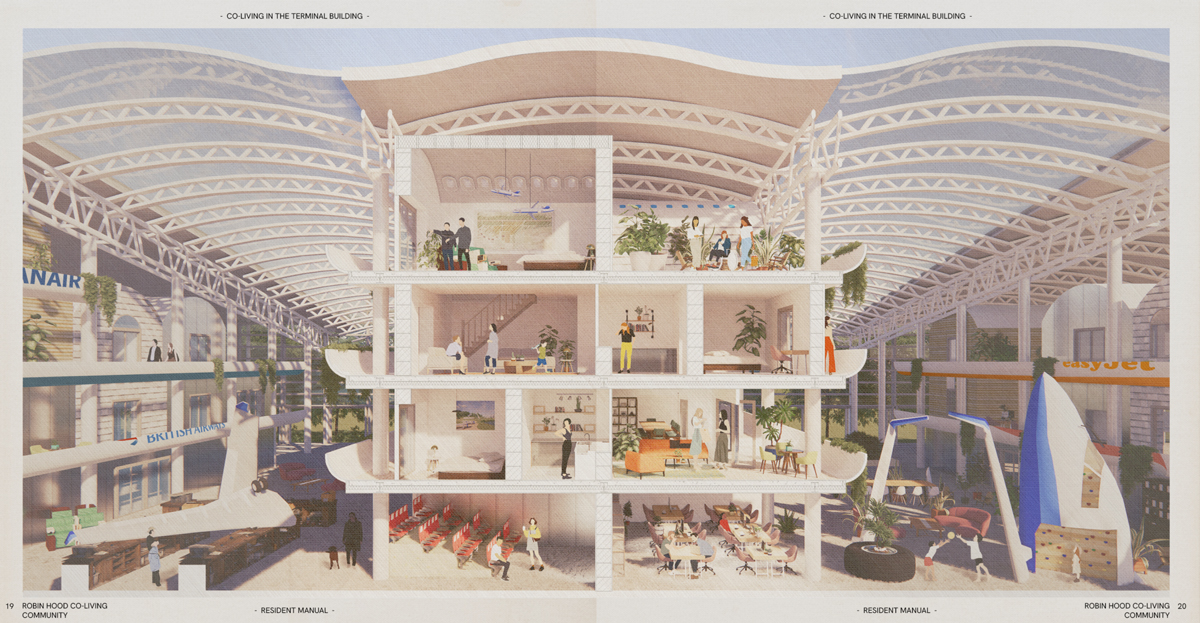
You can see ground layouts and other plans in this entry for the Davidson Prize, an annual design competition that encourages creative and human-centred architecture. The theme for that year was reuse, and so Alma-nac proposed reusing everything on site including obsolete airliners.
Break down a passenger plane and you get structural elements that could be the frame for greenhouses, or windows that could be reused as skylights. They imagined small maisonette homes with slices of aeroplane fuselage for a roof. The seats are reused in a cinema in their proposal, although the climbing wall inside an upright nose cone (bottom right above) feels like a stretch.

None of this amounted to much more than an interesting idea, because this sustainable neighbourhood was never commissioned. After sitting empty for a couple of years, plans are now underway to get Doncaster-Sheffield Airport open and flying again. The site has been taken into council ownership, and it is being pushed forwards as a source of local jobs and economic growth – very much like ours is in Luton.
Still, perhaps there are a handful of ideas here that might themselves get reused. If Easyjet have a plane they don’t need any more, I know some community gardens that could do with a greenhouse.
- For another imagining of a sustainable community in an airport terminal, of the more post-apocalyptic kind, see Emily St John Mandel’s Station Eleven or the TV series based on the novel.
 The Earthbound Report