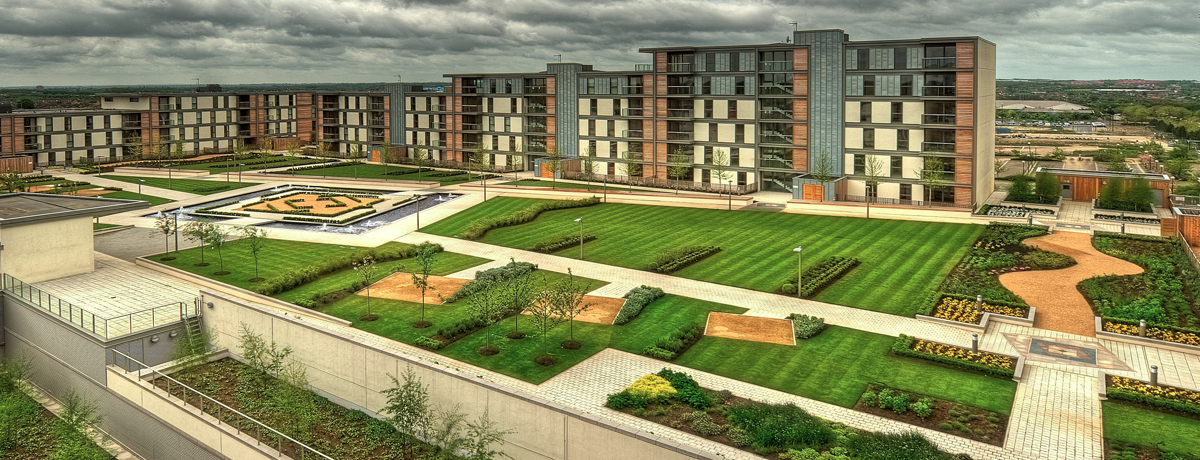
I don’t usually have much business there, but for various reasons I’ve had to make multiple trips to the city of Milton Keynes this month, 45 minutes up the road. On the last trip, for a conference on climate change and health, I met a man named Chris Bridgman who installs green roofs. Milton Keynes, it turns out, is home to several of them.
There are green roofs on a school, a community centre, the Open University. The mall has one, and there’s particularly large and impressive roof garden on a branch of the Sainsbury’s supermarket.
Eight floors up on the roof of the YMCA you’ll find the Green Roofs Project, a ‘living lab’ that serves as a demonstration of what you can do with rooftops, and the heart of MK’s little movement for green roofs. It has growing spaces that produce food for the cafe downstairs, a bee-hive, and it serves as a learning space for training young people in the installation and maintenance of green roofs.
A couple of years ago I wrote about Rotterdam’s innovative rooftop strategy, and how they were putting roofs across in the city for community, energy, biodiversity, arts and culture. It turns out there was something similar happening closer to home, and I’d love to see a bit more of that green roof action down the road in Luton.
Beyond the obvious fact that anything unusual on a roof is instantly interesting to people on the ground, there are several reasons why we should invest more in green roofs. Take the schools that I work with. Some are on tight urban sites with little green space. They are prone to overheating in summer and flash flooding in heavy rains. A green roof would help with all three of those problems.
One school I visited recently has a sewer for the whole neighbourhood running underneath the building. That recently filled up so much during a heavy rainfall that it pushed up the drains and flooded the corridors and walkways. A big contributing factor was the run-off from the school’s huge flat roofs, dumping too much water into the drains all at once when they were already overloaded. A green roof can catch and slow rainwater, allowing it to soak away at a more manageable pace.
Since warmer air carries more moisture, these sorts of events are more likely in a changing climate, so green roofs can be a form of climate adaptation. They would also help to cool buildings during the summer – overheating is the most common climate impact experienced by schools in the UK, which were not designed for current weather.
Hopefully more schools in Milton Keynes will discover these benefits for themselves if the city’s strategy succeeds. And perhaps it will inspire and inform others as they consider the advantages of green roofs.
 The Earthbound Report