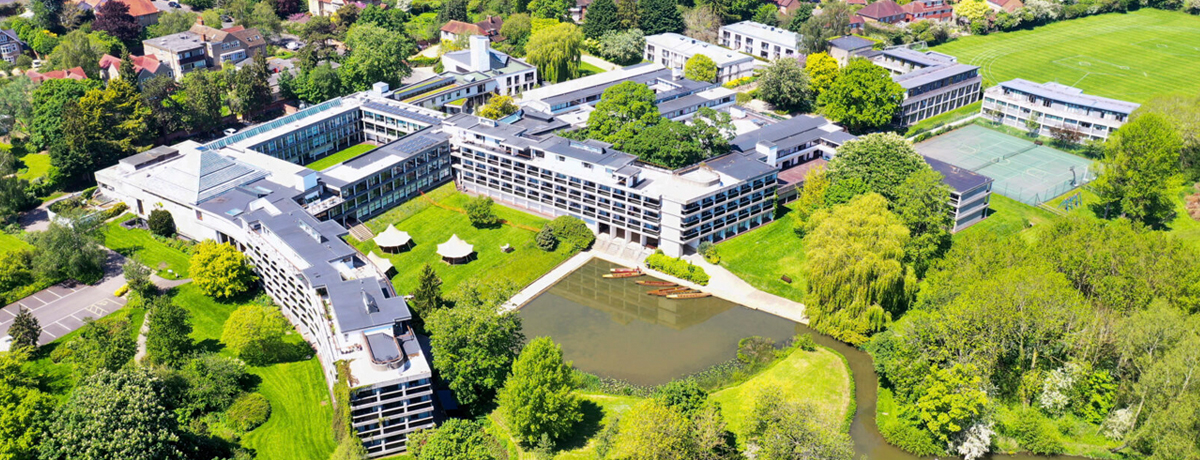
As I’m spending so much of my time helping educational institutions get to net zero, I’m always looking out for people who have already done it. There are a handful of schools that have reached zero emissions, and Wolfson College in Oxford claim to be the first to achieve it in higher education.
Oxford colleges evoke ancient quads in honey-coloured stone, and Wolfson College is not that. It’s just out of town in a 1974 build in steel and glass, from noted modernist architects Powell & Moya. It’s more attractive than many buildings of its era and grade II listed, but it was never energy efficient and burned a lot of gas to keep all those plate-glass corridors warm in winter.
The college began working on this 2010, adding a first heat pump and solar panels. Work to genuinely decarbonise began in 2020 after declaring a climate emergency. (Hey, look – someone who did the climate emergency thing and meant it!) They replaced over a thousand panels of glass and fitted new prototype insulated window frames, which dramatically reduced heat loss without changing the look of the listed building. Then they electrified their heat.
Wolfson invested in seven heat pumps across the estate, connected into a campus-wide heat network. This is the first time it’s been done in the UK, so it’s a useful demonstration project that shows how localised heat networks can work for campuses and other multi-building sites.
With no gas burned on site, they eliminated their most direct sources of carbon emissions, known as Scope 1. Scope 2 are the emissions from fossil fuels burned on your behalf, mostly in power stations supplying electricity. Wolfson switched to renewable energy to eliminate those as well.
Scope 3 are the emissions in the supply chain and aren’t generally within an institution’s control. Wolfson have taken steps towards reducing these too. For example, they were getting 70 van deliveries a week either to the college or to students living on site. They partnered with a local cycle courier called Pedal & Post so that most last-mile deliveries now get to the college with zero carbon.
An electric minibus shuttle service runs students into the town centre. The college have also divested from fossil fuels, and on-site catering has reduced meat consumption and cut out single use plastics. The rest of its Scope 3 emissions depend on suppliers doing their own decarbonisation, so that’s about as near to net zero as anyone is going to get right now.
At Let’s Go Zero, my job is to help schools get to zero carbon by 2030. It feels like a tall order sometimes, with such big problems and so little money available to do it. But places like Wolfson show what’s possible, and we need to learn from those taking these steps first.
 The Earthbound Report