People have been tapping the force of gravity for centuries to get work done. The area where I live had a number of water mills in the medieval era, all running off the power of falling water. Hydropower uses the same logic, generating electricity from water running downhill.
There’s an important role for gravity power in the clean energy transition too. As we all know, wind and solar are intermittent, and so we need energy storage to see us through periods of low production. There are multiple ways to do this – I listed ten here – and so far gravity has been one of the most useful.
The world’s largest and most reliable form of energy storage is pumped hydropower, where water is pumped uphill during times of surplus energy production, and held in reservoirs until required. Then it’s released and flows back downhill, generating electricity on the way. For all the hype around batteries, 90% of the world’s large scale energy storage is still pumped hydro.
Pumped hydro is very useful for managing spikes in demand, as it can bring a lot of power online quickly. But it needs a certain kind of landscape. Not everyone has an appropriately shaped and conveniently located mountain they can use, and so a handful of start-ups have been investigating the possibility of raising and lowering weights. I’ve written before about Gravitricity in Scotland, who plan to drop weights down mineshafts to generate power and winch them back up again when those Scottish wind turbines are spinning. They are yet to build a commercial installation, as far as I’m aware.
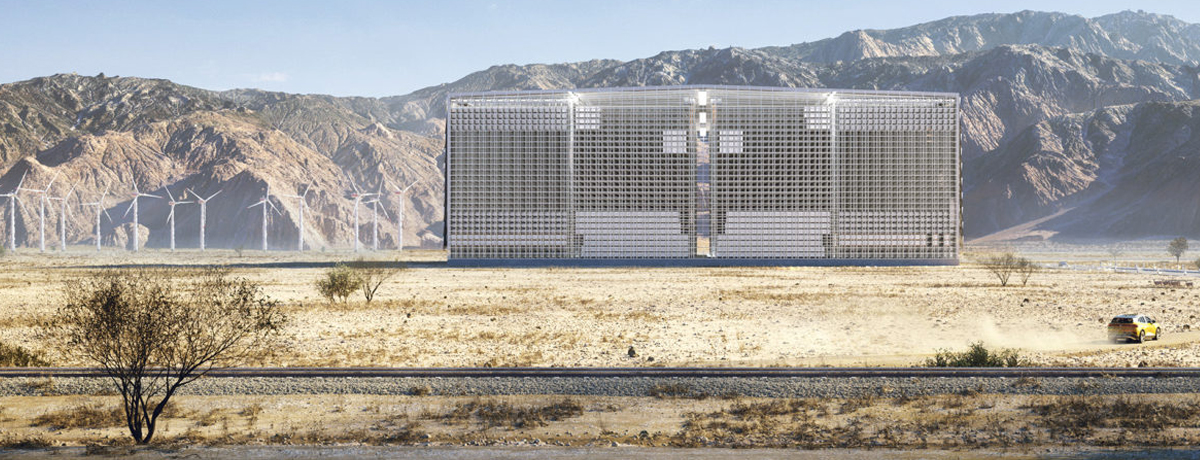
Energy Vault is attempting something similar, though they do it without the mine shafts. Instead, they construct a huge grid of steel shelves and a system of pulleys and cables that can raise and lower heavy blocks. It’s mechanically simple and durable, and modular construction means it’s easy to scale. The blocks don’t need to be concrete either, as the embedded emissions would be enormous. Energy Vault use composite blocks of press materials sources locally.
A few years ago we had some prototypes around a crane which generated a lot of interest online. Then they released some glossy concept images like the one above. Their first full scale project is being built right now in China, and so we get to see what one of their gravity batteries looks like in real life:
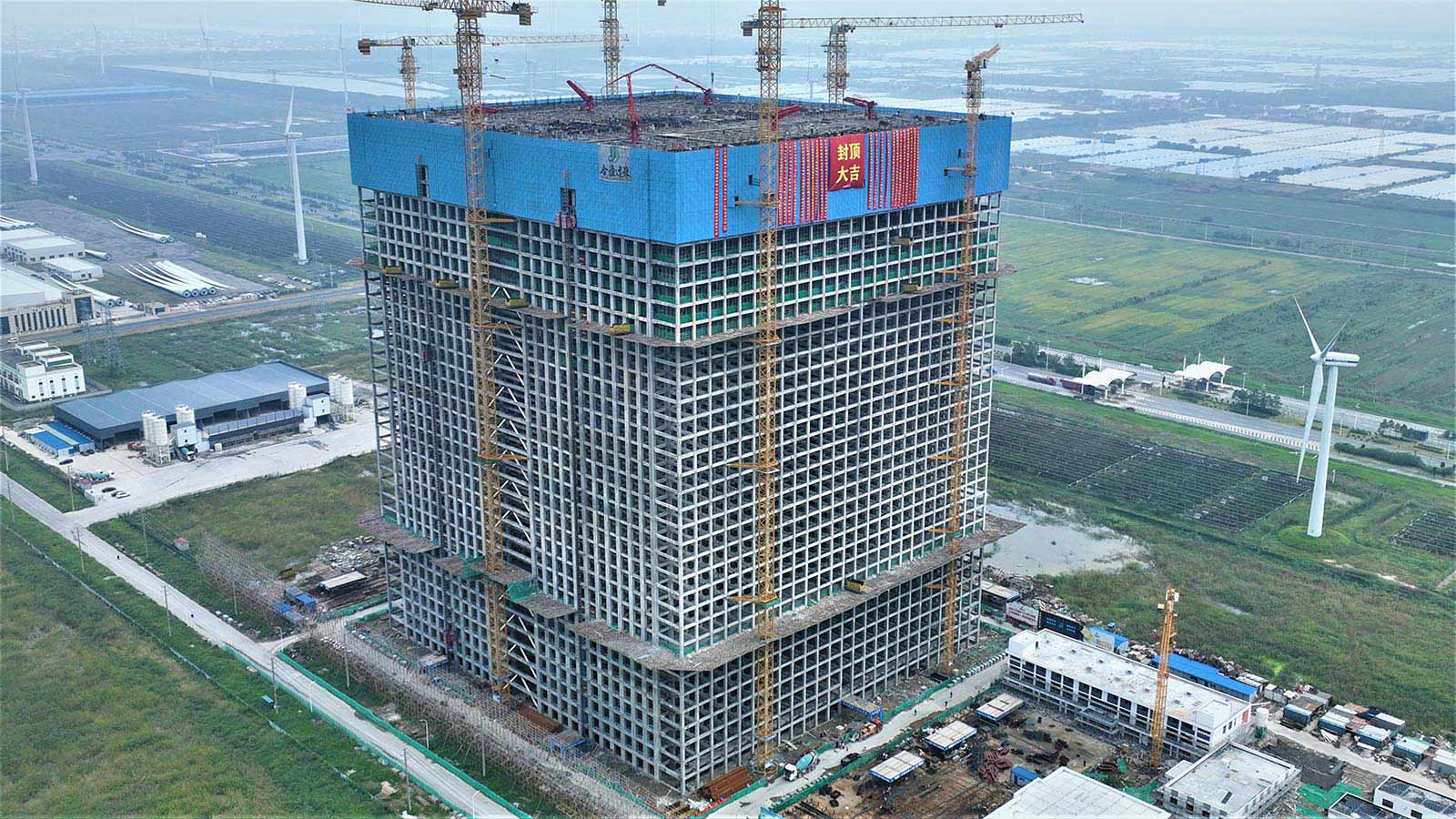
Inside this monolith, computers will control the raising, storage and lowering of composite blocks. It can store 100MWH of energy from the solar and wind farms nearby, and generate a maximum of 25MW of power as needed – so it can run for four hours at peak production. That doesn’t sound like very much to me. Britain’s largest grid-scale lithium ion battery has twice that storage capacity on what looks like a similar land footprint, and all at ground level. This is a technology that needs a lot of space.
Despite being such a vast structure, towering over those neighbouring wind turbines and dominating the landscape for miles around, this isn’t the largest of Energy Vault’s projects in China. Others are under construction and China seems to be backing the idea. It’s hard to imagine anyone applying for planning permission for such a thing in the UK, and I suspect it’ll be the mine shaft option for us.
This being a global first, it’s too early to tell whether the economics of gravity batteries like this are going to work out. They use no lithium and their capacity doesn’t degrade over time, so they have advantages over batteries. But they’re enormous and use a huge quantity of other materials, and the price of batteries is falling. It’ll be interesting to see if gravity batteries become an established technology of the energy transition, or if they fall by the wayside.
 The Earthbound Report
I remember the first time reading about this idea in your newsletter .
So it’s good to hear updates.
Maybe it’s not viable as you say due to space, but such a simple, clean and effective way. I still find it fascinating!