I get to visit a lot of schools with my job as a Climate Action Advisor, and so I get to see a lot of school playgrounds as well. It’s a mixed bag. I’ve seen schools with exceptional play facilities and brilliant ideas, such as a mini-golf course, BMX track, a bouncy hopper arena, or a quiet writer’s shed full of books, paper and pens. Other school playgrounds can be a little depressing, especially in urban settings.
It wouldn’t be fair to blame the schools for this. School budgets are tight. It’s hard to justify new playground equipment if you also need new toilets or a new boiler. But when I see children running out to play in featureless patches of asphalt or grass, I do long for something better, a national vision for quality playgrounds and imaginative play. Britain’s children don’t deserve anything less, and we don’t need to look very far to find inspiration.
The city of Paris has a plan for its school playgrounds. It has transformed dozens of them already, and hopes to get round all 700 in due course. It’s a plan that simultaneously makes them more fun and better suited to a changing climate.
The scheme is called Oasis Playgrounds, because the city suggests that school grounds and other public spaces can function like an oasis during heatwaves. As the world saw during the Olympics Games last summer, Paris is vulnerable to heatwaves. Part of the plan is to make playgrounds cooler in summer, and more resilient to extreme weather. The name Oasis is also an acronym for their guiding principles. Perhaps they lose something in translation, but those princples are Openness, Adaptation, Sensitisation, Innovation and Social Ties.
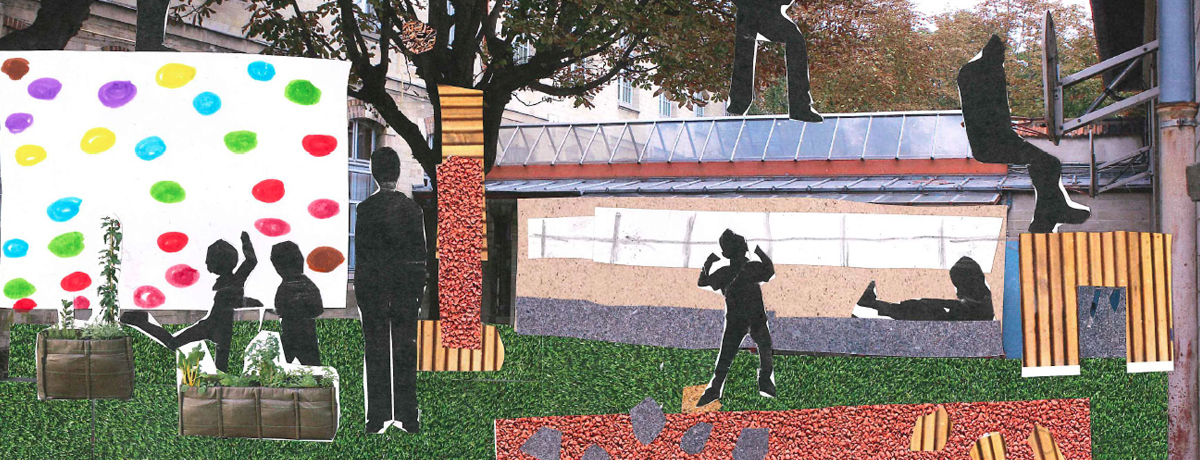
Many Paris schools have playgrounds like the ones I encounter sometimes in London or Luton, little more than flat concrete or tarmac yards. “Adieu bitume” says the Oasis project, and digs this up. Tarmac absorbs heat and water runs off it during heavy rainfall, increasing the risk of flash flooding. They add grass, sand or bark chips instead, stepping stones, decorative walls and a variety of surfaces. They also vary the terrain, unflattening it and adding little hills and dips, embankments and ramps. These cleverly incorporate drainage systems to manage stormwater, but they’re also play features. They’re designed to get children improving their motor skills in ways that aren’t possible on flat concrete, through balancing, jumping and climbing.
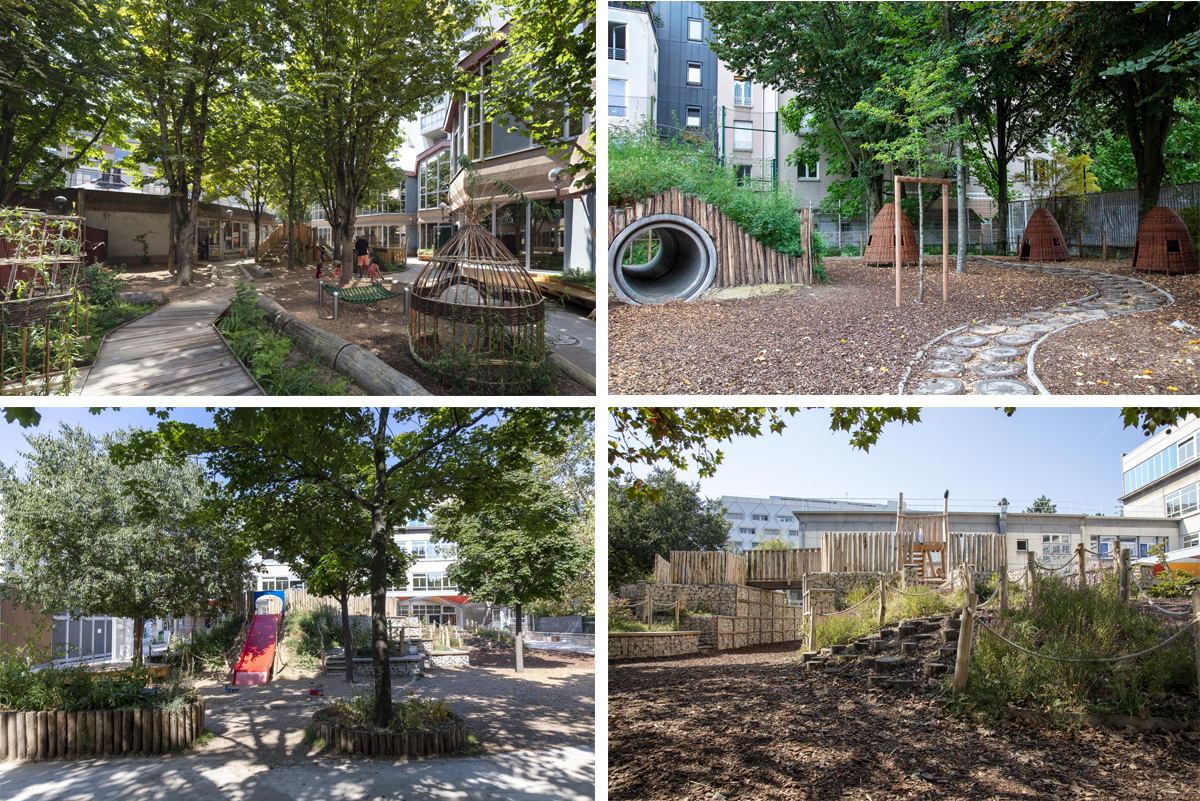
Like any oasis, shade is a priority. Existing trees are incorporated into the designs, with paths and decks and seating areas that draw children into the shade. New trees are planted, and shade structures such as canopies, trellises and pergolas are installed. Water helps to cool the city too, so some school playgrounds are being fitted with water features, including fountains, sprinklers or little rivers that children can splash in.
Along with trees, Oasis use greenery to ‘soften’ the hard lines of urban playgrounds. They use hedges and climbing plants to hide bare concrete walls and break up stark boxy boundaries. They use drought-resistant plants and species that encourage biodiversity. Every school gets a growing space as well, and all of this is done with an eye on participation. Sites are co-designed with children, often with open community work days so that families can help to build the new school grounds they have imagined together.
There’s a gallery of Oasis playgrounds online, courtesy of urbanism thinktank CAUE, so the rest of us can draw ideas from what Paris is up to. Other places around the world have taken note, and the Oasis team have already provided training to other French cities, and partner projects in Belgium, Denmark, New York City and New Zealand. They’ve written up their recommendations for everyone else to download and learn from.
As far as I’m aware nobody has picked this up in the UK just yet, but the needs are similar. Research suggests that at two degrees of warming, schools in England could experience overheating for a third of the academic year. Half of schools are already at risk of flooding. A national plan to transform school grounds would get ahead of these climate adaptation issues and deliver better, more imaginative and more fun playgrounds at the same time. Shall we do it?
 The Earthbound Report