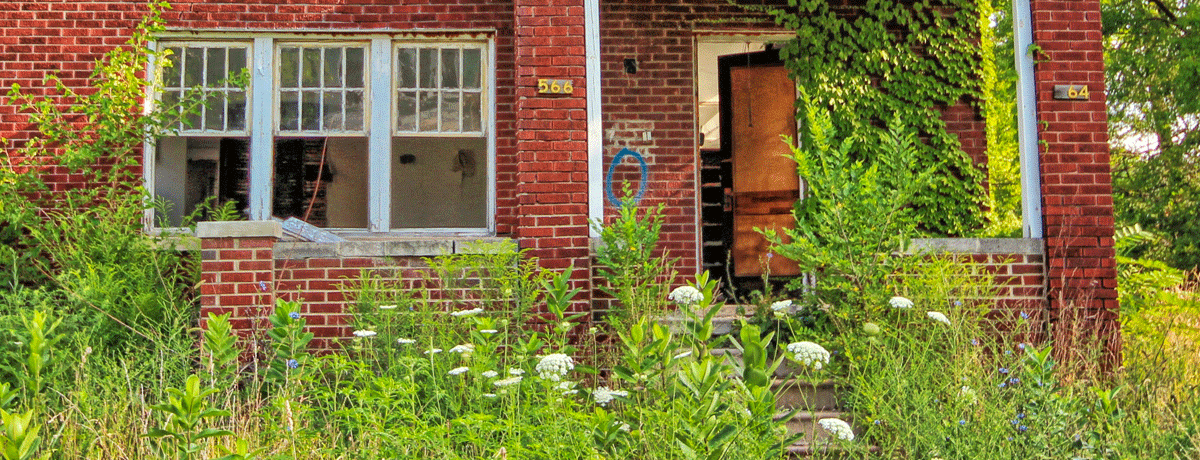

From slag heaps in the Lothian to the ‘urban prairie’ of Detroit, Islands of Abandonment is a nature book of a different sort, seeking out resurgent nature in ruined places.
There are four main types of landscapes, Cal Flyn suggests. There is pristine land untouched by human activity, land that has been reshaped for production, such as agriculture or forestry, and ornamental landscapes. Flyn’s interest lies in the ‘fourth kind’, those that emerge by themselves after being abandoned. The life found in these places isn’t necessarily a return of what was there before. It’s a “fresh wild”, a new ecosystem of its own.
Written as a first person narrative, Flyn describes her journeys to some intriguing places. There’s the evacuated city of Pripyat, next door to the Chernobyl power station. We visit the buffer zone between Greek and Turkish areas of Cyprus, and an overgrown botanical garden in Tanzania.
Each chapter combines travel writing and science, as the author ducks through fences and encounters the plants and animals making themselves at home in the dereliction. Chapters explore different facets of the ecology of abandoned places, investigating invasive species, forest transitions, indicator species. A visit to the polluted waters of the Passaic looks at how creatures can develop chemical resistance. The chemical plants here once produced DDT, agent orange and dioxins. The water is utterly toxic, and somehow the Killifish found here are an estimated 8,000 more resistance to the poisons than the same fish found elsewhere.
The chapter on Detroit explains domicology, the study of the life cycle of buildings, the stages of decay and how nature breaks them down. In the forest of Verdun, still off-limits due to the weight of unexploded ordinance from the First World War, we read about plants that only grow where there are specific metals. Geobotanists can identify 27 different plants that grow in soil that is polluted by copper and cobalt.
Richly descriptive and full of scientific and historical asides, Islands of Abandonment will appeal to those with an interest in derelict places – and the number of Instagram accounts dedicated to abandoned places suggests that’s a considerable audience. But this is also a nature book that raises some important questions for conservation. We protect what we find pretty, and so ruins – especially industrial ones – aren’t usually valued. As it happens, they can often be very biodiverse, and some have been named as places of special scientific interest.
Not only that, the ecosystems that emerge on their own can often be more sucessful than attempts to remediate the landscape. That’s not to say we can ignore all the places that have been wrecked by human activity. It’s more a suggestion that we should act with humility and not assume that more human meddling is what the land needs. For all its melancholy tone, there’s a hopefulness about the book. All is not lost. The possibility of healing remains.
“It is not only big, structured conservation projects that offer a return of the wild, but the scrappy abandoned car park at the end of your road. Consider it, and every one like it, a tiny islet in an archipelago stretching over the whole world, stepping stones for species as they recolonise what was lost.”
- Islands of Abandonment is available from Earthbound Books.
- Feature image by Daniel Tuttle
 The Earthbound Report
I loved this. Brilliant.
Sounds like shades of ,”The Unofficial Countryside,” by Richard Mabey to me.
Definite similarities, though that was out half a century ago and so and there’s both more science and more dereliction to explore. Thanks for the reminder, I like Richard Mabey.