
There’s a persistent problem when it comes to addressing the climate crisis. Polls consistently show that people care about climate change and want to see more done about it, but they’re not convinced that everyone else feels that way. Because we underestimate public support, we hesitate on climate action. Progress is slow and easily reversed.
At its worst, politicians falsely conclude that climate policies are unpopular and that they could win votes by binning them – and nobody calls them to account on that because we think that’s what most people actually want.
Is it possible that the perception gap is one of the biggest things holding back our response to the climate crisis?
A recent global study of this perception gap found that 89% of us want more a stronger political response to climate change. But “individuals around the globe systematically underestimate the willingness of their fellow citizens to act,” says the report. “This perception gap, combined with individuals showing conditionally cooperative behaviour, poses challenges to further climate action.”
‘Conditionally cooperative behaviour’ is an interesting phrase there. We’re prepared to act if we think others will. If we’re convinced that nobody else is doing anything, then why should we? That’s something we hear all the time in different forms. “Why should the UK act if China doesn’t?” is a classic example, which ignores the colossal low carbon revolution going on in China right now.
The study polled 130,000 people in 125 countries, and quantified the perception gap across them all. One question asked people if they would be willing to pay 1% of their income to prevent climate change. Most people said yes – 69% – often with higher rates in countries that were more vulnerable. They were then asked to estimate, out of a hundred, how many of their fellow citizens would do the same. The average guess was 43.
The study maps this gap in actual ‘willingness to contribute’ (WTC) and perceived willingness, across all 125 countries:
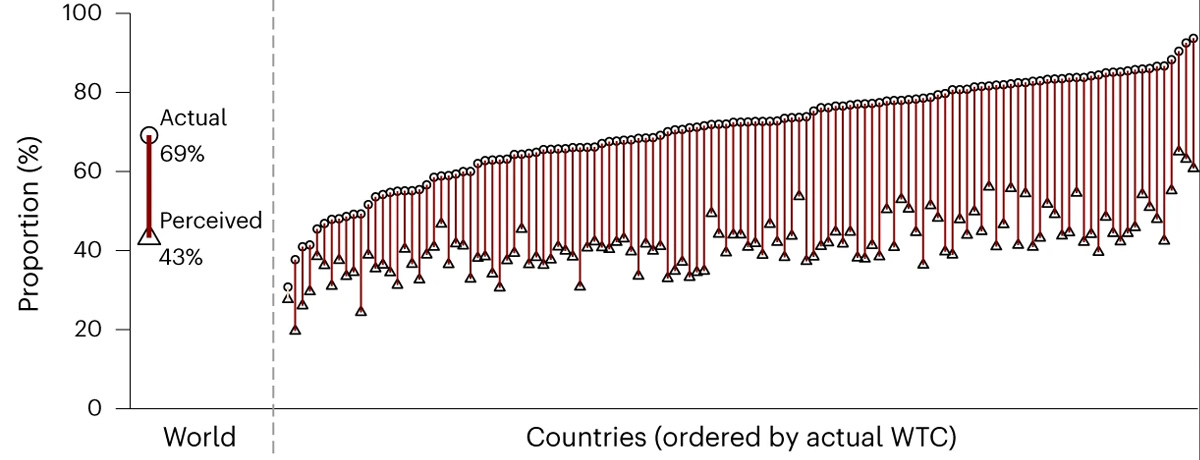
This is why we need stories about solutions and about participation. As the study says, “raising awareness about the broad global support for climate action becomes critically important in promoting a unified response to climate change.”
Bad news sells, and sceptical voices often dominate discussion. Social media amplifies the most contentious opinions, making them look more common than they really are. Behind the noise, far more of us are ready for climate action than we might think.
Tell everyone, okay?
 The Earthbound Report