
After several years of planning towards it, we had a heat pump installed in the house last week. It’s the last step in getting our house to zero carbon – or effectively so. It’s impossible to eliminate fossil fuels in the supply chain, but as a household we’re no longer burning any directly.

As I’ve been doing with each of the low carbon interventions we’ve made to the house, I thought I’d write up what we’ve learned in the process. There is a lot of interest in heat pumps at the moment, with the government providing a significant grant towards their installation. There are adverts on UK television at the moment reminding everyone of this, because we need to be fitting a lot more of them. The government’s advisory body, the Climate Change Committee, suggests that half of all UK homes will have heat pumps by 2040.
At the same time, there’s a huge amount of misinformation out there. It’s not news if something just works, so heat pumps are almost exclusively featured in negative headlines. There is also a deliberate effort to discredit heat pumps. Talk about them on social media, and suspicious strangers turn up in the comments telling you they don’t work. So we need success stories and personal experiences. Here’s mine.
When we moved into our house, it had a relatively new gas boiler. It was an early combi, quite efficient and it’s done well for itself. As of this year it would be 20 years old, and parts are no longer available for it. So we knew we had to replace it anyway, and have been planning to shift away from gas this time.
Our house is a 1920s mid-terrace, and it isn’t big. When I first looked into heat pumps, it was clear that it would be a challenge in this property. There was nowhere obvious to put the internal fittings, and our garden isn’t big enough to give us the legal clearance from neighbouring homes. Even if we could afford it, it didn’t look likely.
Things have shifted since I first did that research. You don’t need planning permission any more. There are new heat pumps that run on different temperatures that aren’t as invasive to fit. And there’s that aforementioned government grant. Internal space was still a problem, but last year we decided to do some remodelling to the house. While we were doing the extension, we could plan in a plant room. I had first looked at heat pumps ten years ago and ruled them out for us, but it’s now viable.
I started by doing some research into our exact heating needs. I used an online platform called Heatpunk for this, building a digital model of our house that detailed the thickness of the walls and the location of existing radiators and windows. This was more technical than I’m normally comfortable with, but my heat loss calculation turned out to be identical to the one the professionals created later, which is a testament to Heatpunk’s ease of use.
The heat loss calculation gave us the size of heat pump we would need (5 to 6kw) and an indication of which rooms needed upgraded radiators. This information helped us to budget, and to know whether we were being sold a larger heat pump than we needed.
I looked into a variety of companies that could do the install. We narrowed it down to two, Octopus and Aira, both of whom supply heat pumps that are suitable for retrofits and older pipework. Aira’s guarantees and installation processes bumped them to the top of the list, and their engineer came out to survey the property and design a system. This took a couple of hours, most of which consisted of him measuring rooms and making videos of where things would go.
Our installation fell somewhere between a new-build and a retrofit, and we had a checklist from Aira of fittings to put in place. Cold water supply to the internal plant, connections to the heating system, drain for the hot water tank. Flow and return pipes, power cable and communication cable from the location of the internal to the external units. Enough free slots on the circuit board for the electrics. Our builder took this in his stride.
A lot of this is work that an installer would do themselves on a retrofit job, and it’s the bit that I found most stressful. I expected us to miss something, despite going over that checklist multiple times. As it happens, everything slotted in exactly where it was meant to go. The electrician spent a morning on the wiring where it would normally be a two day job, and everyone got to finish early on the Friday and go to the pub. The only thing we got wrong was the pipework for a new radiator, which was 5mm out of alignment.
The installation itself took five days. Everything was delivered and put in the right places on day one. Radiators were replaced upstairs and downstairs on days two and three. By the end of day four the hot water was running off the heat pump, and on day five the gas boiler came out and the gas supply was capped. Things were carefully sequenced so that we were never without heating or hot water overnight.
It was a team effort. We had a lead engineer who was there for all five days, with plumbers and electricians coming in on various days for different parts of the job. Much of the last day was the project lead working to complete all the detailed pipe cladding.
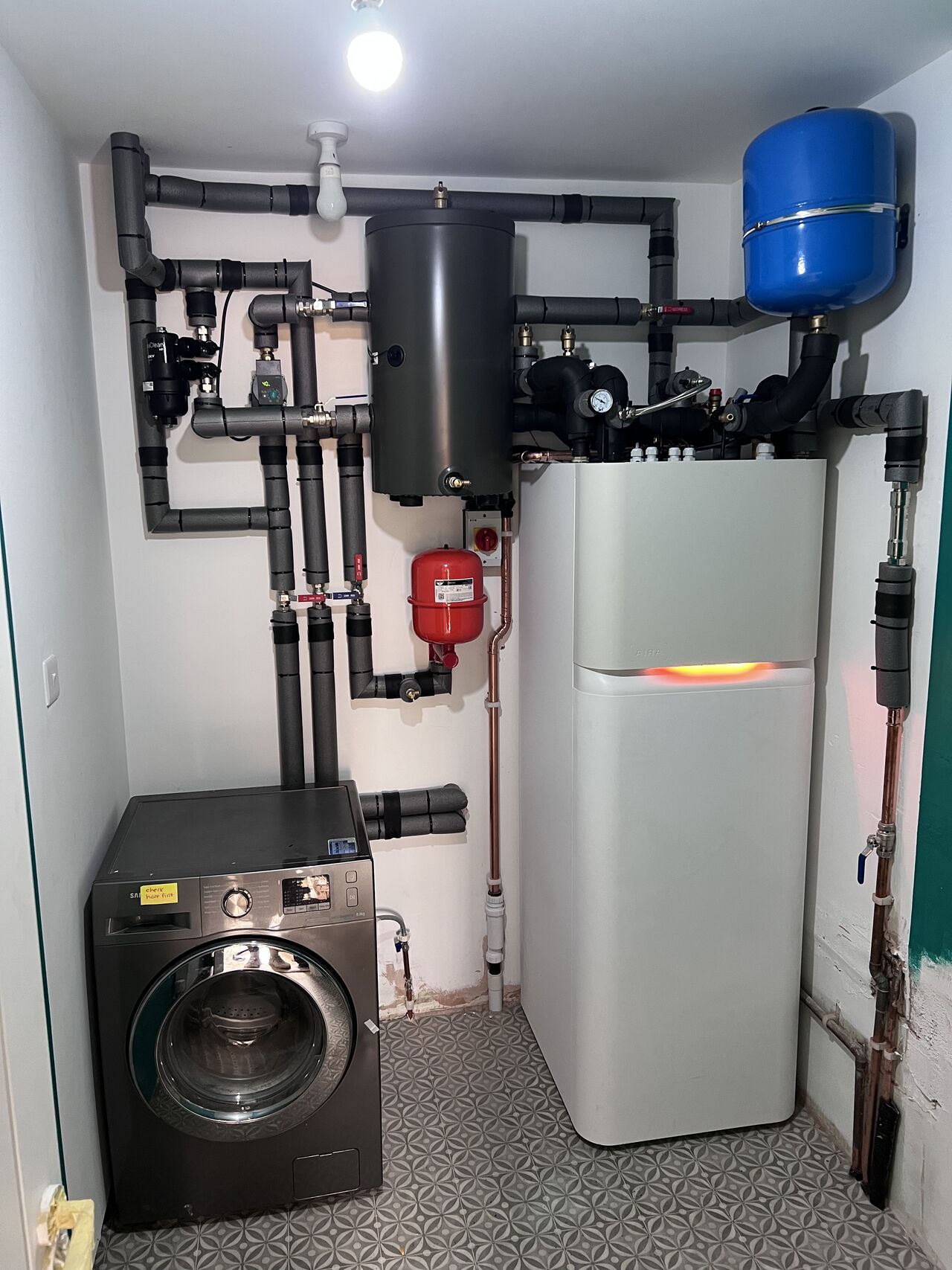
The inside unit now looks like this on the left – and it’s always the external units that feature in the marketing brochures, right? The big white unit that looks like a fridge is the hot water tank, with a smaller buffer tank for the heating and two expansion tanks. All told it takes ten times more space than the old gas boiler, plus the external unit of top of that. It can be tucked in more tightly than we have here, and some people manage to cram it into old airing cupboards. We let the engineer use the space, and it will all be tucked out of sight behind sliding doors in a utility room very soon.
Besides this room, there are no visible insulated pipes running around the house. The pipework to the external unit runs through the floor under the extension. The connection to the existing heating system runs up through the ceiling in the top left of the picture here, and runs under the bath to the old boiler cupboard. We didn’t need to rip out any copper piping and install wider pipes either. Other installs might not be as neat.
It should go without saying that heat pumps are better designed in from the start, and should be standard on new homes. Some smaller homes or apartments may be better with an air to air heat pump – common in many other parts of the world – rather than the air to water system that we have here. A friend of mine from New Zealand shifted his home off gas this way. But if you can retrofit a 1920s terrace to zero carbon standard, you can do most homes.
I’m quite happy with the system so far. The external pump isn’t noisy. Temperatures haven’t been low enough to truly put the heating to the test and might not be until the autumn now, but the hot water is all working fine. I’ll write another update after next winter and let you know how it’s performed, and how our bills compare to the gas heating.
 The Earthbound Report