Around a decade ago, astute observers of the renewable energy market began to imagine a solar powered world. It wasn’t obvious at the time, given the dominance of fossil fuels. But the logic was simple enough: the price of solar was falling so fast that it would soon be the cheapest form of electricity generation. Sunlight is free, so once your panels are installed, solar power will always be cheaper than the alternatives. Slowly but surely, solar power will displace coal and then gas from electricity grids.
Those projections have proved correct, and the economic logic of solar power would be convincing even without climate change. It’s just better all round, and we can now see the results. Solar is in the ascendance, and how fast it moves depends on local incentives and/or obstacles thrown up by the fossil fuel industry and the politicians they can buy.
The fastest moving solar revolution at the moment is in Pakistan, where imports of solar panels have boomed as prices have fallen. The country added 17GW of new solar power in 2024 – that’s more than the entire solar capacity of the UK, installed in a single year. Nowhere is moving as fast as Pakistan when it comes to solar power.
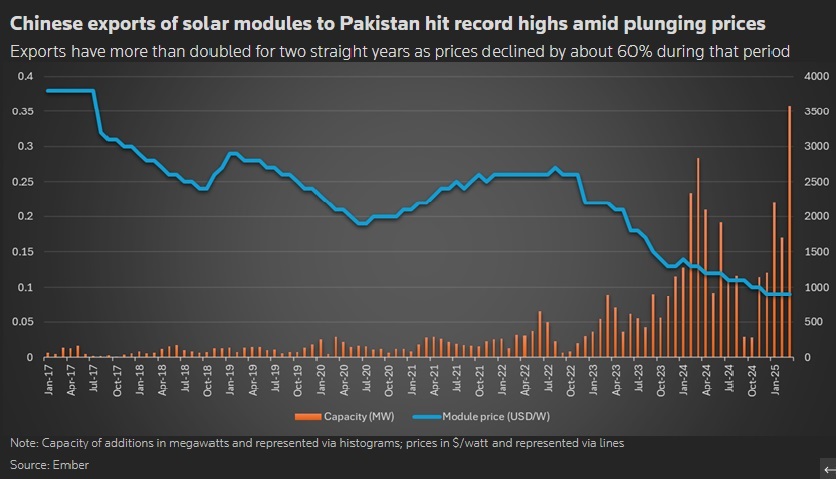
Like any big change like this, local factors have a huge role to play. In Pakistan’s case it’s not just government climate policy or incentives for solar – though there are some – but people responding to higher energy prices, heatwaves, and an unreliable grid.
A boom like this brings problems of its own too. People are choosing to buy solar and go off grid, which puts more pressure on the country’s indebted legacy energy providers. Those who can’t get panels of their own end up worse off. In the background of any solar story, there’s always the uncomfortable facts about why Chinese solar panels are so cheap. Decades of vast state investment, sheer economy of scale, and a significant contribution from forced labour in the Uyghur regions.
All these issues matter, and ideally energy transitions are more carefully planned and with greater transparency in the supply chain. More on such things another time.
For today, it’s worth noting that this looks like a genuine energy transition. It’s fashionable in deep green circles to rubbish the idea of energy transitions. Renewable energy doesn’t displace fossil fuels. It is layered on top of them. Countries didn’t stop burning wood when fossil fuels were invented, or stop burning fossil fuels when cleaner alternatives were developed. The percentages might change in the energy mix, but the actual emissions continue to grow. Jean-Baptiste Fressoz’s recent book More and More and More is the latest I’ve seen making this argument.
This isn’t universal, and it isn’t the case in Pakistan. The government placed a moratorium on new fossil fuel generation years ago, and fossil fuel use for electricity has peaked. Consumption of coal and gas has fallen, and so have total emissions. Something rather remarkable has happened in Pakistan. If it can be sustained and others can learn from it, it’s good news for the climate.
 The Earthbound Report
No.1 Solar Energy Solution Company in Pakistan
Solar Cleaning Services in Karachi
Pakistan’s no 1 solar installer