One of the big obstacles to creating a circular economy is that there’s a big disconnect between producers and waste. Companies create and sell products, and usually have no involvement with waste disposal. That’s done by an entirely separate industry or by local government. Even if a company wants to take responsibility for the waste they produce, there is rarely a clear route back from the customer. We end up with expensive schemes to post things back or find a drop-off point. You have to be pretty committed to use these, and if you have to drive across town to drop off your handsoap dispensers or used felt tip pens, is there any environmental gain?
This disconnect also means that companies don’t know what happens to their waste. They can switch to recyclable packaging, but they can’t know for sure if people are disposing of it properly, or how much of it is getting recycled.
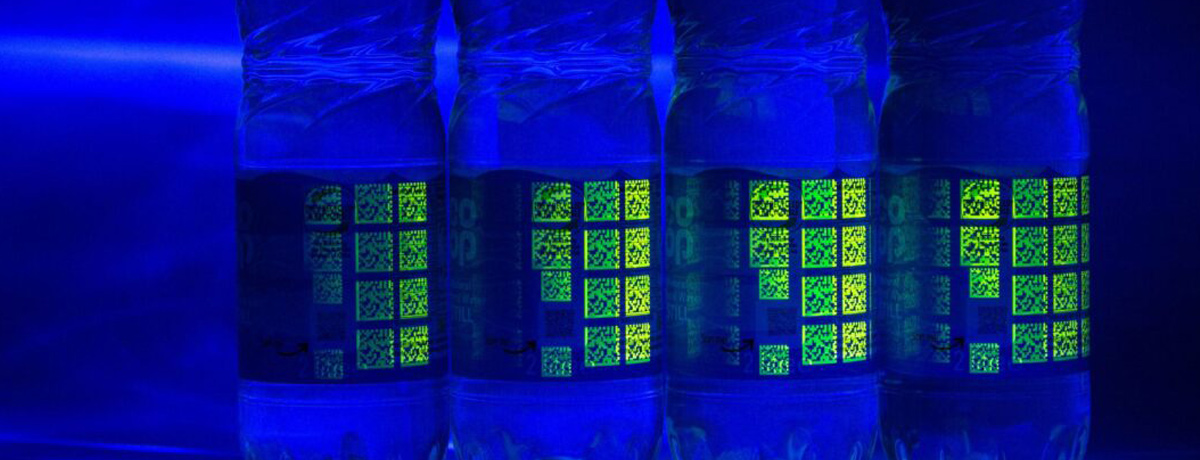
Polytag is a company that has spotted a gap in the market for better data in the recycling process. They’ve developed a method for adding invisible tags to packaging, similar to QR codes and easily added at the labelling stage. These can be read under UV light, and scanners to detect them can be added to the conveyors at waste processing plants. Because most waste in the UK goes through large centralised processing plants, they’ve calculated that they can scan 90% of the country’s recycling by installing around 40 scanners at waste sites.
There are lots of applications for this technology. One is to help with sorting mixed recycling, which refines the waste stream and delivers higher quality bales of waste materials.
The data produced by these scanners would be useful to the companies, so they can understand what happens to their packaging. If recycling rates of a particular item are low, companies would know that they need to explain themselves better on the packaging. Polytag don’t make a big deal of it, but if you’ve got data on exactly what is being recycled, you could also charge the appropriate companies for it. Wouldn’t it be great to be able to charge the likes of Coca Cola s small recycling fee for every bottle of theirs that goes through a council waste depot? Polytag’s technology could power extended producer responsibilty.
Polytag’s codes can help with bottle deposit schemes too, making it easy and using existing recycling habits. Consumers would be able to scan codes on packaging and get paid as they recycle, without the need to drop off bottles at a reverse vending-machine or bottle bank. This isn’t theoretical – a trial with Ocado recently saw 20,000 people claim a reward for recycling. Since the tags are unique, companies don’t need to wait for the government to sort out incentives for recycling. They can just do it themselves. (As a reminder, the government’s bottle return scheme was announced in 2018 and is expected to begin in October 2027)
Recycling is not the big solution to plastic waste in a circular economy. But better data would open up new possibilities, and a growing list of companies are on board. I’ll be keeping an eye out for more on Polytag as retailers and producers adopt the system.
 The Earthbound Report