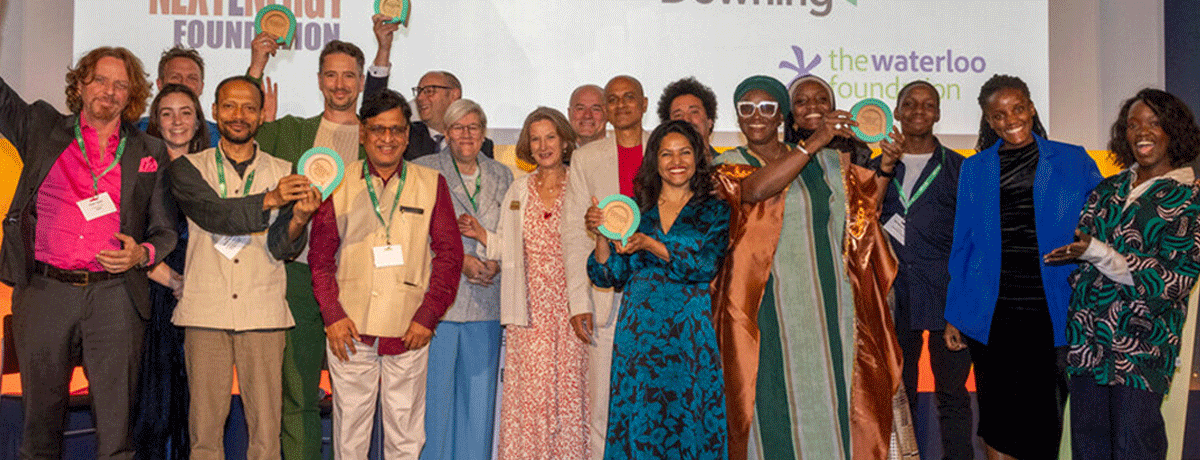
The Ashden Awards were held last night, marking 25 years of the awards for climate innovation. To mark the occasion, four previous winners were honoured with outstanding achievement awards, in a ceremony presented by Myra Anubi, with special guests Vanessa Nakate and UK Climate Envoy Rachel Kyte. Two new winners also took home awards, Emergent Energy in the UK and Sosai Renewable Energies from Nigeria.
The awards were set up by Sarah Butler-Sloss, who told the story of their genesis at the ceremony. She had been researching the connections between sustainability and poverty in Africa, recognising that clean energy could be a powerful tool for improving people’s lives – an idea that was ahead of its time in the 1990s. A particular moment of inspiration came when visiting schools in Kenya, and noticing the difference between kitchens that cooked on traditional three-stone fires, and those that had more efficient cookstoves. The traditional fires burned more wood and were thus more expensive to run, and the smoke filled the kitchen, blackening the walls and harming the health of the cooks. Clean-burning cookstoves were healthier, cheaper and quicker. The technology was available, and so the challenge was to popularise them and help the manufacturers to scale up and meet demand.
The purpose of the awards is to showcase these sorts of ideas, bringing attention and funding to organisations with outstanding solutions, and helping them to accelerate their impact. As Butler-Sloss noted, the concept was proved in year one, when one of the winners returned home and was greeted at the airport by the president and a crowd of journalists. The award helps to draw in both investors and policy-makers, with Ashden providing support to help them grow and take advantage of the attention.
Over the years the awards have evolved, adding a second stream for UK innovators in 2003, alongside winners from the global South. The focus has remained on inclusive solutions, ones that bring the benefits of clean technologies to those at the margins, including awards for those working specifically in refugee contexts. There was also a series of awards for sustainable travel, clean air, and awards for schools.
Ashden itself has evolved in response to the awards, developing an alumni network for the growing number of winners, and launching various supporting projects. For example, when the National Trust won an award in 2006 for its sustainability initiatives, they were inundated with queries from people who wanted to learn from them. That led to the forming of Fit for the Future, a sustainability learning network for the heritage sector. Other projects within Ashden focus on forests, affordable cooling technologies, or renewable energy.
In total, there have now been 271 winners from across Asia, Africa and the UK. Many of them have successfully grown into much larger organisations, reaching millions of people. Some have gone on to further recognition, such as S4S in India or D.Light in Kenya, both of whom have won the Earthshot Prize. The winners and their projects are what the awards are all about, so while I wanted to write about the awards themselves today, I’ll feature a series of winners in the weeks to come.
- More about the awards here
 The Earthbound Report