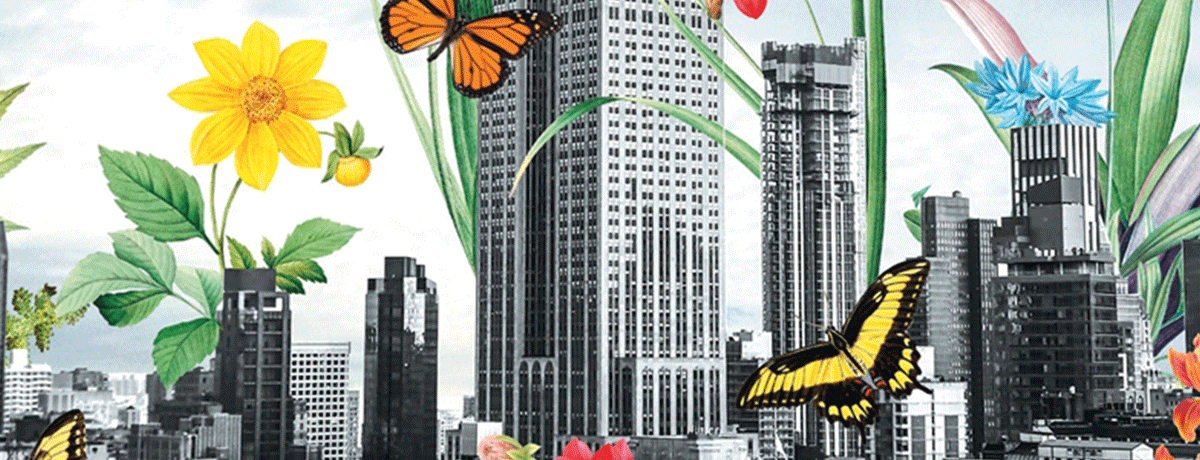

“This book, I should say at the outset, is against green cities.”
That’s the contrarian premise of The City of Today is a Dying Thing, from Irish sociologist Des Fitzgerald. You don’t need me to tell you how counter-cultural that is. Visions of greener cities are ubiquitous, from simple plans for more street trees to Saudi Arabia’s grandiose desert follies. I am myself very much in favour of greener cities – sorry Mr Fitzgerald – but I nevertheless rather enjoyed the book.
Why? First, because it’s entertaining, irreverent and witty. More importantly, it’s insightful and curious and proves that you don’t have to agree with an author to find their book useful.
Fitzgerald is pretty fearless in his unpopular opinions. “I hate Paris” he says uncompromisingly. Copenhagen, a city that I loved and would happily have moved to on the spot, is written off as “just about the most miserable and isolating place I had been to in my entire life.” Because he is smart and informed enough to warrant an audience, my response to these sorts of declarations is to read on and find out why one might hold such views.
As the arguments of the book unfold, what emerges is a knot of questions around urban greening. It’s not that a street tree is bad, but it’s complicated. Green cities aren’t an easy answer to anything, and we should be wary of the idea that inserting ‘nature’ into cities can fix bad design.
What is nature anyway? This is a recurring theme. Anthills and bird’s nests are nature. Who decided that human constructions aren’t? Buildings are made of clay and stone, sand and gravel. Even concrete is made of natural materials in combination, but lies outside the definition of ‘natural materials’.
How natural is the nature in cities anyway? Wildlife in cities aren’t glimpses of wild nature in the streets, they are urban creatures like we are. Isolated trees and green walls can be entirely artificial, an illusion of nature. They can also be imposed on cities in simplistic and idealistic ways, drawing on ideas of biophilia or neuroscience that may not be as universal as some people claim. Besides, how much of this is cultural – do people think greener cities are better because that’s an inherited common sense, rather than an objective truth?
A lot of the research into the benefits of greener cities, Fitzgerald points out, comes from the US in the 1970s. American cities were at peak dysfunction at that time, the utopian approaches of modernism had been found out and were collapsing. We should be careful, the book argues, that our vision for the cities of the future aren’t driven by prejudice against cities – and the density and diversity that they represent.
The book takes a variety of case studies from history and from the present, and illuminates the philosophy behind them, often with a visit to the place or a conference about it. Victorian parks may be a beautiful legacy, but for the capitalists who paid for them they had an explicit purpose, aimed at pacifying and civilising the workers. One chapter looks at King Charles’ model town of Poundbury, and the underlying assumptions behind its traditionalist architecture and design, another at Port Sunlight, or the garden city movement. What these examples show is that greenery in cities can be political. It can be a tool of social control. It doesn’t make urban greenery wrong, but it is more complicated than it might appear.
That much I would agree with, and it goes without saying that greening the city has to be done well – unlike the ill-fated Marble Arch Mound that is gleefully deconstructed in the book. But I think being against greener cities in general is a problematic position to take in an age of climate change. Trees and green spaces have an important role in climate adaptation, cooling the city and reducing the urban heat island effect. Often the sacrificing of nature in cities is to do with car culture rather than architecture, something the book doesn’t get into. There is power and politics in the absence of nature too.
Fitzgerald is aware that he’s out of step, and admits that “I wrestle with my own cynicism.” He likes cities as they are, but beyond offering “a resolutely affirmative view of city life,” we don’t get much of a sense of his own preferences. The subtitle of the book suggests a search for the cities of tomorrow, and I’m not sure any answers emerge by the end of the book – but I do have some better questions, and that’s useful enough.
- You can buy The City of Today is a Dying Thing from Earthbound Books
 The Earthbound Report