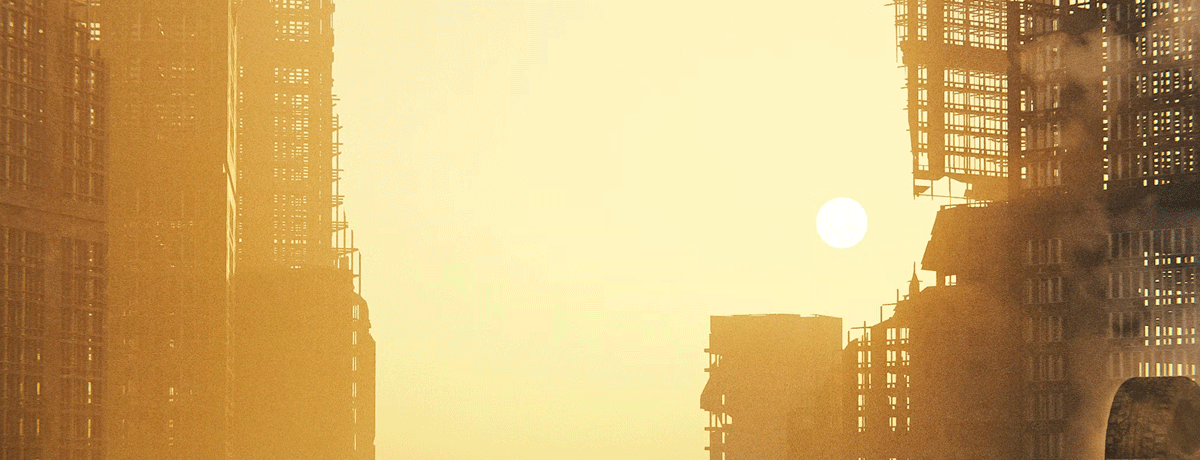

Over the last couple of months I’ve read a number of books about the future, both positive and negative. It wasn’t particularly intentional as a programme of reading, but it’s been an interesting exercise in comparing and contrasting. Everything Must Go fits well into the theme, as an examination of apocalypse in popular culture.
People have always thought they were living in the last days for one reason or another. Journalist Dorian Lynskey traces the various fears and preoccupations that have gripped humanity at various points, teasing out observations along the way.
This giant literature review starts with the book of Revelation and predictions of the second coming. It looks at the ‘Great Disappointment’ of 1844, when the Millerite movement waited in vain for the return of Christ and then had to sheepishly get on with their lives. Speculation about the Antichrist endures. Ronald Reagan was apparently guided by the book of Revelation in his Cold War policies and today, tech billionaire Peter Thiel is a self-declared expert on the topic. (He claims to give JD Vance “feedback” on US foreign policy based on his understanding of Bible prophesy.) The poet Byron, meanwhile, shocked his audiences with a the entirely Godless apocalypse in his poem Darkness.
Byron and friends seemed to tap into a cultural ennui with their stories of the last man on earth, and great cities in ruins, which became something of a trend. More usually our fears of the end seem to be prompted by specific things. There’s a chapter on comet lore, a recurring terror throughout human history. This was generally unscientific hysteria until paleontologists began theorising that the dinosaurs were wiped out by an asteroid.
Things tilt after the First World War. Where end of the world fiction was mostly natural disasters, after the war man-made apocalypses rise to the fore. That accelerates in the nuclear age, which provides Lynskey with rich cultural pickings. The book hops from Oppenheimer and the development of the bomb, to Kubrick’s Dr Strangelove or Dylan’s Hard Rain, Planet of the Apes, the Twilight Zone and Raymond Briggs. It’s a sequence that could include Katherine Bigelow’s new film A House of Dynamite, which I watched last week.
Moving on through hundreds of different sources, the book discusses pandemics, collapse, zombies and AI overlords, all with intellectual curiosity and perhaps a little glee. A lot of books on my own bookshelves get a mention, from Kurt Vonnegut and J G Ballard to Margaret Atwood’s MaddAddam trilogy, Emily St John Mandel’s Station Eleven, Colson Whitehead’s Zone One, or the ingenious short stories of Ted Chiang. I too apparently enjoy the end of the world.
With climate change, genocide, COVID and the rise of AI, we seem to have lot going on right now. And it’s been that way for a while: from the millennium bug onwards, Lynskey notes that apocalyptic fretting has broken the historical pattern somewhat. It’s now “all flow and no ebb”, with a majority of young people convinced that humanity is more or less doomed. What does this do to us, culturally and individually?
Lynskey doesn’t draw many conclusions. The book presents 200 years of fiction, film and rumour about the end of the world and lets readers make their own observations. Perhaps there is something reassuring about the fact that people have always worried about the end of the world. It puts our own fears into perspective, and brings some humility to our chronocentrist tendency to make ourselves the most important moment of history, the most consequential generation. Knowing the history of these ideas can equip us to ask better questions of our current risks, sorting the real ones from the fearmongering.
However much I enjoy a good dystopia, I do wonder if it is so pervasive today that we can no longer imagine good outcomes. And if we can’t imagine them, we won’t work towards them. That makes me think about Sarah Housley’s book Designing Hope, and the need for futures literacy. And while I really enjoyed Lynsky’s gallery of apocalyptica, it’s Housley’s book that I’d recommend reading first.
- Everything Must Go is available from Earthbound Books
 The Earthbound Report
Thanks for the review and I now have two books to add on the to read pile. Thinking positively of the future is so important for us working in sustainability – just to help us keep going. With this in mind I recommend Rob Hopkins’ Falling in Love with the Future.