Here’s an image I came across on social media recently that I found useful. Yes really, something useful on social media. That doesn’t happen often anymore, though I should point out that it was LinkedIn, which used to be the most boring and staid of all social media platforms and now feels like the only one that’s still worthwhile. It’s an image from the infographics newsletter Made Visual Daily. Here’s the image, and some observations on it below.
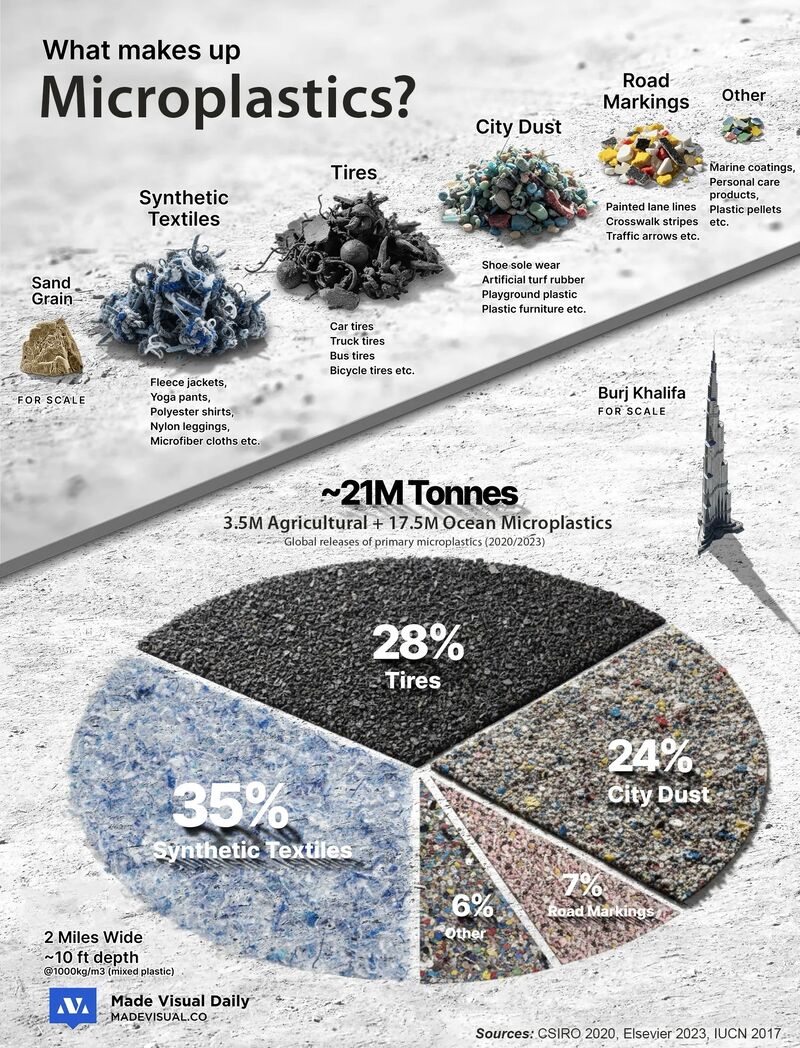
I posted a similar graph last year in a post about road markings, but this one is more visual. What struck me this time is the potential disconnect between the sources of microplastics and general awareness of them. Arguably the most high profile consumer based campaigns have focused on microbeads in cosmetics, which would be a small part of the 6% ‘other’ category. I suppose this is because – like glitter – it’s added on purpose and unnecessarily. Perhaps because it’s in objects we might have in our houses and so it feels personal, something we can responsibility for.
Other campaigns have highlighted microplastics from clothing, and that feels like a similarly personal target with potentially bigger impact. Are other pollution sources getting a free pass? Some of these feel much more invisible. Is anyone working on them?
One area where there has been some movement is around microplastics from tyres, though it hasn’t been picked up on the consumer side anywhere as far as I know. And perhaps that’s just as well, as the tyre industry is huge, and its pollution problem is not something that can be solved with consumer boycotts or ethical consumer choices.
The biggest step in the right direction on tyres is from the EU, who passed new pollution standards for vehicles in 2024 that include tyre abrasion for the first time. This has made the tyre industry consider tyre durability, and the types of plastic that they use.
The solutions might not lie entirely with the industry either. It may need changes to city infrastructure, filtering stormwater to remove microplastics before they enter rivers and then the sea. Another project, The Tyre Collective, is developing car-mounted devices that capture tyre particles before they enter the environment. So far they’ve developed art projects out of captured microplastics, but they have working prototypes and might be on to something.
If you are in the market for tyres and want to choose one that produces less pollution, Michelin performed best in this study from Germany. They’ve had their eye on this problem for a while, to their credit. Firestone were the worst.
Have you come across any other campaigns or projects addressing the less known sources of microplastics?
 The Earthbound Report
Particles from tyres are regularly quoted in anti-EV propaganda: the claim is that, because of their greater torque and alleged extra weight, they shed more particles than ICEs.