
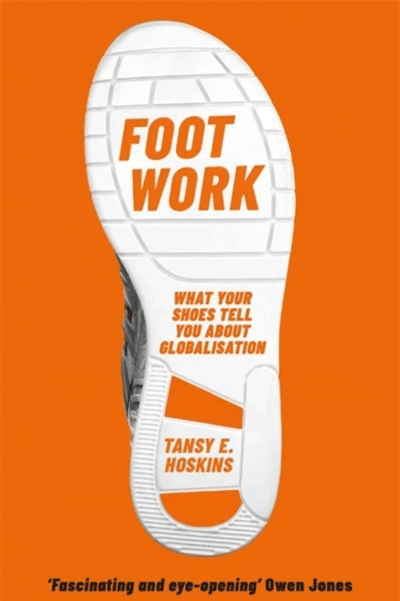
As readers of a certain generation will know, trainers have always been an icon of globalisation. Naomi Klein’s No Logo drew the connections between consumer brands and their exploited labour 25 years ago. Hipsters who had read the book used to black out the logos on their trainers with a marker pen in protest.
Not a lot has changed, as journalist Tansy E Hoskins describes in her book Foot Work, redrawing those connections to see what this very ordinary object can tell us about global power relations.
In the hopeful early rhetoric of globalisation, it was all about shared global culture and widening prosperity through trade. While many still see it as a success story, “the shoes on our feet tell a different story”, and they provide a useful case study in both “the propulsion and the consequence of globalisation”.
The books starts with the propulsion, at Sneaker Con in London, where sneakerheads – mostly young, mostly men – browse rare and expensive trainers. Some have come to buy, with hundreds of pounds ready to spend. Others have come to sell, somewhat desperately in some cases, failing to find the greater fool ready to take their hyped limited editions off their hands. These are not shoes to be worn, but essentially objects of worship. Most of them will never be worn, which goes part of the way to explaining how the world makes 24.9 billion pairs of shoes every year.
24.9 billion pairs of shoes is a number both “wondrous” and obscene, and needless to say it doesn’t work out as a tidy three pairs of shoes each for the global population. Many have none, and a few have lots. In the 80s Imelda Marcos appalled the world with the decadence of her shoe collection. Today she’d be an also-ran among the influencers, celebrities and Youtubers with instagrammable shoe closets and no shame. And before we get distracted by the top 1%, the average woman in the UK had 6 or 7 pairs of shoes a generation ago, and 24 pairs on average today, half of which are never worn.
As Hopkins reminds us, every single shoe on the planet is made by hand, by a real person. The shape and construction of shoes is such that it has never been substantially automated (though a chapter in the book looks at how it might be in future, and what the consequences might be.) There is a huge labour force behind footwear. Most are made by women, almost entirely in developing countries, and often in terrible conditions. Despite decades of activism around sweatshop labour, it remains rife, invisible, and very difficult to address. When scandal hits, brands move factories elsewhere and carry on. If a country brings in new laws to improve conditions or raise the minimum wage, the brands move. If workers unionse, the brands move.
One complicating factor is how many layers there are to shoe production. A big name brand might take reluctant responsibility and inspect its supplier’s factories, but there is no pressure on less high profile brands or unbranded shoes, which make up the majority of the market. Trainers are made from multiple components, and it’s much harder to get consumer attention on things like the leather or plastics industry, or factories making laces or metal grommets. A lot of work isn’t happening in factories at all, but at home through casual labour, the very bottom of the labour pile and with no rights whatsoever.
This vast inequality is a choice. There is nothing inevitable about this, as if it were impossible to pay people more. Hoskins mentions Michael Jordan, who still receives a licensing fee on every pair of Nike shoes sold with his name on them. This amounts to around $300 million a year. That’s enough to pay a living wage to every single person making those shoes with his name on, but the money all gushes to the top, to Nike and its shareholders and celebrity partners.
Hoskins investigates the world of shoes through ordinary people, meeting both sweatshop workers and trainer collectors, and uncovering all sorts of hidden aspects of shoes. The book ventures well beyond labour and branding too, with chapters looking at the environmental cost of shoe production and disposal. Another looks at how demand for leather makes shoe production inseparable from the meat industry, and the associated deforestation that’s a major driver of climate change.
Alongside the voices of real people, which brings these issues to life, Hoskins has an eye for curiosities. We hear about the global warehouses that specialise in matching odd shoes that have been separated in the supply chain of donated footwear. There’s a section on fake shoes, as sneakers are the most counterfeited item in the world. There’s the story of the journalist throwing their shoes at George Bush, an event celebrated with a statue of a shoe in Tikrit, Iraq. There’s an eye-opening history of high heels, orginally popularised by the court of King Louis, and used by men of rank to demonstrate that they didn’t work and expected to be carried. The fell out of fashion with men, but not for women, and feminists are divided on the subject of whether deliberately impractical shoes are empowering or infantilising.
The possibility of progress on all of this is not entirely lost, though Hoskins warns readers not to get distracted by their own personal consumer choices. “Neoliberalism would love for you to retreat to your own cocoon, to focus only on yourself, to perfect your own little space, and feel comfort and pride in your personal choices. But where does that leave everyone else?” By all means think through what you buy, how much you need and where things come from, with the awarness that the real solutions will not be found in shopping. Support campaigns to improve conditions, and push for political change. Governments and legislation will be vital, bringing regulation and scrutiny to supply chains. Since workers themselves are best placed to report on conditions, empowering workers with the right to unionise and speak up is the first priority.
- Footwork is available from Earthbound Books
 The Earthbound Report