Now, more than ever, people need to see that environmental action makes a tangible improvement to their lives. These are febrile times. People want certainty and the safety of what they know. Politicians and the media can easily scapegoat climate policy and erode support for ‘new and untested’ low carbon technologies. Despite the urgency of climate change, everything moves slow, two steps forward and one step back.
This isn’t necessarily a problem with your neighbours and friends. Only 12% of UK citizens oppose government policy on climate, according to a long running government attitudes tracker. That’s not the impression we get from the media, which insists that nobody wants this net zero malarkey. The right leaning newspapers continue to print climate sceptic takes, and the left leaning news outlets endlessly fret about that scepticism. Both amplify those voices, one deliberately and one accidentally, and contribute to the gap between what people think, and what they believe everyone else thinks.
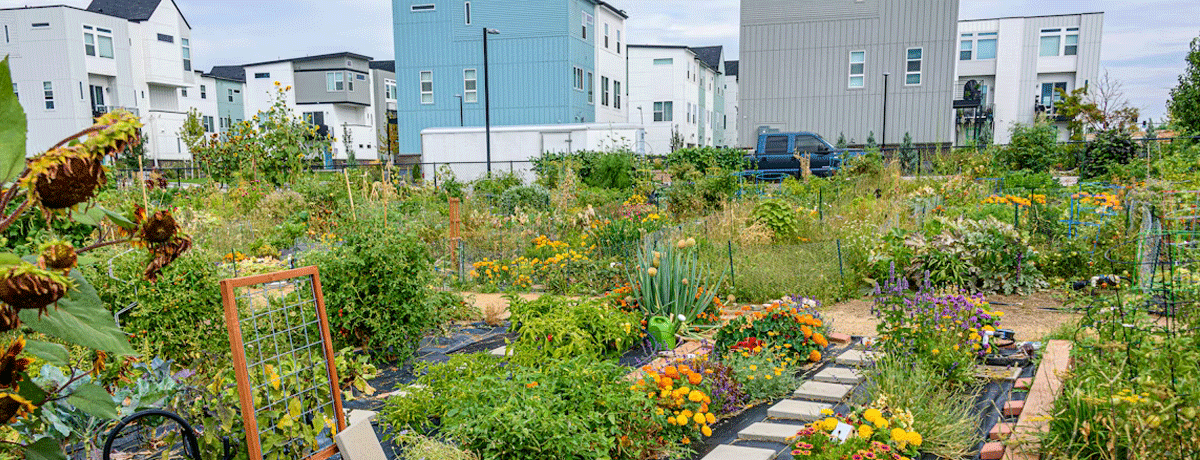
The best antidote to this is to make climate action visible and irrefutable. There are great examples of local projects doing this – community energy, repair networks, forestry and nature restoration initiatives. Some of these are so successful that they spin out into national networks, like the Transition Towns movement out of Totnes, or Incredible Edible from Todmorden. The Edinburgh Remakery spawned all kinds of similar projects around repair and reuse. Lots of people are working ro replicate what Power Station are doing in Walthamstow.
Others look on slightly enviously at some of these examples, as they struggle to rally volunteers and find funding to keep their own project going. So what makes the difference? Are there are any common factors? What can we do to grow more successful and powerful local climate projects, deliver change at a bigger scale, and take the brake off the green transition?
Carbon Copy, as the name suggests, are specialists in learning from and replicating good environmental ideas. They have been asking these sorts of questions, and just released a new report into why some local projects have a bigger impact than others. Last year they researched a range of climate projects and identified a series of case studies across the UK, in nature, renewable energy, the circular economy, etc. They have now analysed those 12 success stories, looking to draw lessons for others looking to run impactful local climate projects.
There are some important findings. One of the most important is that “success is possible everywhere“. This isn’t just for nice middle class market towns. There are plenty of examples that disprove that idea, one of my favourites being Energise Barnsley, winner of a recent Ashden Award.
Another headline is that “success factors can be copied“. That doesn’t mean that projects can be easily replicated, and places are different – “one size does not fit all” is another of the report’s messages. But what makes a project successful isn’t usually unique, and we can learn from what others are doing.
The report highlights three core characteristics that underpin success. One is a mindset of abundance, which is a focus on existing local skills and experience, rather than fixating on what’s missing. This is particularly important when funding is tight, empowering people to look at what they can do rather than what they can’t. A second key characteristic is belonging, a sense of connection with places and communities. Third, successful projects have a clear purpose that motivates and organises people around the mission.
When you put all this together, you get projects that create much bigger change, and Carbon Copy have coined a word for this: a ‘changeprint’. Not to be confused with the ‘carbon handprints‘ I wrote about not long ago, a changeprint is the “positive impacts and consequences beyond carbon reduction of collaborative action… it’s the sum of all the benefits the project generates, such as creating stronger community ties, a healthier environment locally or more jobs.” Unlike a carbon footprint, which you want to shrink, you want a changeprint to be as big as possible.
I’m not convinced by this neologism – isn’t ‘measuring your changeprint’ the same as ‘demonstrating impact’, which in turn is the third sector jargon for what most people call ‘making a difference’? But I do share their ambition to stretch our impact further, and make the green transition real to as many people as possible, and so I appreciate their research.
I won’t repeat what they’ve written, because if you run a local climate project of any kind, you should download the report and browse its findings for yourself. Read the tips at the end. See what you can refine and improve about your work, see if there’s anything you’ve missed or that you could do better. I’ll certainly be thinking it through with my own projects.
 The Earthbound Report