Sometimes when I give talks about energy and carbon, I use the Energy Dashboard website to talk about live energy sources. We get to see how much electricity is coming from wind, nuclear and gas. I point out the red coal label, now joyously obsolete. And usually someone will hear about energy imports for the first time, seeing the electricity coming in from overseas.

The British Isles have a number of interconnectors with other countries, allowing us to share power and balance our respective grids. There are multiple undersea cables to France and Ireland. We have connections to Belgium and the Netherlands, and Germany will be connected by 2028. We can import cheap wind power from Norway and Denmark, the latter hooking up in 2023 with what is currently (and probably briefly) the world’s longest undersea interconnector.
The more connections we have, the easier it is to efficiently manage the variable production of renewable energy. If the wind drops off in Scotland we can draw on nuclear power from France. It’s rare for the UK and Denmark to have the same weather at the same time, which means when one of us has power to spare the other is likely to need it. East-west connections allow countries to shift power to their neighbours in the next time zone, helping to manage morning and evening peaks.
Imagine this power across the globe, linking wind turbines spinning at night to cities in daylight. Imagine Nordic countries powered from desert solar, landlocked regions drawing offshore wind power across continents. Is any of that likely?
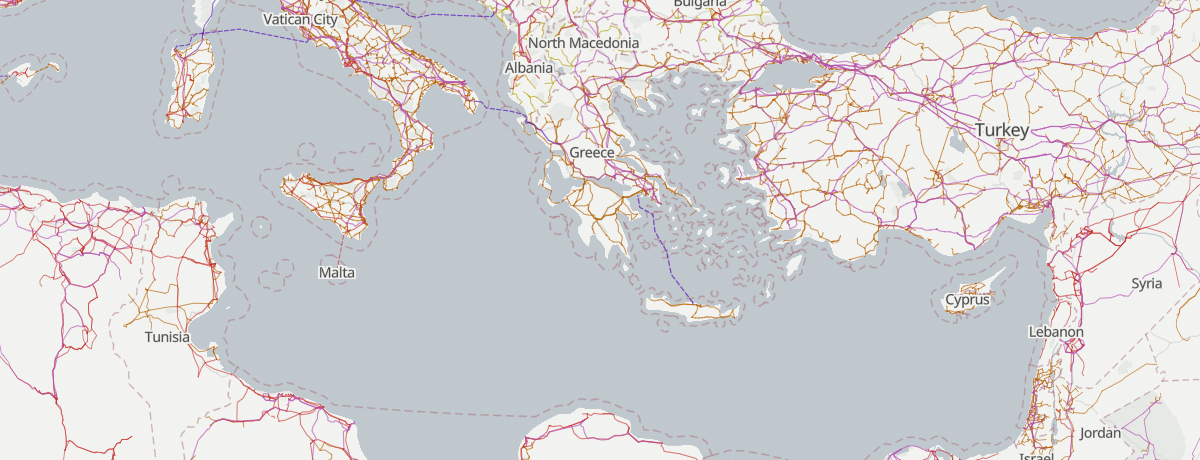
First of all, plenty of regions are deeply connected already. There’s already a super-grid for the EU. Russia cabled up all its neighbours decades ago during an ambitious USSR infrastructure project. India is hooked up to its neighbours, with the notable exception of Pakistan. You can browse the world’s grids on the Open Infrastructure website. Some places buck the trend and don’t even have a national grid yet, like Japan or the US. The US has several grids, for historical and political reasons that I won’t wade into.
The second thing to note is that these regional grids are expanding and linking up. A West Africa network has grown out of Nigeria and a southern equivalent from South Africa, while Kenya and its neighbours are connected in the East. Stretching infrastructure across the continent looks possible. North African nations have already spotted the benefits of connections into the Middle East and Europe, and the potential for energy as a major export. Companies, not-for-profits or development projects form around specific cable ideas, such as Desertec‘s long-mooted plans for Saharan solar, or the Great Sea Interconnector across the Mediterranean.
With these sorts of regional networks growing already, there are various projects to create a global grid or at least to work towards it. The UK’s contribution is a merger between our own Green Grids Initiative and India’s One Sun One World One Grid. Launched at COP26, the merger means we can build from both sides. India is connecting South Asia to East Asia on one side and the Middle East on the other. A second phase would then see that continental grid integrated into Africa. Meanwhile the work goes on to expand expand European connections east towards Central Asia until the two projects meet in the middle.
One Sun One World One Grid, as the name suggests, is focused on delivering a network optimised for solar power. Other plans are broader, and the Chinese non-profit GIEDCO is one of the more advanced. Working as part of the ‘belt and road’ intiative, it ultimately hopes to connect 100 countries and 80% of the world’s population by 2050.
So in answer to the question in the title, yes – we almost certainly will have a global grid eventually. We’re halfway there already. There will be geopolitical shenanigans about it all, for sure. And it remains to be seen how global it will actually be. Some places won’t get a look in for geographical reasons – sorry Madagascar. Others won’t join for ideological reasons, and for practical purposes it might make more sense for the Americas or Australasia to be separate projects. But for those of us on the Eurasian landmass, the supergrid is well underway.


Hi Jeremy, Great to hear you were back engaging with students at Dulwich College (Singapore) yesterday. I was running and (unfair) Monoploy simulation with modified unfair rules and speaking about the differences between equality and equity. I hear lots of great things from teachers and students from your session. Thank you for being so generous with your wisdom and time as I know it was another ungodly hour for you to connect with students! I’m now based in Singapore and making this my home with my girlfriend and her kids for the next 12 months and then it might be to Sydney from there… Will keep in touch and I might be in the UK to work with our UK school, Sherfield, near Reading at some stage near the summer… Wishing bests
d’Arcy.