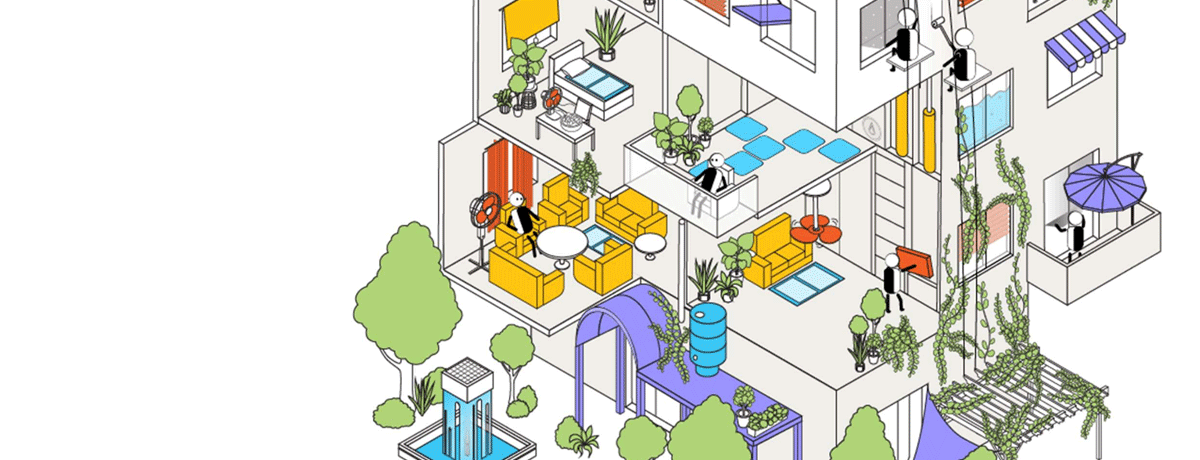
Having grown up in tropical countries, I know the value of shade, the cool and the relief from an oppressively hot sun. On moving back to Britain, I couldn’t help noticing that I was often alone in this. People will sit all day in the sun at the beach or the park, giving themselves sunstroke and blaming it on the cider. Since we don’t tend to seek it out, shade often isn’t provided in ways that it would be elsewhere. Perhaps it’s inevitable in a country known for grey skies, but as a nation, we’re just not that into shade.
What people do in their leisure time is one thing, but the failure to appreciate shade is also apparent in the design of our buildings and public spaces. Shade structures that are common elsewhere in Europe are strangely absent in the UK. Visiting France last year, I bored my family by pointing out the many types of shutters, blinds and awnings fitted to people’s homes. It was the same in Denmark, where I saw apartment blocks with elegant canopies that extended above the south-facing windows. I’ve never seen anything like that in Britain.
This is going to be a problem in a warming climate. People might be willing to put up with a few weeks of heat a year, but the warm season is going to last longer and temperatures are going to be higher. Summer overheating can’t be dismissed as a temporary inconvenience forever, especially in hospitals, schools and workplaces, where people don’t have any choice about being there.
I’ve seen this with my work in schools. I’ve been to schools that reliably overheat every summer. They did so when they opened 50 years ago because they were poorly designed, and it has steadily got incrementally worse ever since. At no point in all that time has anyone bothered to fix the problem, because it’s only a few weeks a year and there’s never been any money for such things. Even the 2022 heatwave and Britain’s first 40 degree temperatures weren’t enough to tip the scales, even though many schools had to shut and send children home because it was no longer safe. How long do we let it run before we call time on overheating, start taking it more seriously and finally come up with some solutions?
Shade the UK is a campaign to raise awareness of shade and its importance in climate adaptation. They hosted an exhibition recently at London’s Building Centre, they’ve published reports on overheating and shade, and they run projects to engage the public in shade and passive cooling techniques.
They are creating a knowledge hub for shade solutions, and are working with partners to develop a building overheating index to better understand the problems.
They’ve also published the Overheating Adaptation Guide for Homes, which you might want to download and browse yourself if you live in a home that overheats – 50% of us in the UK do. The guide has lots of practical solutions and compares their various advantages and costs. They consider renters as well as homeowners. I’m going to ask them if they’ll do a version for schools next.
Shade isn’t just about comfort. It’s also a matter of justice. As I’ve explained before, heatwaves are natural disasters and have a higher death toll than more dramatic disasters such as fires and floods. It is the most vulnerable who are at risk – those with medical conditions, the elderly, people living in cramped and inefficient apartments. Shade can save lives, and in Britain at least, it’s an unsung adaptation solution for a warming world.
 The Earthbound Report