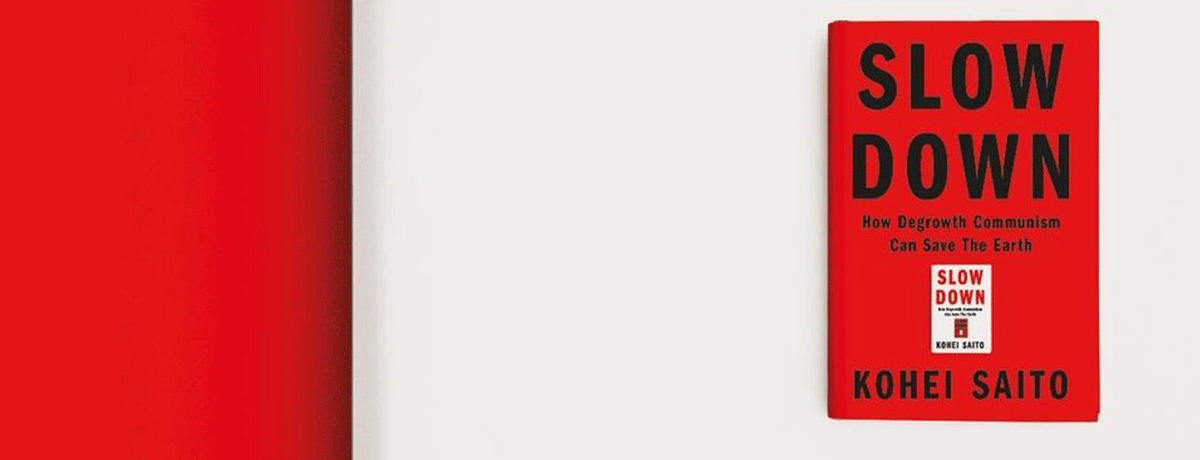

Of all the world’s political ideas, degrowth and communism are among the hardest to sell. One would think then that a book subtitled ‘how degrowth communism can save the earth’ would be of niche interest at best. And yet, on release in 2020, Kohei Saito’s book somehow captured imaginations in Japan. It sold half a million copies over the next two years and started a resurgence of interest in Marxism.
It’s fair to say I wouldn’t have sought the book out without this backstory, but now that it’s here in an English translation and a slightly different title, I’m curious to find out what others have seen in it. Communism has surely been running on fumes for decades now. Are there any susprises left in Marxism?
Saito certainly thinks so. He argues that Marx’s thinking was still evolving at the point of his death, and his planned volumes 2 and 3 of Capital were unfinished. Friedrich Engels subsequently edited together what was available from his friend’s notes, but large parts of the argument were still a work in progress. In particular, Marx had been studying the natural sciences and the politics of indigenous cultures, as part of a theory about the ‘metabolic’ relationship between people and land. He was building an argument for ‘indigenous communism’ as a response to soil depletion, extinction and fossil fuels.
These research notes have never been published and are in practically indecipherable handwriting, which means that even die-hard Marxists don’t actually know where Marx was going with it. Saito has read these notes and draft essays, as part of a global scholarship project on Marx’s writings, and has written entire books on the lost ecological thought that Marx was developing. In essence, Saito suggests, if Marx had completed his work as intended, he would have argued for degrowth communism.
“How far-fetched is this argument?” he writes, anticipating the question. Not far-fetched at all, he insists. How useful is it? That’s another matter. Does the fact that Karl Marx may have been a degrowther make the idea more compelling or less? Presumably it makes it more interesting to those already devoted to Marxist thought, and even more horrifying for everyone else. In other words, potentially a hindrance.
On the other hand, Saito’s findings explain why – despite the ‘watermelons’ insult of those on the right – the radical left has not traditionally been any better on the environment than anyone else. It sketches in the missing ecological dimension of Marxism, shaping what Saito describes as Marxism fit for the anthropocene. That brings a new energy to the debate, and this is what has sparked a reappraisal of Marx in Japan.
As Saito explains in the introduction, previous generations of degrowth writers were developing their theories in the context of the Cold War. That influenced their ideas, making them reluctant to critique capitalism and leaving us with half measures. Growth is so fundamental to capitalism that trying to imagine degrowth in a capitalist context is “like trying to draw a round triangle”. Younger writers have less baggage when it comes to Marx, and can move postgrowth ideas forwards because they’re intellectually free to interrogate capitalism.
Saito certainly feels free to slay some sacred cows, calling the Sustainable Development Goals “capitalism’s last stand”. The Green New Deal is worthless to Saito, so is the IPCC and all your well-meaning attempts to reduce your own carbon footprint. He has no time for the circular economy, electric vehicles, and even declares climate adaptation to be “nothing other than saying climate change cannot be stopped.” For Saito, it’s a straightforward choice: degrowth communism or barbarism.
Not that this is a Soviet style communism. In line with what Marx was moving towards, he imagines more low key mutual aid, worker coops, short work weeks, community ownership and workplace democracy – all things I support, incidentally, without considering them communist.
In short, this is a complicated book. It’s frustrating. It’s overstated at points, and contrarian. It’s also engaging, curious, well-argued and more fun to read than you might expect. There is a good chance that Saito is on to something, and the book’s unlikely bestseller status is a testament to that. Perhaps most of all, it’s an intellectually courageous book, inviting readers to return with an open mind to one of the 20th century’s most contentious thinkers.
- You can pick up Slow Down from Earthbound Books
 The Earthbound Report