
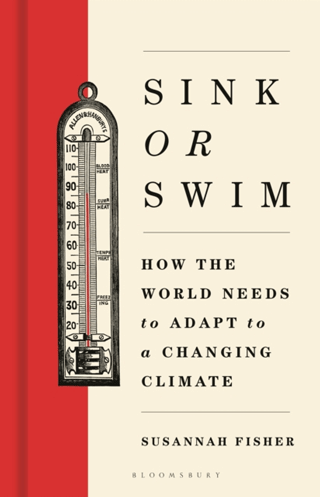
The earlier the world had started to reduce carbon emissions, the easier it would have been. We’d have had time, and activists would never have needed to demand radical action. The same is true of climate adaptation. We are going to have to adapt to a warmer world, and the sooner we do it the better. Leaving it late means doing it urgently, with a much greater risk that it will be done badly.
Susannah Fisher’s book makes this point very clearly, because climate adaptation is fraught with complicated trade-offs. When is the right time to abandon one’s home to changing conditions? Can you still have national sovereignty if your country doesn’t exist? If fish stocks move across international waters because of global warming, who has the right to them? These sorts of questions deserve thoughtful responses and inclusive discussion, because there are no easy answers.
Fisher is a research fellow at University College London, formerly of the International Institute for Environment and Development, and a specialist in climate adaptation. She brings a global perspective to proceedings, drawing on examples from all over the world as the book investigates the issues of people, food, nature and conflict.
Climate change will disrupt each of these. The mounting damage of droughts, rising sea levels or natural disasters will force people from their land, driving migration. Some of these movements will be small scale, involving the local politics of relocating a village on an eroding coastline, for example. Some will be much more challenging, with mass movements across regions and borders, some groups seeking sanctuary and others playing host. Fisher is alert to ‘climate reductionism’ here, and that migration is a complex mix of factors (something Amitav Ghosh also explores in his fascinating book The Nutmeg’s Curse.) Few people would consider themselves exclusively ‘climate refugees’, but a changing climate is a factor in a growing number of migration stories.
The natural world also has to adapt to climate change, moving in response to increasing heat and changing seasons. On the US West coast for example, populations of crabs, lizards and hummingbirds have all shifted north. How will this redefine our categories of native and invasive species? How will conservation identify landscapes to protect and those it should allow to change? Who gets to decide those sorts of things?
There are no ‘solutions’ as such to conundrums like this, but there are stories we can learn from and some useful ideas. Sections in the book look at how early warning systems save lives, and have reduced death rates from natural disasters even as the risk rises. Insurance is an underappreciated tool for climate adaptation, with case studies including Belize, which has insured a vital coral reef. Climate passports are another innovation, giving people permission to relocate as parts of the world become uninhabitable, and they could be very important indeed should entire nations cease to exist in any practical form.
Having read a couple of books that write imaginatively about the future recently, I liked the way Fisher invites readers to consider positive and negative visions of things to come. Each chapter ends with a ‘sink’ scenario and a ‘swim’ scenario, describing the situation in 2070 where people either have or haven’t dealt with the challenges of climate adaptation well.
Climate adaptation remains a quieter side-conversation in climate circles, as debates focus on reducing emissions. Fisher makes a good case for thinking about it before it’s urgent, and Sink or Swim is a really useful explanation of the challenges, the difficult questions we face, and some possible ways through them.
- Sink or Swim is available from Earthbound Books

