
We’re more sophisticated at it now with our gas boilers and internal combustion engines, but humans have depended on a simple energy principle since we lived in caves: if you need energy, set something on fire.
If we’re going to prevent climate disaster, then we need to move away from burning stuff. And while solar and wind power are cleaner and cheaper, there is a trade-off. You can’t stock your woodpile with sunshine ready for the winter. You can’t turn the wind on and off when you want a hot shower. Fuel is portable and versatile. Renewable energy is live and intermittent, and so a clean energy revolution depends on energy storage.
One of the most important forms of energy storage is batteries, and that means materials. Some of these are rare and expensive, and this has held back the development of clean technology. Others have problematic supply chains, with certain countries controlling key minerals, or unethical practices in their extraction. There are concerns about future shortages, potential conflicts over minerals, and some commentators argue that materials is where the clean energy transition will fall down.
I don’t share those fears. I remember making a lemon battery at school. I may not remember why that works – something to do with electrolytes – but it suggests to me that there are diverse ways to make a battery. Let’s not get hung up on cobalt, lithium and lead. Here are some unexpected ways to make a battery:
Salt – China is a decade ahead of much of the world when it comes to battery technology, and there are electric cars and motorbikes on sale already that use sodium-ion batteries. As you might expect, salt is easier to source than lithium. It is a fraction of the price and nobody controls rare reserves of salt. Tabloid scaremongers will be disappointed to learn that salt batteries don’t catch fire. Advanced salt batteries looked improbable just a couple of years ago, but the world’s biggest battery manufacturer – China’s CATL – announced earlier this year that it will be mass producing salt batteries for EVs.
Water – If you can make a battery out of salt, and you can make salt out of seawater, could you just make a battery out of seawater? Good thinking, and there are flow batteries that run on saltwater already. They’re bigger and less responsive than other battery types, so you won’t get one in an electric car. They work well for grid storage instead, coming in modular units built into shipping containers. Here’s one installed at Schipol airport:
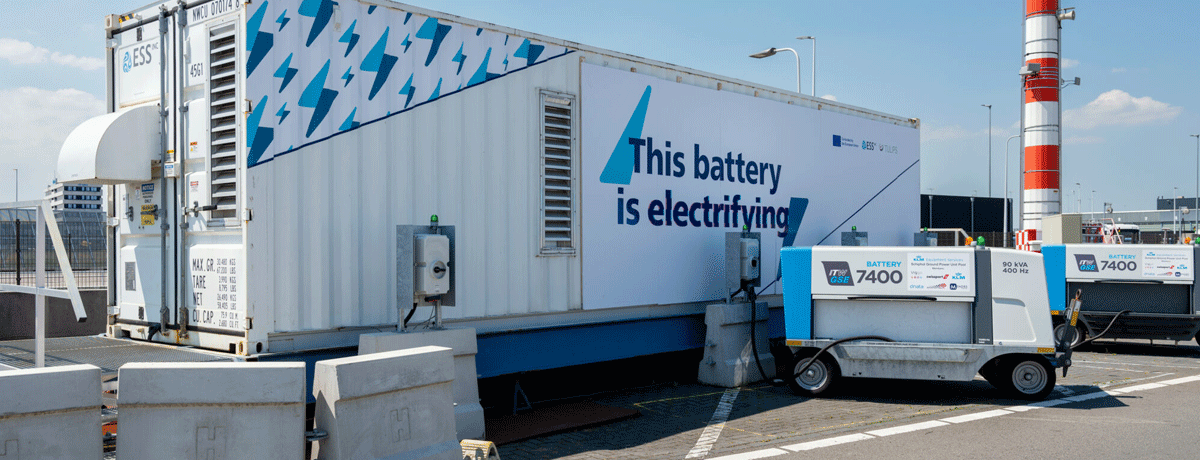
That’s not technically using seawater – just ordinary water with salts and minerals added. Seawater itself is corrosive and if you’re going to use it directly, you’re better off with a non-battery form of energy storage – like this pumped storage system in Japan.
Plants – Scientists everywhere have been looking around for alternatives to lithium. And when Scandinavian scientists look around, they see trees. No, you can’t make a battery out of wood, but there are materials in trees that can be used in batteries. A company called Stora Enso takes a by-product of the paper making industry and creates a material that it calls Lignode, replacing the graphite that is most commonly used in lithium-ion batteries.
We all know that when people start talking about environmentally friendly alternatives, it’s only a matter of time before somebody mentions hemp. If we branch out beyond wood specifically, then there are other fibres that can be used in battery manufacture. Including hemp, sure – though that’s very much a science project at the moment. Japanese start-up JPJ Eye has a battery that currently uses cotton, and their carbon battery could use waste from sugar cane processing and other by-products.
Dirt – If we’re able to use water and plants, how about the most universal substance on earth – the earth itself? Can you make a battery out of dirt, mud or sand? In theory, and making an earth battery is an experiment you can do, like the lemon mentioned above. Practically speaking you won’t get enough direct power out of dirt to run anything, but if we change our focus from electricity to heat, then new possibilities open up. The world’s largest sand battery is in Finland, and stores excess renewable energy as heat. A company in California does the same with high tech bricks. These electrified thermal storage batteries are still relatively rare and that will change – an insulated tank full of sand under a building can store summer heat for the winter, and more buildings will have them in future.
Air – Okay, if we’re just plucking energy storage technologies from the air here, let’s do it literally. Here’s a company in Germany that claims the first air battery, though I think it’s playing fast and loose with the terms ‘first’ and ‘battery’. They’re using surplus renewable energy to pump air into a sealed underground cave, and then releasing it under pressure to generate electricity through a turbine. It’s air-based energy storage and that’s not new as a general concept. Far more impressive is the liquid air storage system being built in Manchester right now, that will be able to power 480,000 homes.
As that last example shows, alternative forms of energy storage aren’t all that alternative any more. Air storage is being done on a large scale. Salt batteries are being slotted into new electric cars right now in China, and those will arrive elsewhere soon – making batteries safer and cheaper. Earth batteries make long term heat storage possible, getting us through colder weather without burning coal or gas. Everything in this article – minus the facetious mention of hemp – is a technology in use today somewhere in the world.
There’s also a huge amount of research going into energy storage and battery science, and we’re nowhere near done with their development. For tens of thousands of years we’ve just set stuff on fire for energy, and we got very good at that. Storing energy is, relatively speaking, in its infancy. There are commercial solutions right now, and many more to come.
The next time you hear someone talking down the energy transition – and that’s just as likely to be an environmentalist as a climate denier – tell them about salt, water and sand batteries.

