
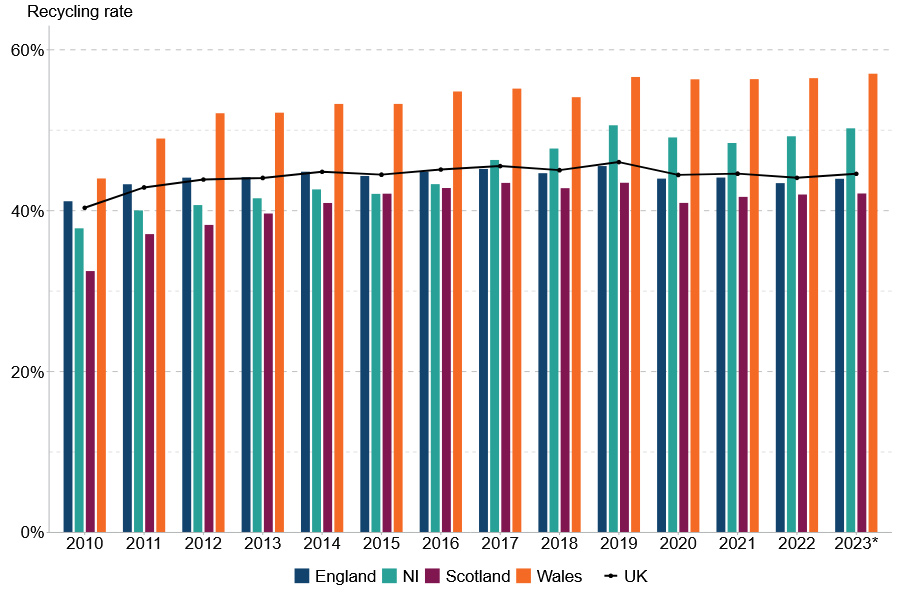
Last week new national guidelines came into force on recycling in the UK. There will be some teething issues as not every council is quite ready. There will still be enduring questions around esoteric plastic items. But generally speaking recycling is much more straightforward. The postcode lottery of whether or not you can recycle something should come to an end.
We’ve been waiting for standardised recycling for 25 years, and perhaps it will drive an uptick in recyling rates that have been stalled for a decade. DEFRA’s statistics seem to run a few years behind, so it will be a little while before we see the difference, but I look forward to revisiting this graph in future.
While progress on recycling is welcome and long overdue, it is of course the third priority in the classic waste hierarchy of reduce, reuse, recycle. So what’s happening across the whole spectrum of actions on plastic?
Here’s a quick review of what the UK has achieved across successive governments, and what remains to be done. Some progress to begin with:
- It was the plastic bag charge, introduced in 2015, that began a new focus on plastic waste. There are still a lot of bags out there, but there’s no question that it has worked. The number of bags used in the UK has fallen from a frankly absurd 2,116,000,000 in the year before the ban to 427,000,000 today.
- In 2018 microbeads were eliminated from cosmetics and cleaning products, killing off a brief and foolish fashion for putting tiny colourful plastics into shower gels and skin scrubs.
- Seizing the moment, it was citizen-led campaigns that initially drove a switch away from plastic straws. ‘Refuse the straw’ volunteers went from door to door through town centres, persuading pub and restaurant owners to stop supplying them. That later became law, and stirrers and plastic cotton buds were also banned.
- A year on from that, in 2023, the catering industry got to grips with new rules to end polystyrene food packaging and cups, along with single use plastic cutlery. How well this is enforced is debateable. These items remain on sale from suppliers and there are takeaways near me that never got the memo.
- The most recent waste phase-out was for single-use vapes, illegal since the summer of 2025. This reduces plastic waste and litter, and also reduces the risk of fires at recycling plants.
One apparent ommission in this list is retail packaging – and it would be a glaring omission, considering this is the biggest source of plastic waste. However, there’s more going on here than meets the eye, as the interventions have been in the supply chain rather than at the consumer end. The government has been reluctant to put its legislative foot down and rather than ban things, the approach has been to nudge companies towards solutions by raising the price on virgin plastics.
The Plastics Packaging Tax was brought in from 2022 and applies a levy on manufactured or imported packaging that doesn’t include at least 30% recycled plastic. This should do a couple of different things. It should encourage innovation and investment in the packaging industry. That includes the composition of plastics, and also how much is used – the more efficient you can be in your design, the less you’ll need to pay. The tax should also incentivise quality control in the waste stream as demand for recycled plastics rises, and perhaps spur more local use of recycling instead of shipping it across the world for someone else to deal with.
Is it working? There is visible evidence of companies responding to the tax and reducing their plastic use. Sainsbury’s use of vacuum-packing in its meat range is one example, a technique that uses 55% less plastic than a tray and film lid. Some companies are using thinner plastics, and it’s become more expensive to add unnecessary decorative plastic. You could see this for yourself if you went to a supermarket recently and noticed how Easter eggs are packaged. How many of them still come in the elaborate plastic shells that were ubiquitous a few years ago?
The levy on virgin plastics rises each year, from an inital £200 a tonne to £228 as of last week, so companies will want to keep ahead of those costs. You could of course pass them on to consumers and carry on, but that’s risky at a time when the cost of living is rising. Slowly and mostly without fanfare, this is reducing plastic use.
Other steps are in progress or on the way.
- We’re not done with banning things just yet. From May next year you won’t be able to buy wet-wipes that contain plastic. ‘Plastic-free’ options have been on the market for a long time and will soon be the default. That will include baby wipes, and those sold for make-up removal or household cleaning.
- A plastic bottle deposit scheme was announced in 2015 by then environment minister Michael Gove – remember him? You may have noticed we still don’t have one. After multiple false starts, it is due to be introduced in 2027. There are a variety of reasons why this has taken 12 years, and lobbying from the drinks and plastic industries is at the top of the list. In the meantime, Britain ploughed through 6.5 billion disposable drinks bottles and cans for every one of those 12 years.
- There’s another more technical set of rules coming into force at the moment around Extended Producer Responsibility (EPR). For too long companies have been able to create plastic waste and let councils deal with it at taxpayers expense. It doesn’t have to be that way, and electronics producers have had to pay their way since the WEEE regulations were introduced across Europe in the early 2000s. New rules around responsibility for waste are gradually rebalancing the cost of dealing with waste, and they include better reporting on plastic manufacturing and fees for disposal.
Not everything has worked out. The UK Plastics Pact, which aimed to eliminate hard to recycle plastics, didn’t meet any of its objectives. The Refill Alliance, which I wrote about in 2023 and that planned to introduce refills across a coalition of supermarkets, has sunk almost without trace (only Ocado are still operating a refill service through their online platform). While plastic packaging is slowly declining, we buy a lot more plastic stuff overall and it’s hard to say whether we’re really turning the tide on plastic waste.
Still, looking back at those bullet points, a fair amount has been achieved. We shouldn’t lose sight of that in the drive to do more and do better – and there is a lot more to do. So let’s keep up the pressure on retailers and manufacturers, and see if the new recycling regulations move us a step closer.

